

THE LIFE OF ROBERT KIRK
"If it be true that Mr. Robert Kirk was chosen as her chaplain by the Fairy Queen, Her Majesty is to be congratulated on her good taste." - David Baird Smith (1921)

It is believed that Robert Kirk was born around 1644, 9th December 1644 according to Donald Maclean, who gave a talk to the Gaelic Society of Inverness titled The Life and Literary Labours of the Rev. Robert Kirk, of Aberfoyle in 1924, and quoted a diary entry by Kirk that reads "Decr. 9, 1689, Age 45". Though Rossi in his Text-Criticism of Robert Kirk's Secret Commonwealth believed it was probably 6th August. He was the youngest son of James Kirk, minister of Aberfoyle, and according to Maclean, Robert was the seventh son. He was educated at the University of Edinburgh and studied theology at St Andrews and after his studies became the minister of Balquhidder on 9th November 1664, aged just 19 years old. Interestingly, Maclean said that Robert himself spelt his surname as 'Kirke' in his Bible and letters, but in his psalms spelt it 'Kirk'. Here I will be using the latter, as it is most often used today.
According to Scott's Fasti Ecclesiae Scoticanae Volume IV (1923) Kirk married Isabel Campbell January 1670, and they had 2 sons, Colin and William. Sadly, Isabel passed away on 25th December 1680 aged 25. David Smith's article titled Mr. Robert Kirk's Note-Book, which appeared in The Scottish Historical Review July 1921, tells that Robert recorded his wife's death in his notebook, together with an elegy, and he writes she "was married to her husband near 3 years, and left alive one son, Colin." This would put their date of marriage nearer 1677 and suggests that if they did have a second son, William, sadly he did not survive. Perhaps poor Isabel died in childbirth.


.JPG)
THE WRITINGS OF ROBERT KIRK
Although famous for his mysterious death, he is perhaps most well-known today for his writings on fairies, more commonly known as "The Secret Commonwealth of Elves, Fauns and Fairies". During his own lifetime he was better known for his religious work, including his first complete translation of the Scottish metrical psalms into Gaelic. According to Reid's Bibliotheca Scoto-Celtica (1832), during the time Kirk was writing his Psalter he found out the Synod of Argyle was intending to publish their own translation, and "such was his anxiety to have his finished first, that he sat up the greater part of the night for many months; and, during this time, the method he took to chase away sleep was rather singular,- he put a piece of lead into his mouth, and placed a basin of water in position, into which the lead dropped as soon as he fell asleep." Maclean writes of Kirk, "his name will be honourably associated for ever with the first Gaelic Bible that was put freely in the hands of Highlanders.", and he reminds us that for over 100 years Kirk's Bible was the only Gaelic Bible available to the Highlanders of Scotland.
As well as writing religious texts, Kirk also recorded some of his thoughts and learning in a series of notebooks and diaries. Some of these books have survived and are now held at the University of Edinburgh. When I saw a couple of his manuscripts a few years ago at the Between Worlds exhibition in Durham, I was surprised to see that he seemed to enjoy drawing and doodling in his notebooks. Below are a couple of pages from Kirk's Summa Doctrine Posterior (Dc.8.114) thought to date from around 1660, before he took his minister post at Balquhidder. You can see more images from his notebooks here on the University of Edinburgh Collections website.

An interesting article titled Mr. Robert Kirk's Note-Book was included in The Scottish Historical Review 18 in 1921. It was written by David Baird Smith, who purchased a notebook written by Robert Kirk at a sale in London of the library of Professor John Ferguson of Glasgow University. He gives the title as: first Manuscript | A | miscelany of occuring | thoughts on various | occasions | Ro: Kirk | Love and live | August i. at Balquhidder | 1678. Smith also tells it has the signature of C. Kirk inside, probably the writer's son Colin he believes, and the name Thomas Rutherford 1698. The article includes some fantastic extracts from the notebook, including an interesting early mention of fairies:
"lykewise the story of the human-shaped incubi, and stealing of children and nurses, give probable surmises that there are divers clans and kynds of spirits who make their vehicles seen to us when they please, though they are not so gross as terrestrial bodies, but most part aerial needing to be soakt and fed some way as well as ourselves. Such may be the fauns, fayries, satyrs and haunters of hillocks, wells, etc. (for no thing nor place but is inhabited within of some creatures) and since many of these disappear at mentioning the name of God, and that thy foresee evil rather than good, why may they not have a polity among themselves, some of them not so miserable as others, some of them reasoning and learning, others as yet obstinate, blinded atheists (for they but see the works of God to prove a duty as we do; yet are there atheists among us)."
Interestingly, it also contains an example of Robert Kirk having his own unusual experience that perhaps predicted a future event:
"Though I use not to notice dreams much, yet March 25, 1679, I viyels perceived and thought I felt a great tooth in my head break into two halves part by part and com off; on the morrow (my father being removed twenty years before) my mother took bed and on Monday thereafter about 2 a clock, gave up the ghost. Who knows if some courteous angel gives us a warning by our imaginations or senses, of extraordinary accidents. I am sure at several slips, I have susteand immediately loss of goods or hurts of my body, vexing reports of fama. Though God does observe and may manage every particular in this world by himself; yet he may use the medial ministry of angels towards men, as of man towards beasts."
It appears Kirk was perhaps not fully appreciated by his parish, and he writes "When I hear of evil tales concerning myself in the country (endeavouring intirely to keep the commandment) only reply that I thank God they have not worse news to occupy them with." I wonder what 'evil tales' people were telling of him?
Another entry suggests that perhaps someone stole from him at the church or manse, and he writes that "robbing and stealing from ministers is a visibl token of atheism and total decay of the sense of God and religion". In another entry he writes "How true is it, homo homini lupus? No creatures prey on their own kind but man. Look through tame and ravenous, none make it their own profit or glory to kill or steal from those of their own feather or keel." He writes of the difficulties of being a minister, and how his preaching appeared to have little effect at times and "many thousand good discourses are spent among deaf stones and men and timber every day. Great therfor must be the pains in kindling som sparks of knowledge by catechising and rooting the youth in the principls of religion e'er they can attean to be attentive to a sermon, and not only gaze (but not understand) like bruits." The notebook entries included in Smith's article give the impression that Kirk was a very pious man, a deep thinker with strong opinions, but also with a feeling of isolation from those in his parish. Maclean's The Life and Literary Labours of the Rev. Robert Kirk mentions a letter written from his friend Rev. James Kirkwood to Robert Boyle, where Kirk is described as "a learned, pious and zealous man".
THE SECRET COMMONWEALTH MANUSCRIPTS
At some point it appears Kirk decided to collect his notes and thoughts on fairies and the second sight and similar subjects together and write a manuscript, now known as The Secret Commonwealth, a shortened form of its much longer title. No one knows exactly what prompted this, but some believe it all began during a visit to London to oversee the printing of Bedel's Bible into Gaelic, where he spent 10 months before returning to Aberfoyle in March 1690.
Rossi tells us that during this time in London Kirk visited many churches, of all denominations from Anglican to Roman, and also Quaker meetings, and wrote down comments on them in his notebooks. Maclean writes that Kirk "did not attend religious services to satisfy a craving for curiosity, or to pay a formal respect to his conscience and vocation, but in the spirit of a devout and receptive hearer who was willing to be a debtor to any religious instructor irrespective of his religious or ecclesiastical communion." In his diary he wrote a summary of each sermon together with his opinion of the preacher and their sermons, the size and "quality" of the audience, the features of the church or meeting house, and any other notes including a Quaker who irritated him with misquotations, and a country minister who made tedious repetitions. Kirk gives a fair assessment of each but concludes that the preachers of the Church of England surpass all others in pulpit effectiveness.
One of these services that Kirk made note of was a sermon by the Bishop Stillingfleet at St Andrew's in Holborn on 6th October 1689, where he spoke against miracles and apparitions, and at the end of the sermon he invited Kirk to his home for dinner. Kirk wrote in his diary that Stillingfleet "came to enquire of the Second Sight, only heard to be in the Highlands of Scotland. When I told him some had it innocently by their predecessors, he said original sin came from ancestors, yet not innocently, and so sins of ignorance. When I said some acquired it by contact with evil men or spirits, he replied that, it being a voluntary act, and having no natural dependence of cause and effect, it was sinful. I said yawning was voluntary, yet it affected others by imitation, and that innocently, and there was no more dependence of the effect from the cause naturally, and understood by us, than of the loadstone drawing steel." Kirk continues later in the diary entry for that night, "When I urged to the Doctor that as lynxes and cats see in the night beyond men, and as telescopes aid the natural sight by art, so may not some men have, or attain complexionally to such a habit or faculty. He answered that by many subtle, unthought of insinuations the devil interposed in such cases, and sought no other invitation than the eager curiosity of the enquirer as of him that caught a fly and put it in the box." Maclean's The Life and Literary Labours of the Rev. Robert Kirk contains these and more fascinating diary entries, and of that night Maclean writes of Kirk, "One cannot help, even at this distance of time, applauding the brave mountaineer.".
At this dinner Kirk also met Lady Stillingfleet, the Bishop's wife, who was interested in learning of the seventh child's gift of touching for the King's evil. Some say she had recently given birth to a seventh child herself. Rossi tells us that among the many biblical quotations on the title-page of MS 5022 of the Secret Commonwealth there is a note, 'Sent by the writer to the right Reverend... Bishop of Worcester, His Lady'. Rossi believes that "Kirk had somehow tacitly or expressly promised to send to Lady Stillingfleet (not to the Bishop for understandable reasons of bienséance) a full account of stories referring to fairies, charms, second sight, etc." Hunter's The Occult Laboratory shows that some parts of the manuscript seem to match entries written in his London diaries, which also suggests he started writing his manuscript whilst in London. Kirk's time spent in London was probably quite a contrast to his isolated years spent at Balquhidder, and I imagine he relished the opportunity to share his thoughts with others who shared his interests. Perhaps it was that dinner with the Stillingfleets that further stirred his interests in the second sight and fairies and encouraged him to put pen to paper and write a manuscript.
Trans. Manuscript / Adv.MS.34.6.9
After Robert Kirk's death his manuscript appears to have been left unpublished until a copy of his manuscript (Rossi names this manuscript Trans.) was rediscovered in the Advocate's Library and 100 copies were published in 1815, possibly by Sir Walter Scott. However, John Ferguson's Bibliographical notes on the Witchcraft Literature of Scotland (1897) mentions that he enquired about the manuscript at the library and "so far as can be judged from catalogs, there never was one". Though Ferguson does mention finding another copy at the University Library in Edinburgh, complete with extra pages not included in the 1815 edition, which was probably La.III.551. Rossi also looked for the Trans MS but found no trace and believed it lost. However, I believe it has not been lost after all, and is held by the National Library of Scotland, and is now known as Adv.MS.34.6.9.
The webpage for MS.5022 here mentions in the bibliography that "The work was printed in 1815 from Adv.MS.34.6.9, folios 413 verso-433.". The page for Adv.MS.34.6.9 does indeed include a copy of Kirk's Secret Commonwealth, and the source of acquisition is "Presented, 1925, by the Faculty of Advocates to the nation on the foundation of the National Library of Scotland." I have not been able to visit in person to see the manuscript for myself, but Kevan Manwaring's Performing Kirk webpage mentions that he also came across this manuscript and viewed it in person. I contacted the library, and they confirmed that they do hold this copy of the manuscript, and from their description I believe it most likely is the manuscript that was used for the 1815 edition. However, the catalogue places the manuscript as early 18th century and it does not appear to have been written by Kirk himself unfortunately, so is most likely another later copy. Both Trans and Adv.MS.34.6.9 are incomplete, and end in the middle of the fifth objection, with a note to 'See the Rest in a little Manuscript belonging to Coline Kirk'.
La.III.551
La.III.551 was acquired by David Laing in 1823 and bequeathed to the university in 1878, according to Sharp in The Scottish Historical Review, Vol. 38, No. 126, Part 2 (1959). Page 126 ends 'Finis coronat opus. Writen be Robert Campbell at Insh-Alladine in the paroch of Aberfoyl in Monteith 1691 - Love and Live Robert Campbell' and on p129 'This book belongs to R. C. Pryce 12 sh.'. The full title of this volume is 'The Secret Commonwealth or a treatise displaying the chief curiosities among the people of Scotland as they are in use to this day being for the most part singular to that nation a subject not heir to fore discoursed of by anie of our writers. Done for the satisfaction of his friends by a modest inquirer, living among the Scotish-Irish 1692.' The final sentence suggests that perhaps it was written for the benefit of another, perhaps Robert Campbell or the Stillingfleets? We have no way of knowing, and we do not know who Robert Campbell was unfortunately, though Sharp in The Scottish Historical Review, Vol. 38, No. 126, Part 2 (1959) believes it was possibly Kirk's brother-in-law. Maclean's The Life and Literary Labours of the Rev. Robert Kirk, contains two letters written by Kirk in September 1691 which are addressed from 'Inch-Allodine', suggesting that Robert Campbell was writing the manuscript whilst in Kirk's house.
Rossi describes the handwriting as "decidedly different from that of Kirk, clumsier, badly formed" and writes that Professor Kenneth II. Jackson examined the manuscript and judged it to have been written by someone who could not spell in Gaelic, strongly suggesting that Kirk himself did not write it. Rossi suggests that perhaps Kirk dictated the words to Campbell on his sick bed, but Sharp suggests from the omissions and "several instances of visual anticipation of words lower down the page" that it was copied, though perhaps revised by Kirk himself. Hunter's The Occult Laboratory tells that some amendments to La.III.551 appear to be in Kirk's own handwriting, and that the handwriting of the manuscript changes slightly at intervals, suggesting that it was written in stages.
This is the most complete manuscript found so far, and it includes all of the Secret Commonwealth, the objections and replies, a section on charms, and a dictionary of difficult expressions. Rossi suggests that this last section was composed for the use of 'someone somewhat uneducated' and suggests perhaps it was for Robert Campbell, who did not understand certain terms used by Kirk.

MS. 5022
The National Library of Scotland also holds an incomplete copy known as MS. 5022, acquired in 1949 from an Edinburgh bookseller who vaguely recollected purchasing it in Angus. According to the NLS website, the remains of the binding show it was once part of a larger volume. Rossi believes the handwriting to be more recent than La.III.551 and suggests the beginning of the 18th century. Rossi tells us that among the many biblical quotations on the title page there is a note, 'Sent by the writer to the right Reverend... Bishop of Worcester, His Lady', which is "inserted with no special marks, as if it were another quotation", suggesting that the writer was copying from another text. He writes that the text is complete up to the end of the exorcisms on p50, and this corresponds to p110 of La.III.551, which then continues with further exorcisms and the vocabulary.
Gen.308.D
The University of Edinburgh Archive describes Gen.308.D as an 18th century copy, bound by William Henderson in 1814 according to a note on the end paper, and purchased from Storey, Accession E61/18. Walsh says in his The Secret Commonwealth and the Fairy Belief Complex (2002) that it was acquired in 1964, so unfortunately it is not included in Rossi's Text-Criticism that was published in 1957. Walsh also compared the manuscripts and believes that Gen.308.D and MS. 5022 are similar enough to suggest they were copied from the same source.
The Reay Manuscript
Hunter's The Occult Laboratory, as well as containing a wonderful reliable version of La.III.551, also contains some very fascinating letters written to Pepys regarding the second sight. In a letter dated 24th October 1699 Lord Reay writes to Pepys:
"I have Gote a mannu-script since I came to Scoteland Called Ane Essay of the Nature and actiones of the Subterrenians (And for the most parte) Invisible people, heirtofor goeing under the names of Elves faunes and faries, or the like among the low Countrey Scots & tearmed hubhrisgedh, caiben, lusbartan 7 siotbrudh Amongst the Tramontans or Scotish Irish as they are now Descrybed By those that have the second sight And Now to occassione furder enquerie Collected and compared by M: R K. /p.4/"
He tells the writer was a parson and he received a letter this day from a friend promising him his acquaintance. Kirk passed away 7 years ago in 1692, but the manuscript title and R K initials strongly suggest that this was Robert Kirk's manuscript, and that his friend was unaware of Kirk's death. Reay tells Pepys that "when ever I have occasione I shall send you a Coppie of the booke", suggesting that the Secret Commonwealth was in circulation in the 1690s, and had perhaps been published after all, though no printed copies have been found.
MANUSCRIPT CONCLUSION
It is believed that none of the existing copies are in Kirk's own handwriting, and all are copies of another manuscript, apart from possibly La.III.551 which may have been written down by Campbell on behalf of Kirk, if he was indeed too ill to write it himself. Though, it may also be a copy of a currently undiscovered manuscript or have been copied from Kirk's own notes or diaries that have not been found. Rossi raises the possibility that Kirk may have made a fair copy as best he could to send to Mrs Stillingfleet, perhaps whilst in ill health, and that this was later copied and became M.S. 5022, with the original being lost. Then perhaps, in declining health, he had Campbell make another copy with the final extra additions, which became La.III.551. Unfortunately, it is unlikely we will ever know, but we can hope that more manuscripts of the Secret Commonwealth will yet come to light.
For anyone wishing to read The Secret Commonwealth, there are a variety of editions available, some more reliable than others. After the 1815 edition, it was published again in 1893 with an introduction by Andrew Lang, and in 1933 with an introduction by R. B. Cunninghame Graham. The 1893 edition is available online to read for free on the Internet Archive website, here. Rossi warns that the 1893 and 1933 editions were published with the same spelling mistakes as the 1815 edition and are unreliable, and incomplete. Hunter's The Occult Laboratory (2001) contains a reliable and complete copy of manuscript La.III.551, and Stewart Sanderson’s edition for the Folklore Society in 1976 is supposed to be superb, but I have been unable to find a copy so far. Rossi's Italian version of The Secret Commonwealth, Il Regno Segreto, is also a reliable copy and is available to borrow here on the Internet Archive Website.
I would also thoroughly recommend Rossi's Text-Criticism of Robert Kirk's Secret Commonwealth. Translated by M.I. Johnston. Edinburgh Bibliographical Society Transactions Vol III Part 4 (sessions 1953-54, 1954-55) published 1957, for anyone interested in learning more about the various manuscripts and the differences between them.
For anyone wanting to learn more about the life of Robert Kirk I recommend the Rev. Professor D. Maclean's The Life and Literary Labours of the Rev. Robert Kirk of Aberfoyle. Transactions of the Gaelic Society of Inverness vol XXXI 1922-24 (1927).

THE STRANGE DEATH OF ROBERT KIRK
Kirk was not the only minister of Aberfoyle with a keen interest in folklore. In the 2nd edition of Rob Roy (1828) Sir Walter Scott writes "It is remarkable, that two successive clergymen of this parish of Aberfoil have employed themselves in writing about this fairy superstition" and gives mention of Patrick Graham. It is Graham we have to thank for telling us of the mysterious death of Robert Kirk, and in his Sketches of Perthshire (1812) he tells of that fateful night:
"He was walking, it is said, one evening in his night-gown, upon the little eminence to the west of the present manse, which is still reckoned a Dun shi'. He fell down dead, as was believed ; but this was not his fate:
"It was between the night and day,
When the fairy king has power,
That he sunk down (but not) in sinful fray,
and, 'twixt life and death, was snatched away,
To the joyless Elfin bower."
Mr Kirk was the near relation of Graham of Duchray, the ancestor of the present General Graham Stirling. Shortly after his funeral, he appeared in the dress in which he had sunk down, to a mutual relation of his own and of Duchray. "Go," said he to him, to my cousin Duchray, and tell him that I am not dead ; I fell down in a swoon, and was carried into Fairy-land, where I now am. Tell him, that when he and my friends are assembled at the baptism of my child, (for he had left his wife pregnant) I will appear in the room, and that if he throws the knife which he holds in his hand over my head, I will be released, and restored to human society." The man, it seems, neglected, for some time, to deliver the message. Mr Kirk appeared to him a second time, threatening to haunt him night and day till he executed his commission, which, at length, he did. The time of the baptism arrived. They were seated at table; Mr Kirk entered, but the laird of Duchray, by some unaccountable fatality, neglected to perform the prescribed ceremony. Mr Kirk returned by another door and was seen no more. It is firmly believed that he is, at this day, in Fairy-land."

SIR WALTER SCOTT & THE NOT-QUITE DEATH OF REVEREND PATRICK GRAHAM
In the 2nd edition of Rob Roy (1828) Sir Walter Scott refers to Patrick Graham as the 'late' Dr. Patrick Grahame, which seems to have come as quite the surprise to Graham, who was very much alive and well! He wrote a rather amusing letter to Scott in December 1829 to say he was indeed alive. "Though till now unconscious of this very material change in the scene and mode of my existence, I am far from questioning a fact stated on such high authority." He makes reference to Robert Kirk, and jokes "Perhaps, indeed, like a well-known predecessor of my own, I have been only carried off by the Daonine Shie, in which case the unearthly being who now addresses you may be no more than a Fairy changeling, left for a time to occupy the place of the departed Minister of Aberfoyle. The whole letter can be found in The Private Letter-Books of Sir Walter Scott, edited by Wilfred Partington (1930).
In Scott's Letters on demonology and witchcraft (1887) he writes of Robert Kirk and includes a version of Graham's story of Kirk at the christening, with Kirk appearing to a relation and commanding him to tell Grahame of Duchray "that I am not dead, but a captive in Fairyland, and only one chance remains for my liberation. When the posthumous child, of which my wife has been delivered since my disappearance, shall be brought to baptism, I will appear in the room, when, if Duchray shall throw over my head the knife or dirk which he holds in his hand, I may be restored to society; but if this opportunity is neglected, I am lost for ever." When Kirk appeared, Grahame of Duchray "in his astonishment, failed to perform the ceremony enjoined, and it is to be feared that Mr Kirke still "drees his weird in Fairyland,"". It appears that Patrick Graham and Scott were good friends, with Scott recommending his Sketches of Perthshire, and calling him "an excellent man and good antiquary". Scott was also said to have visited Graham at the Manse in Aberfoyle.

Antique postcard of The Manse, Aberfoyle. From Strathard Heritage Website
FURTHER TALES OF ROBERT KIRK
The Reverend Robert Kirk has been fascinating folklorists for over 100 years, and many have visited Aberfoyle to find out more.
Evans-Wentz writes in his The Fairy-Faith in Celtic Countries (1911) of making a visit to Aberfoyle, where he spoke to Mrs J. MacGregor who kept the key to the old Churchyard containing Kirk's tomb. She pointed to the Fairy Knoll and told him "the hill is full of caverns, and in them the 'good people' have their homes". He also visited Rev. William M. Taylor, the present minister of Aberfoyle, who was familiar with the story and said he searched the presbytery books but could unfortunately find no record of Kirk's death. He acknowledged that folk believed "he was taken because the fairies were displeased with him for prying into their secrets", but he thought it more likely that Kirk was taken ill suddenly with "something like apoplexy" while on the Fairy Knoll and died there. Rev. Taylor was sure Kirk's body was buried, but others in the town Evans-Wentz spoke to were less convinced, with some believing that both his body and soul were taken, and others that only his spirit was taken, and his body buried.
MacGregor's The Peat-fire Flame (1937) tells that "The old folks crossing the River Forth at Aberfoyle, just by the "Dun Shi'" or faery knoll, used to say that, ever since the translation of the Rev. Robert Kirk to the Secret Commonwealth of Faeries, they felt as though someone were riding on their backs. And they sincerely believed this to be none other than the minister who, about the year 1692, had been "spirited away" to faeryland."
Katharine Briggs, in her Dictionary of Fairies (1976), tells a slightly different story of Kirk's death, with Kirk only being found unconscious on the hill rather than dead, "he was accustomed to wander round the fairy hills by night, and one morning he was found unconscious on the Fairy Knowe of the Sith Bruach at Aberfoyle. He was carried to bed, and died without fully regaining consciousness." Briggs also writes that in 1944 "an officer's young wife was a tenant of Aberfoyle Manse and was expecting a child. She had been told that if a christening was held at the manse, Kirk could still be disenchanted. The chair that was traditionally his still stood in the dining-room, and if anyone stuck a dirk into the seat of it, Kirk would be freed. The young wife hoped that they would not be posted before her baby is born." Unfortunately, I can find no record of whether she was still in Aberfoyle at the time of giving birth, and whether a christening was held at the manse.
According to Scott's Fasti Ecclesiae Scoticanae Volume IV (1923) Kirk "was walking on a 'fairy knowe' when he sank down and disappeared". Some say that Kirk is still inside the fairy hill today, and a poster in Balquhidder church tells that "his parishioners believed that he had been spirited away by the Little People to live with them inside the Fairy Hill."
A Robert Kirk display at The Lodge Forest Visitor Centre, run by Forestry and Land Scotland, tells "The Fairies did not like being listened to and stole the Reverend Kirk's spirit and trapped it in a pine tree. The villagers found his lifeless body on the hill with his ear to the ground."

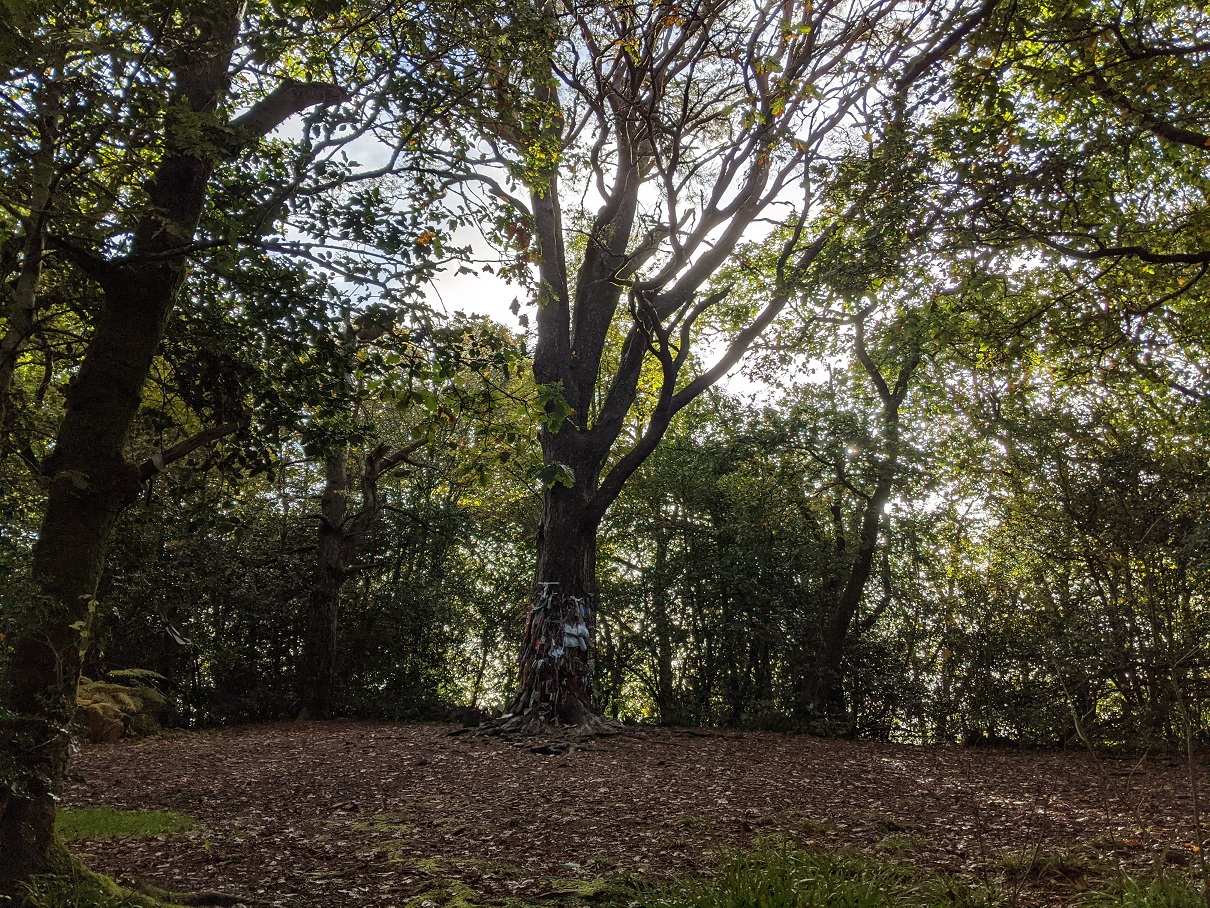
The Minister's Pine, as it is called on a sign by the gates to the kirkyard, can be found on the top of Doon Hill. I have yet to find any older sources that mention the tree's connection to Robert Kirk, but it features heavily in current folklore in the Aberfoyle area, including in the name of a local bar and restaurant, The Faerie Tree. Hendrie's The Trossachs: History & Guide (2004) tells "At the top of Fairy Hill, as it is often known, the exact spot where the minister was spirited away by the fairies is said to be marked by the tallest tree, a solitary Scots pine which soars skyward amongst the surrounding oaks." Other stories take this further and claim that Robert Kirk's soul is trapped inside the tree. A Forestry Commission Scotland sign at the base of Doon Hill, tells "The old Scots pine tree on top of Doon Hill is said by some to house the soul of Robert Kirk.". A Queen Elizabeth Forest Park leaflet by Forest and Land Scotland contains a Doon Hill walk and tells that the solitary scots pine at the top is "thought to mark the entrance to a Fairy Queen's underground palace".
According to issue 85 of Strathard News (2014) St Mary's Episcopal Church column, over the summer months they delved into the archives and script of the BBC Home Service programme about the Trossachs, broadcast in 1939. The article tells "The programme's producers were anxious to find out more about the Fairy Knowe outside Aberfoyle so brought the then Minister of Aberfoyle Kirk the Revd W.G. Strachan to the microphone. Mr Strachan opened his talk by advising his listeners who might visit the hill to walk around it nine times anti-clockwise. Only then might they be admitted to the community of the 'Little People'." I have not come across this piece of folklore before in connection with Doon Hill, but it is a well-known method of entering a fairy hill, so it appears that this Minister of Aberfoyle was also familiar with the folklore of the Good People!
Issue 7 of Strathard News (July 2003) tells that BBC Scotland commissioned a drama documentary on Robert Kirk, titled 'Kirk Away with the Fairies' that was due to be shown later that year, but I have been unable to find a copy unfortunately.
ROBERT KIRK TODAY
In the twelve years since I last visited Aberfoyle, the fairies have certainly become a lot more noticeable! When I last visited in 2010 Kirk's gravestone was bare, but today I found it absolutely covered in coins. I was told by a local lady that people leave offerings to the fairies there.

There are fairy houses carved into tree stumps along the path up the hill, covered in colourful ribbons and offerings, and the Minister's Pine is also covered with a wide variety of messages and wishes. A wooden mushroom along the path has coins hammered into it too. A sign at the base of the hill from Forestry Commission Scotland asks that people only leave non-biodegradable items behind and says that biodegradable "clouties" are available from local businesses in Aberfoyle.


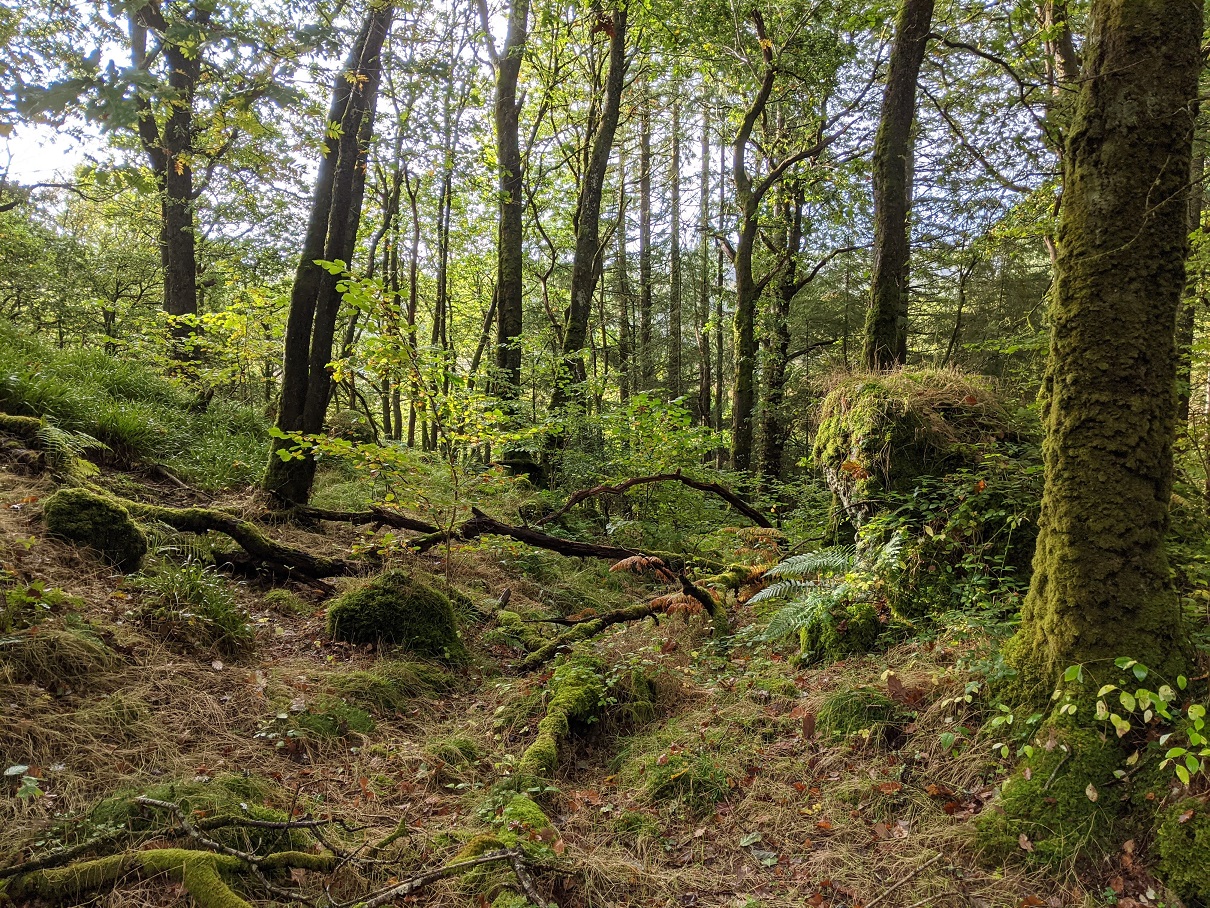
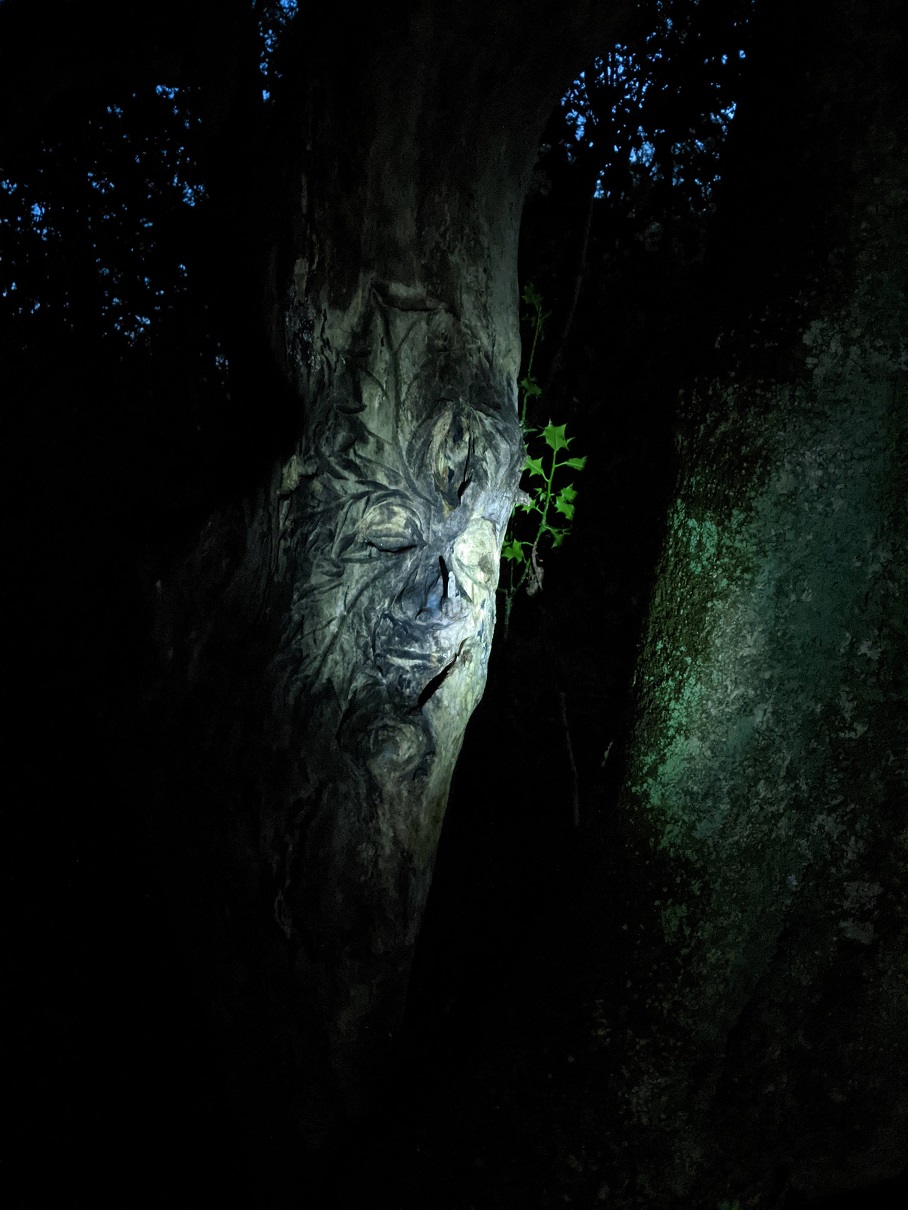
But there is far more to Doon Hill than bright garlands and shiny coins, it also has a certain wildness...



Sources and Further Information
Briggs, Katharine. Dictionary of Fairies (1976)
Edinburgh University Library, Images from Robert Kirk related manuscripts
Evans-Wentz, Walter. The Fairy-Faith in Celtic Countries (1911)
Ferguson, John. Bibliographical notes on the Witchcraft Literature of Scotland (1897)
Graham, Patrick. Sketches of Perthshire (1812)
Henderson, Lizanne. The Guid Neighbours: Fairy Belief in Early Modern Scotland 1500-1800 (1997)
Hendrie, William. The Trossachs: History & Guide (2004)
Hunter, Michael. The Occult Laboratory (2001)
Macgregor, Alasdair Alpin. The Peat-fire Flame: Folk-tales and Traditions of the Highlands & Islands (1937)
Maclean, Donald. The Life and Literary Labours of the Rev. Robert Kirk of Aberfoyle. Transactions of the Gaelic Society of Inverness vol XXXI 1922-24 (1927) p328-366
McKerracher, Archie. The Minister of Fairyland, Fate Magazine January 1990
Partington, Wilfred. The Private Letter Books of Sir Walter Scott (1930)
Reid, John. Bibliotheca Scoto-Celtica (1832)
Rossi, Mario. Text-Criticism of Robert Kirk's Secret Commonwealth. Translated by M.I. Johnston. Edinburgh Bibliographical Society Transactions Vol III Part 4 (sessions 1953-54, 1954-55) published 1957
Sanderson, Stewart. A Prospect of Fairyland, Folklore, Volume 75 (1964)
Scott, Hew. Fasti Ecclesiae Scoticanae Volume IV (1923)
Scott, Sir Walter. Letters on Demonology and Witchcraft (1887)
Sharp, L.W. The Scottish Historical Review, Vol. 38, No. 126, Part 2 (1959)
Smith, David Baird. Mr. Robert Kirk's Note-Book, The Scottish Historical Review 18, volume XVIII No 72 July 1921 https://archive.org/details/ScottishHistoricalReview18
Walsh, Brian. The Secret Commonwealth and the Fairy Belief Complex (2002)


