Showing posts with label Northumberland. Show all posts

Monday, 26 September 2011

Whitton Dean, Northumberland


Whitton Dean in the Rothbury Forest and Simonside area of Northumberland was once known as a haunt of the fairies according to Tomlinson. According to his Comprehensive Guide to Northumberland (1888), "Whitton Dene is said to have been one of the haunts of the fairies in olden times." He also mentions the mysterious rocks marked with concentric circles, but does not explain if these are also connected to the fairies. Unfortunately this is all I have been able to find out about this site, though I wonder if perhaps the names have gotten muddled over time as there is also a Whittle Dene in Northumberland, also known as a dwelling place of the fae.

We parked up in the Simonside Car park opposite the ancient hill fort remains and wandered to Whitton Dean. It's a rather rocky trail with amazing views over the hills, and at this time of year the hills are covered with beautiful purple heather, with busy bees and butterflies flittering around.


If you look carefully you can find Hare Bells, also known as Scottish Bluebells, or Fairies Thimbles. These delicate blue bell shaped flowers were once said to be rung by the fairies to warn of an approaching hare, perhaps due to the lore that witches used the juice from Hare Bells to transform into hares.


It is clear to anyone who visits this area why it has become associated with the faery folk. The hills are scattered with mysterious ancient rocks, many with cup and circle markings, and ancient burial cairns. In days gone by folk often associated these ancient sites with the fae, and thought that the fairies made cups in the rocks to make their porridge! The Simonside Hills are also said to be home to the duergars (see Duergars of Simonside), dangerous dark dwarves who led travellers to their deaths.


Follow the slope down the other side of the hill, passing the old mossy stone wall and windswept thorn trees. It's here that we became a little pixy led and couldn't for the life of us find where the footpath had vanished off to. We ended up retracing our steps back up the hill and eventually found the path again. Unfortunately I didn't have the sense to remember to turn an article of clothing inside out to see if that improved matters, an old remedy for being pixy led. We passed some lovely old gnarled and mossy trees, and a hidden little sparkling stream.


It's at the bottom of this sloping hill that you'll find Whitton Dean, a tucked away hidden little wooded valley with a stream running through. Ancient mossy rocks are dotted along the banks, and a fallen gnarled old tree lies nearby, the perfect dwelling place for any remaining fae still inhabiting the dene.   


Sources & Further Information
Tomlinson's Comprehensive Guide to Northumberland
Streetmap - Location of Whitton Dean

Thursday, 26 May 2011

Knockers of the North


Northumberland was once scattered with mining villages and pits, and the miners were a superstitions type of folk, and with good reason too as ghostly goings on and unexplained events weren't unknown down the mines. Here in Northumberland we have our own breed of goblin that are very specific in their dwelling requirements and choose only to live down mines. They're perhaps similar to the Cornish knocker, but with their own northern cheekyness and charm!
The two most famous goblins were known as the Shilbottle Bluecap or Blue Bonnet, and Cutty Soams. An article from the 23rd May 1863 edition of the Colliery Guardian gives more information:
"Two goblins were believed to haunt the northern mines. One was a spiteful elf; who indicated his presence only by the mischief he perpetrated. He rejoiced in the name of "Cutty Soams," and appears to have employed himself only in the stupid device of severing the rope-traces or soams, by which an assistant-putter -- honoured by the title of "the fool "-- is yoked to the tub. The strands of hemp which were left all sound in the board at "kenner-time," were found next morning severed in twain. "Cutty Soams" has been at work, could the fool and his driver say, dolefully knotting the cord."
"The other goblin was altogether a more sensible, and, indeed, an honest and hard-working bogie, much akin to the Scotch brownie, or the hairy fiend, whom Milton rather scurvily apostrophises as a lubber. The supernatural personage in question was no other than a ghostly putter, and his name was "Bluecap." Sometimes the miners would perceive a light blue flame flicker through the air, and settle on a full coal-tub, which immediately moved towards the rolley-way, as though impelled by the sturdiest sinews in the working. Industrious Bluecap was at his vocation; but he required, and rightly, to be paid for his services, which he modestly rated as those of an ordinary average putter; therefore once a fortnight Bluecap's wages were left for him in. a solitary corner of the mine. If they were a farthing below his due, the indignant Bluecap would not pocket a stiver; if they were a farthing above his due, indignant Bluecap left the surplus revenue where he found it."
An article in the Monthly Chronicle dated August 1887 gives further detail on Cutty Soams and claims that some miners believed he was the ghost of a man killed in the mine. Others thought that it was the doings of a deputy named Nelson as it always seemed to be his turn to do the night shift when the ropes were cut, and it was always him who made the discovery. Some rumours even claimed that Nelson tried to kill his love rival by cutting all but one strand of rope with which his intended victim was about to use to descend to the bottom. Unfortunately, or fortunately for the victim, an under-viewer and overman used the rope first and it broke, plunging them to their deaths. The pit fired a few days later and it said that Nelson was killed by the after-damp.

Unfortunately all the mines have long been closed and the mining buildings demolished. I imagine that these goblins must be getting awfully lonely now all the mines have closed, and I do wonder if they may have perhaps moved to the nearby colliery museum of Woodhorn, where the old mine has been preserved and is open to the public. Below are a few photos I took at modern day Woodhorn.

I also managed to find some old maps online showing the old location of the Shilbottle mine where bluecap lived. There are no traces of the old mine, the surrounding fields have been left to farmland, but perhaps old bluecap is still living in the old underground tunnels, listen carefully and you might just hear a faint 'knock knock' from below.

Sources & Further Information
Monthly Chronicle, 1887
Colliery Guardian, May 23rd 1863

P.S. Please let me know if you notice any major formatting issues with this blog entry, as i've switched over to the new blogger editing software. I've also changed the commenting format to a pop-up window as for some reason I can't comment on the embedded version anymore! Sounds like the work of tricksy goblins to me.

Thursday, 5 May 2011

The Fairy Music of Hen Hole

According to local folklore, hidden away in a deep chasm up in the Cheviot hills lives a group of Northumbrian fairies who play the sweetest music known to man. They run and dance through the valley, with all the grace that fairies do, but it is said these fairies have a sinister side too and once lured in a hunting party who remain trapped there to this day. According to 'Rambles in Northumberland' by Chatto (1835):

"On the north-west side of Cheviot there is a deep chasm called the Hen Hole, in which there is frequently to be seen a snow egg at midsummer. There is a tradition, that a party of hunters, when chasing a roe upon cheviot, were wiled by the fairies into the Hen Hole, and could never again find their way out."

The snow egg phrase is explained in volume 3 of the Local Historian's Table Book, legendary division, by Richardson. "This cleft is so deep and so narrow that the rays of the sun can never be said to illumine even its rugged sides, and as might be expected, there is frequently to be seen therein, a snow egg at Midsummer." Richardson also further expands on the story and claims that the hunters "heard issuing from this chasm, the sweetest music they had ever heard, and forgetting the roe which scoured away unheeded, they were impelled to enter, and could never again find their way out." The 1887 edition of the Monthly Chronicles of North-Country Lore and Legend gives further details of the fairies home:
"There is a small cavern in the face of the highest cliff on the right bank of the ravine, still accessible, we believe, to the venturesome, though dangerously so; and into this it is said that one of the early hunting Percies, along with some of his hounds, went and never returned. He and the hounds, if we may credit the legend, still lie in the cavern, bound by a magic spell - not dead, but fast asleep, and only to be released by a blast of a hunting horn, blown by some one as brave as ever Hotspur was, and more fortunate."
This makes no mention of the fairies, but interestingly does seem to merge it with another legend that is tied to various locations in Northumberland and varies but always seems to contain one or more sleeping characters hidden away who can only be woken by a horn being blown or a sword being raised. The characters are occassionally huntsmen but more often knights, or even King Arthur himself. Other locations for this tale include Brinkburn Priory (see my previous blog entry here) and Sewingshield. According to Tomlinson's Comprehensive Guide to Northumberland (1888) the cave at Hen Hole was once home to Black Adam of Cheviot, also known as the Rider of Cheviot, a murderous villain who gatecrashed a wedding and stole the women's jewels and ravished then murdered the bride, and ran away pursued by the groom, Wight Fletcher. The rider leaped the chasm of Hen Hole and escaped to his cave lair (perhaps the above mentioned cave) but the groom followed him and they fought and both fell to their deaths.

Intriguingly, Hen Hole was once known by a more sinister name, Hell Hole. The Border magazine volume 6 published November 1863 contains an article by George Tate titled Northumbrian Legends, which explains:
"Henhole is sometimes called Hellhole, which a learned friend supposes may be it's true name, derived from el or ell, water, and meaning the waterhole whence the colledge has it's source. We think, however, Henhole is the archaic name from hen, celtic, signifying old, and hence we have the old hollow."
It's also worth a mention that there is supposedly a secret underground tunnel stretching from Cateran's Hole (see my previous blog entry here) to Hen Hole, and passing under the Hurl Stone (see my blog entry here), all of which are said to be dwelling places of the fairies. So it seems that the Northumbrian fairies chose to travel underground through secret passageways, connecting their favourite fairy haunts together, allowing them to travel without discovery by humans. The entrance at Cateran's Hole has collapsed, but perhaps there is still an entrance to the tunnel hidden away in the cave at Hen Hole, this will require further field trips and research!

On Beltane morning we set off in search of Hen Hole, and found it very easily as it happens to be marked on Ordinance Survey maps! We walked a little further than planned as the walking guide failed to warn us that the road through College Valley is by permit only and closed for lambing season, so a 3 and a half mile stroll turned into an unexpected 11 mile hike! The views are breathtaking and the lambs adorable, and I soon forgot about my aching feet and walked onwards and upwards to the hill overlooking Hen Hole. The chasm was as dark and foreboding as expected, with rocky jagged crags and cascading waterfalls. It's hard to get a scale from my photographs, but the chasm is truly awe inspiring in person and you get a true feel for how far the drop is and how terrible it must have been for the hunters lured in by the fairies! From this distance I couldn't see any cave entrances, but they could easily lie concealed in the masses of boulders and rubble that has fallen into the chasm over the years. Unfortunately the public footpaths don't pass any nearer to Hen Hole so this was as close as I could get, but I plan to return another day and take the path over the top of Hen Hole and see if I can get a little closer and perhaps hear a note or two of the fairy music for myself!

Here are a few photographs taken along the path leading to Hen Hole, where I encountered a slow worm basking in the sun, a tree that appeared to be wandering down a hill, a beautiful beetle, and an extremely content looking lamb!
Sources & Further Information
Local Historian's Table Book, vol 3 legendary division, Richardson
1887 Monthly Chronicles of the North-Country
Comprehensive Guide to Northumberland, Tomlinson
The Border Magazine, vol 6 November 1863
Rambles in Northumberland, Chatto

Wednesday, 6 April 2011

The Fairy Graveyard, Brinkburn Priory

My blog entry today is about a beautiful old priory in the Parish of Brinkburn. The name 'Brinkburn' is thought to mean "'Brynca's burn, burh or spring', or 'the burn, burh or spring beneath the brink or hill'" according to the Keys to the Past website. A spring beneath a hill certainly sounds like a place that would be held dear to the fae folk, and Brinkburn is known locally as the burial place of the Northumberland Fairies. The earliest written source I've found for the presence of fairies in Brinkburn can be found in 'The Local Historian's Table Book, Legendary Divison Volume 3' (1846) by Richardson:

"In the sweet precincts of the solitude of Brinkburn, the villagers point out a shady green spot as covering the graves of the tiny people, and truly a more suitable place could not have been devised as the scene of so purely poetic a belief."

Another description of this beautiful place can be found in 'History of the Berwickshire Naturalists Club, Volume 4' (1857) by Wilson:
"The fairies, dead and gone this many a weary year, are supposed to lie buried at Brinkburn. Peace be to their tiny ashes! for they could not have a more fitting place of sepulture; not more verdant aisles than those from which the birds and bees intone their requiem."
Tomlinson's Comprehensive Guide to Northumberland (1888) poetically writes:

"A shady green spot in the precincts of Brinkburn is pointed out by a pretty tradition as the burial-place of the Northumberland Fairies. Their tiny forms are no longer seen in the moon-lit glade, but the flowers they loved still bloom plentifully beneath the shelter of green groves."

I'm unsure as to why this place is known as a fairy burial ground, rather than just a fairy hill or dancing green, but Denham suggests that the "mortality, unheard of elsewhere, must have been attributed to the potency of the bells", suggesting that perhaps the building of the priory and the ringing of it's bells killed all the poor fairies living there, the poor things! Brinkburn Priory is also home to another legend, also said to take place at a grassy swell similiar to the fairy resting place. Bit of a long story is this one, and it can be found in Denham Tracts Volume 2 (1895). It is not directly connected to the fairies, but I think may be of interest to some of my readers so I thought to include it:
Under a grassy swell, which a stranger may know by its being surrounded with a wooden railing, on the outside of Brinkburn Priory, tradition affirms there is a subterraneous passage, of which the entrance remains as yet a secret, leading to an apartment to which access is in like manner denied ; and as these visionary dwellings are invariably provided with occupants, it is asserted that a hunter who had in some way offended one of the priors was along with his hounds, by the aid of enchantment, condemned to perpetual slumber in that mysterious abode. Only once was an unenthralled mortal favoured with a sight of the place and of those who are there entombed alive. A shepherd,, with his dog attending him, was one day listlessly sauntering on this verdant mound, when he felt the ground stirring beneath him, and springing aside he discovered a flat door, where door had never before been seen by man yea, that door opening upwards of its own accord on the very spot where he had been standing. Actuated by curiosity he descended a number of steps which appeared beneath him, and on reaching the bottom found himself in a gloomy passage of great extent. Groping along this warily, he at last encountered a door, which opening readily, he along with the dog was suddenly admitted into an apartment illumined so brilliantly that the full light of day seemed to shine there. Thisabrupt transition from darkness to light for some minutes deprived him of the power of observing objects correctly, but gradually recovering he beheld enough to strike him with astonishment, for on one side at a table, with his head resting on his hand, slept one in the garb of a hunter, while at some distance another figure reclined on the floor with his head lying back, and around him lay many a noble hound, ready as ever to all appearance to renew that fatal chase which consigned them all to the chamber of enchantment. On the table lay a horn and a sword, which, seeing all was quiet, the shepherd stepped forward to examine, and taking up the horn first applied it to his lips to sound it ; but the hunter, on whom he kept a watch, showed symptoms of awaking whenever he made the attempt, which alarming him he replaced it, and the figure started no longer. Reassured, he lifts the sword, half draws it, and now both men became restless and made some angry movements, and the hounds began to hustle about, while his own dog, as if agitated by the same uneasiness, slunk towards the door. Alive to the increased commotion and hearing a noise behind him very like the creaking of hinges, he suddenly turned round and found to his dismay that the door was moving to. Without waiting a moment he rushed through the half closed entrance followed by his dog. He had not fled ten paces when, shaking the vault with the crash, the door shut behind him, and a terrible voice assailed his ears pouring maledictions on him for his temerity. The fugitives traversed the passage at full speed, and gladly hailed the light streaming in at the aperture above. The shepherd quickly ascended the steps, but before he got out the cover had nearly closed. He succeeded, and that was all, in escaping perhaps a worse fate than those victims of monkish thraldom which he had just left ; but his poor dog was not so fortunate, for it had just raised its foreparts to come up when the door fastened on it and nipped it through
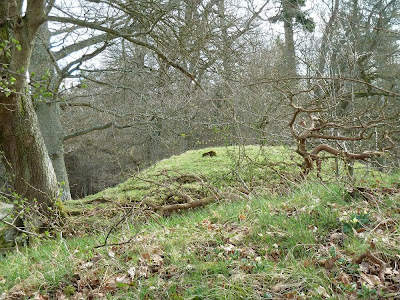
All that stands of Brinkburn Priory today is a restored 12th century church, and parts of the monastic buildings were incorporated into the manor house next door, which has sadly fallen into a state of disrepair. Both are now owned by English Heritage and are open to the public during the summer for a small entry fee. More about the priory and church can be read here on Wikipedia. So along to Brinkburn we went! After a long drive down a country lane we arrived at the car park. Right next to a car park sits a hill that looks remarkably like a fairy hill. At first I thought it might have been created when the car park was made, but there seem to be some old trees growing from it, suggesting that it may be older...
Along the path to the priory we pass primroses, enchanting lush green mossy tree stumps, and a little hole in a trunk, just the right size for a fairy...

A bit further along the path and i'm face to face with a tree, quite literally! Sure i'm not the only one who can see a face or two in the trunk of this tree, and he seems to be hungry judging by the amount of rocks he's eaten!

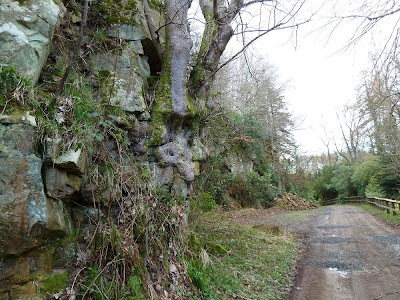
Nearly there, just around that corner...

Brinkburn Priory...

Walking around the beautiful priory grounds, where fairies sleep nestled in the ferns, and curled up in the beautiful pink spring blossom...

I apologise for any formatting issues with my blog, especially if it looks like a small goblin has randomly thrown the images at the page and there's spaces where there shouldn't be! I seem to be having a few problems at the moment and i'm not sure if the problem lies with me or the blogger site. Normal blogging will resume when I manage to turf the tricksy goblin out of my laptop!