Showing posts with label Scotland. Show all posts

Tuesday, 18 October 2022

Robert Kirk Revisited

Doon Hill, from Aberfoyle Kirkyard gates


I first blogged about Robert Kirk and Aberfoyle in 2010 and I have been hoping to return ever since. My original plans were unfortunately cancelled due to the pandemic, but nothing could keep me away this time! I only planned to reread my notebooks before my visit, but quickly fell down the research rabbit hole, and now I present to you a new updated blog post, Robert Kirk revisited. It's a rather long post, but I hope it will be of use to anyone researching Robert Kirk, or anyone who is curious to know more about this most intriguing man.


THE LIFE OF ROBERT KIRK

"If it be true that Mr. Robert Kirk was chosen as her chaplain by the Fairy Queen, Her Majesty is to be congratulated on her good taste." - David Baird Smith (1921)

Drawing of Robert Kirk at Balquhidder, by Watson Wood 1907 

It is believed that Robert Kirk was born around 1644, 9th December 1644 according to Donald Maclean, who gave a talk to the Gaelic Society of Inverness titled The Life and Literary Labours of the Rev. Robert Kirk, of Aberfoyle in 1924, and quoted a diary entry by Kirk that reads "Decr. 9, 1689, Age 45". Though Rossi in his Text-Criticism of Robert Kirk's Secret Commonwealth believed it was probably 6th August. He was the youngest son of James Kirk, minister of Aberfoyle, and according to Maclean, Robert was the seventh son. He was educated at the University of Edinburgh and studied theology at St Andrews and after his studies became the minister of Balquhidder on 9th November 1664, aged just 19 years old. Interestingly, Maclean said that Robert himself spelt his surname as 'Kirke' in his Bible and letters, but in his psalms spelt it 'Kirk'. Here I will be using the latter, as it is most often used today.

According to Scott's Fasti Ecclesiae Scoticanae Volume IV (1923) Kirk married Isabel Campbell January 1670, and they had 2 sons, Colin and William. Sadly, Isabel passed away on 25th December 1680 aged 25. David Smith's article titled Mr. Robert Kirk's Note-Book, which appeared in The Scottish Historical Review July 1921, tells that Robert recorded his wife's death in his notebook, together with an elegy, and he writes she "was married to her husband near 3 years, and left alive one son, Colin." This would put their date of marriage nearer 1677 and suggests that if they did have a second son, William, sadly he did not survive. Perhaps poor Isabel died in childbirth.

The Old Church, Balqhidder


On the 9th June 1685, according to Maclean, he became minister of Aberfoyle, and it was here he married his second wife Margaret Campbell (daughter of John Campbell of Glendaruel, and his previous wife's cousin according to Rossi). Together they had a son called Robert, who became minister of Dornoch, as well as a daughter called Marjorie, according to Scott's Fasti Ecclesiae Scoticanae. 

I have often wondered where in Aberfoyle Kirk lived. Canmore records for the Manse of Aberfoyle mention an "Incomplete and unsigned discharge by Robert Kirk, Minister at Aberfoyle, to William Earl of Menteith, for money for rebuilding the Manse of Aberfoyle. 1687 GD220/6/1835/33, as well as a "Discharge, written and signed by Mr Robert Kirk, Minister at Aberfoyle, to William, Earl of Menteith for 300 merks Scots for rebuilding the manse. 1687 GD 220/6/1835/35". However, whether or not this rebuilding took place I do not know, as there are also record of a proposed Manse to be built in Aberfoyle in 1734. Maclean's The Life and Literary Labours of the Rev. Robert Kirk, contains two letters written by Kirk in September 1691 which are addressed from 'Inch-Allodine'. Was this the name of the Manse, or did he live elsewhere, I wonder?

Antique postcard of Aberfoyle Kirkyard and Doon Hill, from Strathard Heritage Website

Kirk remained the minister of Aberfoyle until his mysterious death on 14th May 1692. His gravestone can still be seen today in Aberfoyle church yard, though Lizanne Henderson points out in her paper The Guid Neighbours: Fairy Belief in Early Modern Scotland 1500-1800 (1997), that the lettering style suggests that the stone was carved at the end of the eighteenth century, if not later, so is unlikely to have been placed there at the time of his death. 

Robert Kirk's Gravestone, September 2010


THE WRITINGS OF ROBERT KIRK

Although famous for his mysterious death, he is perhaps most well-known today for his writings on fairies, more commonly known as "The Secret Commonwealth of Elves, Fauns and Fairies". During his own lifetime he was better known for his religious work, including his first complete translation of the Scottish metrical psalms into Gaelic. According to Reid's Bibliotheca Scoto-Celtica (1832), during the time Kirk was writing his Psalter he found out the Synod of Argyle was intending to publish their own translation, and "such was his anxiety to have his finished first, that he sat up the greater part of the night for many months; and, during this time, the method he took to chase away sleep was rather singular,- he put a piece of lead into his mouth, and placed a basin of water in position, into which the lead dropped as soon as he fell asleep." Maclean writes of Kirk, "his name will be honourably associated for ever with the first Gaelic Bible that was put freely in the hands of Highlanders.", and he reminds us that for over 100 years Kirk's Bible was the only Gaelic Bible available to the Highlanders of Scotland. 

As well as writing religious texts, Kirk also recorded some of his thoughts and learning in a series of notebooks and diaries. Some of these books have survived and are now held at the University of Edinburgh. When I saw a couple of his manuscripts a few years ago at the Between Worlds exhibition in Durham, I was surprised to see that he seemed to enjoy drawing and doodling in his notebooks. Below are a couple of pages from Kirk's Summa Doctrine Posterior (Dc.8.114) thought to date from around 1660, before he took his minister post at Balquhidder. You can see more images from his notebooks here on the University of Edinburgh Collections website.      

Used with kind permission of The University of Edinburgh. 

An interesting article titled Mr. Robert Kirk's Note-Book was included in The Scottish Historical Review 18 in 1921. It was written by David Baird Smith, who purchased a notebook written by Robert Kirk at a sale in London of the library of Professor John Ferguson of Glasgow University. He gives the title as: first Manuscript | A | miscelany of occuring | thoughts on various | occasions | Ro: Kirk | Love and live | August i. at Balquhidder | 1678. Smith also tells it has the signature of C. Kirk inside, probably the writer's son Colin he believes, and the name Thomas Rutherford 1698. The article includes some fantastic extracts from the notebook, including an interesting early mention of fairies:

"lykewise the story of the human-shaped incubi, and stealing of children and nurses, give probable surmises that there are divers clans and kynds of spirits who make their vehicles seen to us when they please, though they are not so gross as terrestrial bodies, but most part aerial needing to be soakt and fed some way as well as ourselves. Such may be the fauns, fayries, satyrs and haunters of hillocks, wells, etc. (for no thing nor place but is inhabited within of some creatures) and since many of these disappear at mentioning the name of God, and that thy foresee evil rather than good, why may they not have a polity among themselves, some of them not so miserable as others, some of them reasoning and learning, others as yet obstinate, blinded atheists (for they but see the works of God to prove a duty as we do; yet are there atheists among us)."

Interestingly, it also contains an example of Robert Kirk having his own unusual experience that perhaps predicted a future event:

"Though I use not to notice dreams much, yet March 25, 1679, I viyels perceived and thought I felt a great tooth in my head break into two halves part by part and com off; on the morrow (my father being removed twenty years before) my mother took bed and on Monday thereafter about 2 a clock, gave up the ghost. Who knows if some courteous angel gives us a warning by our imaginations or senses, of extraordinary accidents. I am sure at several slips, I have susteand immediately loss of goods or hurts of my body, vexing reports of fama. Though God does observe and may manage every particular in this world by himself; yet he may use the medial ministry of angels towards men, as of man towards beasts."

It appears Kirk was perhaps not fully appreciated by his parish, and he writes "When I hear of evil tales concerning myself in the country (endeavouring intirely to keep the commandment) only reply that I thank God they have not worse news to occupy them with." I wonder what 'evil tales' people were telling of him?

Another entry suggests that perhaps someone stole from him at the church or manse, and he writes that "robbing and stealing from ministers is a visibl token of atheism and total decay of the sense of God and religion". In another entry he writes "How true is it, homo homini lupus? No creatures prey on their own kind but man. Look through tame and ravenous, none make it their own profit or glory to kill or steal from those of their own feather or keel." He writes of the difficulties of being a minister, and how his preaching appeared to have little effect at times and "many thousand good discourses are spent among deaf stones and men and timber every day. Great therfor must be the pains in kindling som sparks of knowledge by catechising and rooting the youth in the principls of religion e'er they can attean to be attentive to a sermon, and not only gaze (but not understand) like bruits." The notebook entries included in Smith's article give the impression that Kirk was a very pious man, a deep thinker with strong opinions, but also with a feeling of isolation from those in his parish. Maclean's The Life and Literary Labours of the Rev. Robert Kirk mentions a letter written from his friend Rev. James Kirkwood to Robert Boyle, where Kirk is described as "a learned, pious and zealous man".


THE SECRET COMMONWEALTH MANUSCRIPTS

At some point it appears Kirk decided to collect his notes and thoughts on fairies and the second sight and similar subjects together and write a manuscript, now known as The Secret Commonwealth, a shortened form of its much longer title. No one knows exactly what prompted this, but some believe it all began during a visit to London to oversee the printing of Bedel's Bible into Gaelic, where he spent 10 months before returning to Aberfoyle in March 1690. 

Rossi tells us that during this time in London Kirk visited many churches, of all denominations from Anglican to Roman, and also Quaker meetings, and wrote down comments on them in his notebooks. Maclean writes that Kirk "did not attend religious services to satisfy a craving for curiosity, or to pay a formal respect to his conscience and vocation, but in the spirit of a devout and receptive hearer who was willing to be a debtor to any religious instructor irrespective of his religious or ecclesiastical communion." In his diary he wrote a summary of each sermon together with his opinion of the preacher and their sermons, the size and "quality" of the audience, the features of the church or meeting house, and any other notes including a Quaker who irritated him with misquotations, and a country minister who made tedious repetitions. Kirk gives a fair assessment of each but concludes that the preachers of the Church of England surpass all others in pulpit effectiveness.

One of these services that Kirk made note of was a sermon by the Bishop Stillingfleet at St Andrew's in Holborn on 6th October 1689, where he spoke against miracles and apparitions, and at the end of the sermon he invited Kirk to his home for dinner. Kirk wrote in his diary that Stillingfleet "came to enquire of the Second Sight, only heard to be in the Highlands of Scotland. When I told him some had it innocently by their predecessors, he said original sin came from ancestors, yet not innocently, and so sins of ignorance. When I said some acquired it by contact with evil men or spirits, he replied that, it being a voluntary act, and having no natural dependence of cause and effect, it was sinful. I said yawning was voluntary, yet it affected others by imitation, and that innocently, and there was no more dependence of the effect from the cause naturally, and understood by us, than of the loadstone drawing steel." Kirk continues later in the diary entry for that night, "When I urged to the Doctor that as lynxes and cats see in the night beyond men, and as telescopes aid the natural sight by art, so may not some men have, or attain complexionally to such a habit or faculty. He answered that by many subtle, unthought of insinuations the devil interposed in such cases, and sought no other invitation than the eager curiosity of the enquirer as of him that caught a fly and put it in the box." Maclean's The Life and Literary Labours of the Rev. Robert Kirk contains these and more fascinating diary entries, and of that night Maclean writes of Kirk, "One cannot help, even at this distance of time, applauding the brave mountaineer.". 

At this dinner Kirk also met Lady Stillingfleet, the Bishop's wife, who was interested in learning of the seventh child's gift of touching for the King's evil. Some say she had recently given birth to a seventh child herself. Rossi tells us that among the many biblical quotations on the title-page of MS 5022 of the Secret Commonwealth there is a note, 'Sent by the writer to the right Reverend... Bishop of Worcester, His Lady'. Rossi believes that "Kirk had somehow tacitly or expressly promised to send to Lady Stillingfleet (not to the Bishop for understandable reasons of bienséance) a full account of stories referring to fairies, charms, second sight, etc." Hunter's The Occult Laboratory shows that some parts of the manuscript seem to match entries written in his London diaries, which also suggests he started writing his manuscript whilst in London. Kirk's time spent in London was probably quite a contrast to his isolated years spent at Balquhidder, and I imagine he relished the opportunity to share his thoughts with others who shared his interests. Perhaps it was that dinner with the Stillingfleets that further stirred his interests in the second sight and fairies and encouraged him to put pen to paper and write a manuscript.


Trans. Manuscript / Adv.MS.34.6.9

After Robert Kirk's death his manuscript appears to have been left unpublished until a copy of his manuscript (Rossi names this manuscript Trans.) was rediscovered in the Advocate's Library and 100 copies were published in 1815, possibly by Sir Walter Scott. However, John Ferguson's Bibliographical notes on the Witchcraft Literature of Scotland (1897) mentions that he enquired about the manuscript at the library and "so far as can be judged from catalogs, there never was one". Though Ferguson does mention finding another copy at the University Library in Edinburgh, complete with extra pages not included in the 1815 edition, which was probably La.III.551. Rossi also looked for the Trans MS but found no trace and believed it lost. However, I believe it has not been lost after all, and is held by the National Library of Scotland, and is now known as Adv.MS.34.6.9. 

The webpage for MS.5022 here mentions in the bibliography that "The work was printed in 1815 from Adv.MS.34.6.9, folios 413 verso-433.". The page for Adv.MS.34.6.9 does indeed include a copy of Kirk's Secret Commonwealth, and the source of acquisition is "Presented, 1925, by the Faculty of Advocates to the nation on the foundation of the National Library of Scotland." I have not been able to visit in person to see the manuscript for myself, but Kevan Manwaring's Performing Kirk webpage mentions that he also came across this manuscript and viewed it in person. I contacted the library, and they confirmed that they do hold this copy of the manuscript, and from their description I believe it most likely is the manuscript that was used for the 1815 edition. However, the catalogue places the manuscript as early 18th century and it does not appear to have been written by Kirk himself unfortunately, so is most likely another later copy. Both Trans and Adv.MS.34.6.9 are incomplete, and end in the middle of the fifth objection, with a note to 'See the Rest in a little Manuscript belonging to Coline Kirk'.


La.III.551

La.III.551 was acquired by David Laing in 1823 and bequeathed to the university in 1878, according to Sharp in The Scottish Historical Review, Vol. 38, No. 126, Part 2 (1959). Page 126 ends 'Finis coronat opus. Writen be Robert Campbell at Insh-Alladine in the paroch of Aberfoyl in Monteith 1691 - Love and Live Robert Campbell' and on p129 'This book belongs to R. C. Pryce 12 sh.'. The full title of this volume is 'The Secret Commonwealth or a treatise displaying the chief curiosities among the people of Scotland as they are in use to this day being for the most part singular to that nation a subject not heir to fore discoursed of by anie of our writers. Done for the satisfaction of his friends by a modest inquirer, living among the Scotish-Irish 1692.' The final sentence suggests that perhaps it was written for the benefit of another, perhaps Robert Campbell or the Stillingfleets? We have no way of knowing, and we do not know who Robert Campbell was unfortunately, though Sharp in The Scottish Historical Review, Vol. 38, No. 126, Part 2 (1959) believes it was possibly Kirk's brother-in-law. Maclean's The Life and Literary Labours of the Rev. Robert Kirk, contains two letters written by Kirk in September 1691 which are addressed from 'Inch-Allodine', suggesting that Robert Campbell was writing the manuscript whilst in Kirk's house.

Rossi describes the handwriting as "decidedly different from that of Kirk, clumsier, badly formed" and writes that Professor Kenneth II. Jackson examined the manuscript and judged it to have been written by someone who could not spell in Gaelic, strongly suggesting that Kirk himself did not write it. Rossi suggests that perhaps Kirk dictated the words to Campbell on his sick bed, but Sharp suggests from the omissions and "several instances of visual anticipation of words lower down the page" that it was copied, though perhaps revised by Kirk himself. Hunter's The Occult Laboratory tells that some amendments to La.III.551 appear to be in Kirk's own handwriting, and that the handwriting of the manuscript changes slightly at intervals, suggesting that it was written in stages. 

This is the most complete manuscript found so far, and it includes all of the Secret Commonwealth, the objections and replies, a section on charms, and a dictionary of difficult expressions. Rossi suggests that this last section was composed for the use of 'someone somewhat uneducated' and suggests perhaps it was for Robert Campbell, who did not understand certain terms used by Kirk.

Used with kind permission of The University of Edinburgh


MS. 5022

The National Library of Scotland also holds an incomplete copy known as MS. 5022, acquired in 1949 from an Edinburgh bookseller who vaguely recollected purchasing it in Angus. According to the NLS website, the remains of the binding show it was once part of a larger volume. Rossi believes the handwriting to be more recent than La.III.551 and suggests the beginning of the 18th century. Rossi tells us that among the many biblical quotations on the title page there is a note, 'Sent by the writer to the right Reverend... Bishop of Worcester, His Lady', which is "inserted with no special marks, as if it were another quotation", suggesting that the writer was copying from another text. He writes that the text is complete up to the end of the exorcisms on p50, and this corresponds to p110 of La.III.551, which then continues with further exorcisms and the vocabulary.


Gen.308.D

The University of Edinburgh Archive describes Gen.308.D as an 18th century copy, bound by William Henderson in 1814 according to a note on the end paper, and purchased from Storey, Accession E61/18. Walsh says in his The Secret Commonwealth and the Fairy Belief Complex (2002) that it was acquired in 1964, so unfortunately it is not included in Rossi's Text-Criticism that was published in 1957. Walsh also compared the manuscripts and believes that Gen.308.D and MS. 5022 are similar enough to suggest they were copied from the same source. 


The Reay Manuscript

Hunter's The Occult Laboratory, as well as containing a wonderful reliable version of La.III.551, also contains some very fascinating letters written to Pepys regarding the second sight. In a letter dated 24th October 1699 Lord Reay writes to Pepys:

"I have Gote a mannu-script since I came to Scoteland Called Ane Essay of the Nature and actiones of the Subterrenians (And for the most parte) Invisible people, heirtofor goeing under the names of Elves faunes and faries, or the like among the low Countrey Scots & tearmed hubhrisgedh, caiben, lusbartan 7 siotbrudh Amongst the Tramontans or Scotish Irish as they are now Descrybed By those that have the second sight And Now to occassione furder enquerie Collected and compared by M: R K. /p.4/"

He tells the writer was a parson and he received a letter this day from a friend promising him his acquaintance. Kirk passed away 7 years ago in 1692, but the manuscript title and R K initials strongly suggest that this was Robert Kirk's manuscript, and that his friend was unaware of Kirk's death. Reay tells Pepys that "when ever I have occasione I shall send you a Coppie of the booke", suggesting that the Secret Commonwealth was in circulation in the 1690s, and had perhaps been published after all, though no printed copies have been found.


MANUSCRIPT CONCLUSION

It is believed that none of the existing copies are in Kirk's own handwriting, and all are copies of another manuscript, apart from possibly La.III.551 which may have been written down by Campbell on behalf of Kirk, if he was indeed too ill to write it himself. Though, it may also be a copy of a currently undiscovered manuscript or have been copied from Kirk's own notes or diaries that have not been found. Rossi raises the possibility that Kirk may have made a fair copy as best he could to send to Mrs Stillingfleet, perhaps whilst in ill health, and that this was later copied and became M.S. 5022, with the original being lost. Then perhaps, in declining health, he had Campbell make another copy with the final extra additions, which became La.III.551. Unfortunately, it is unlikely we will ever know, but we can hope that more manuscripts of the Secret Commonwealth will yet come to light.

For anyone wishing to read The Secret Commonwealth, there are a variety of editions available, some more reliable than others. After the 1815 edition, it was published again in 1893 with an introduction by Andrew Lang, and in 1933 with an introduction by R. B. Cunninghame Graham. The 1893 edition is available online to read for free on the Internet Archive website, here. Rossi warns that the 1893 and 1933 editions were published with the same spelling mistakes as the 1815 edition and are unreliable, and incomplete. Hunter's The Occult Laboratory (2001) contains a reliable and complete copy of manuscript La.III.551, and Stewart Sanderson’s edition for the Folklore Society in 1976 is supposed to be superb, but I have been unable to find a copy so far. Rossi's Italian version of The Secret Commonwealth, Il Regno Segreto, is also a reliable copy and is available to borrow here on the Internet Archive Website. 

I would also thoroughly recommend Rossi's Text-Criticism of Robert Kirk's Secret Commonwealth. Translated by M.I. Johnston. Edinburgh Bibliographical Society Transactions Vol III Part 4 (sessions 1953-54, 1954-55) published 1957, for anyone interested in learning more about the various manuscripts and the differences between them.

For anyone wanting to learn more about the life of Robert Kirk I recommend the Rev. Professor D. Maclean's The Life and Literary Labours of the Rev. Robert Kirk of Aberfoyle. Transactions of the Gaelic Society of Inverness vol XXXI 1922-24 (1927).


Painting of Robert Kirk in Balquhidder Church, 
used with kind permission of the artist, Gill Waugh


THE STRANGE DEATH OF ROBERT KIRK

Kirk was not the only minister of Aberfoyle with a keen interest in folklore. In the 2nd edition of Rob Roy (1828) Sir Walter Scott writes "It is remarkable, that two successive clergymen of this parish of Aberfoil have employed themselves in writing about this fairy superstition" and gives mention of Patrick Graham. It is Graham we have to thank for telling us of the mysterious death of Robert Kirk, and in his Sketches of Perthshire (1812) he tells of that fateful night:

"He was walking, it is said, one evening in his night-gown, upon the little eminence to the west of the present manse, which is still reckoned a Dun shi'. He fell down dead, as was believed ; but this was not his fate:

"It was between the night and day,

When the fairy king has power,

That he sunk down (but not) in sinful fray,

and, 'twixt life and death, was snatched away,

To the joyless Elfin bower."

Mr Kirk was the near relation of Graham of Duchray, the ancestor of the present General Graham Stirling. Shortly after his funeral, he appeared in the dress in which he had sunk down, to a mutual relation of his own and of Duchray. "Go," said he to him, to my cousin Duchray, and tell him that I am not dead ; I fell down in a swoon, and was carried into Fairy-land, where I now am. Tell him, that when he and my friends are assembled at the baptism of my child, (for he had left his wife pregnant) I will appear in the room, and that if he throws the knife which he holds in his hand over my head, I will be released, and restored to human society." The man, it seems, neglected, for some time, to deliver the message. Mr Kirk appeared to him a second time, threatening to haunt him night and day till he executed his commission, which, at length, he did. The time of the baptism arrived. They were seated at table; Mr Kirk entered, but the laird of Duchray, by some unaccountable fatality, neglected to perform the prescribed ceremony. Mr Kirk returned by another door and was seen no more. It is firmly believed that he is, at this day, in Fairy-land."  

Image from The Minister of Fairyland by Archie McKerracher, Fate Magazine January 1990


SIR WALTER SCOTT & THE NOT-QUITE DEATH OF REVEREND PATRICK GRAHAM

In the 2nd edition of Rob Roy (1828) Sir Walter Scott refers to Patrick Graham as the 'late' Dr. Patrick Grahame, which seems to have come as quite the surprise to Graham, who was very much alive and well! He wrote a rather amusing letter to Scott in December 1829 to say he was indeed alive. "Though till now unconscious of this very material change in the scene and mode of my existence, I am far from questioning a fact stated on such high authority." He makes reference to Robert Kirk, and jokes "Perhaps, indeed, like a well-known predecessor of my own, I have been only carried off by the Daonine Shie, in which case the unearthly being who now addresses you may be no more than a Fairy changeling, left for a time to occupy the place of the departed Minister of Aberfoyle. The whole letter can be found in The Private Letter-Books of Sir Walter Scott, edited by Wilfred Partington (1930).

In Scott's Letters on demonology and witchcraft (1887) he writes of Robert Kirk and includes a version of Graham's story of Kirk at the christening, with Kirk appearing to a relation and commanding him to tell Grahame of Duchray "that I am not dead, but a captive in Fairyland, and only one chance remains for my liberation. When the posthumous child, of which my wife has been delivered since my disappearance, shall be brought to baptism, I will appear in the room, when, if Duchray shall throw over my head the knife or dirk which he holds in his hand, I may be restored to society; but if this opportunity is neglected, I am lost for ever." When Kirk appeared, Grahame of Duchray "in his astonishment, failed to perform the ceremony enjoined, and it is to be feared that Mr Kirke still "drees his weird in Fairyland,"". It appears that Patrick Graham and Scott were good friends, with Scott recommending his Sketches of Perthshire, and calling him "an excellent man and good antiquary". Scott was also said to have visited Graham at the Manse in Aberfoyle.

Antique postcard of The Manse, Aberfoyle. From Strathard Heritage Website


FURTHER TALES OF ROBERT KIRK

The Reverend Robert Kirk has been fascinating folklorists for over 100 years, and many have visited Aberfoyle to find out more.

Evans-Wentz writes in his The Fairy-Faith in Celtic Countries (1911) of making a visit to Aberfoyle, where he spoke to Mrs J. MacGregor who kept the key to the old Churchyard containing Kirk's tomb. She pointed to the Fairy Knoll and told him "the hill is full of caverns, and in them the 'good people' have their homes". He also visited Rev. William M. Taylor, the present minister of Aberfoyle, who was familiar with the story and said he searched the presbytery books but could unfortunately find no record of Kirk's death. He acknowledged that folk believed "he was taken because the fairies were displeased with him for prying into their secrets", but he thought it more likely that Kirk was taken ill suddenly with "something like apoplexy" while on the Fairy Knoll and died there. Rev. Taylor was sure Kirk's body was buried, but others in the town Evans-Wentz spoke to were less convinced, with some believing that both his body and soul were taken, and others that only his spirit was taken, and his body buried. 

MacGregor's The Peat-fire Flame (1937) tells that "The old folks crossing the River Forth at Aberfoyle, just by the "Dun Shi'" or faery knoll, used to say that, ever since the translation of the Rev. Robert Kirk to the Secret Commonwealth of Faeries, they felt as though someone were riding on their backs. And they sincerely believed this to be none other than the minister who, about the year 1692, had been "spirited away" to faeryland."

Katharine Briggs, in her Dictionary of Fairies (1976), tells a slightly different story of Kirk's death, with Kirk only being found unconscious on the hill rather than dead, "he was accustomed to wander round the fairy hills by night, and one morning he was found unconscious on the Fairy Knowe of the Sith Bruach at Aberfoyle. He was carried to bed, and died without fully regaining consciousness." Briggs also writes that in 1944 "an officer's young wife was a tenant of Aberfoyle Manse and was expecting a child. She had been told that if a christening was held at the manse, Kirk could still be disenchanted. The chair that was traditionally his still stood in the dining-room, and if anyone stuck a dirk into the seat of it, Kirk would be freed. The young wife hoped that they would not be posted before her baby is born." Unfortunately, I can find no record of whether she was still in Aberfoyle at the time of giving birth, and whether a christening was held at the manse.

According to Scott's Fasti Ecclesiae Scoticanae Volume IV (1923) Kirk "was walking on a 'fairy knowe' when he sank down and disappeared". Some say that Kirk is still inside the fairy hill today, and a poster in Balquhidder church tells that "his parishioners believed that he had been spirited away by the Little People to live with them inside the Fairy Hill."

A Robert Kirk display at The Lodge Forest Visitor Centre, run by Forestry and Land Scotland, tells "The Fairies did not like being listened to and stole the Reverend Kirk's spirit and trapped it in a pine tree. The villagers found his lifeless body on the hill with his ear to the ground."

Robert Kirk display at The Lodge Forest Visitor Centre, October 2022

The Minister's Pine, as it is called on a sign by the gates to the kirkyard, can be found on the top of Doon Hill. I have yet to find any older sources that mention the tree's connection to Robert Kirk, but it features heavily in current folklore in the Aberfoyle area, including in the name of a local bar and restaurant, The Faerie Tree. Hendrie's The Trossachs: History & Guide (2004) tells "At the top of Fairy Hill, as it is often known, the exact spot where the minister was spirited away by the fairies is said to be marked by the tallest tree, a solitary Scots pine which soars skyward amongst the surrounding oaks." Other stories take this further and claim that Robert Kirk's soul is trapped inside the tree. A Forestry Commission Scotland sign at the base of Doon Hill, tells "The old Scots pine tree on top of Doon Hill is said by some to house the soul of Robert Kirk.". A Queen Elizabeth Forest Park leaflet by Forest and Land Scotland contains a Doon Hill walk and tells that the solitary scots pine at the top is "thought to mark the entrance to a Fairy Queen's underground palace". 
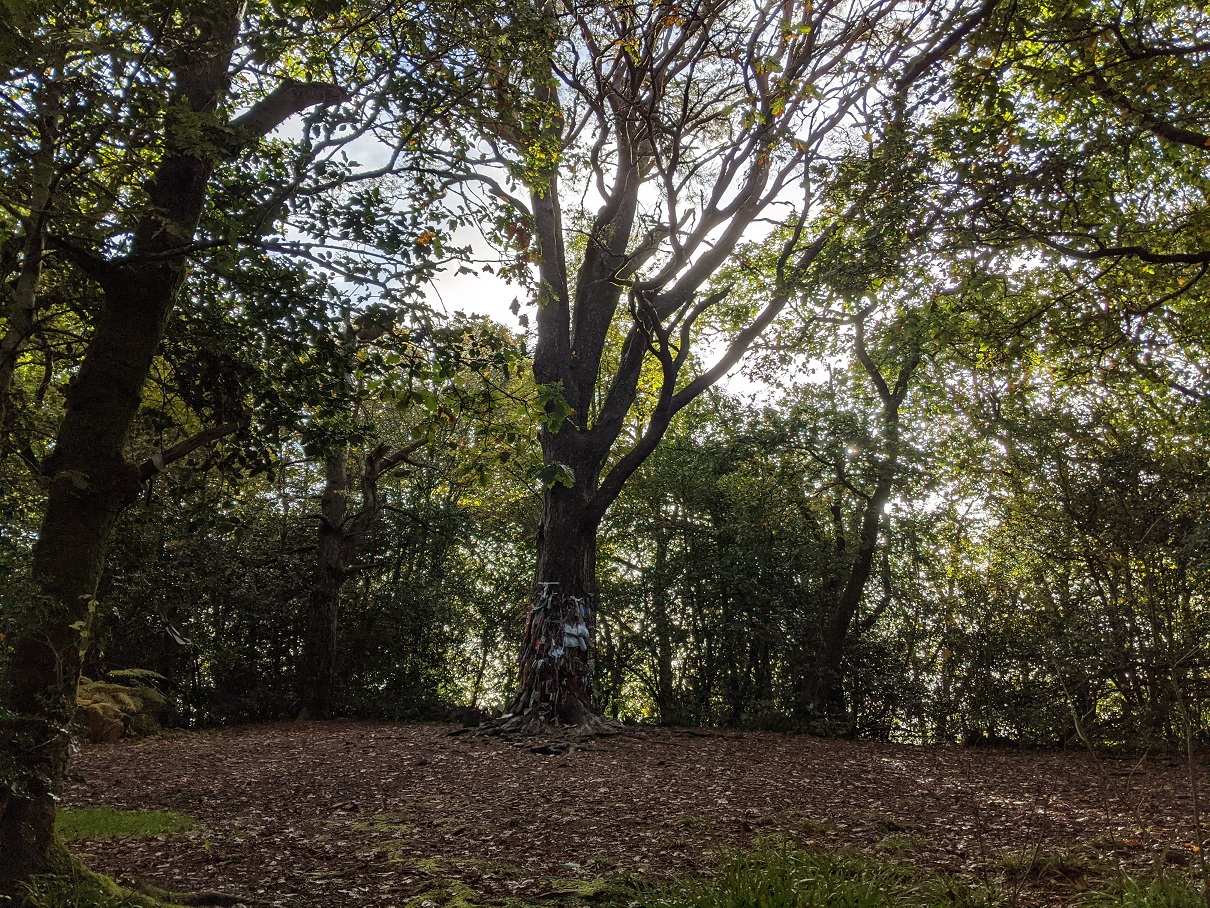
The Minister's Pine on Doon Hill, October 2022

According to issue 85 of Strathard News (2014) St Mary's Episcopal Church column, over the summer months they delved into the archives and script of the BBC Home Service programme about the Trossachs, broadcast in 1939. The article tells "The programme's producers were anxious to find out more about the Fairy Knowe outside Aberfoyle so brought the then Minister of Aberfoyle Kirk the Revd W.G. Strachan to the microphone. Mr Strachan opened his talk by advising his listeners who might visit the hill to walk around it nine times anti-clockwise. Only then might they be admitted to the community of the 'Little People'." I have not come across this piece of folklore before in connection with Doon Hill, but it is a well-known method of entering a fairy hill, so it appears that this Minister of Aberfoyle was also familiar with the folklore of the Good People! 

Issue 7 of Strathard News (July 2003) tells that BBC Scotland commissioned a drama documentary on Robert Kirk, titled 'Kirk Away with the Fairies' that was due to be shown later that year, but I have been unable to find a copy unfortunately.


ROBERT KIRK TODAY

In the twelve years since I last visited Aberfoyle, the fairies have certainly become a lot more noticeable! When I last visited in 2010 Kirk's gravestone was bare, but today I found it absolutely covered in coins. I was told by a local lady that people leave offerings to the fairies there. 

Robert Kirk's Gravestone, October 2022

There are fairy houses carved into tree stumps along the path up the hill, covered in colourful ribbons and offerings, and the Minister's Pine is also covered with a wide variety of messages and wishes. A wooden mushroom along the path has coins hammered into it too. A sign at the base of the hill from Forestry Commission Scotland asks that people only leave non-biodegradable items behind and says that biodegradable "clouties" are available from local businesses in Aberfoyle.


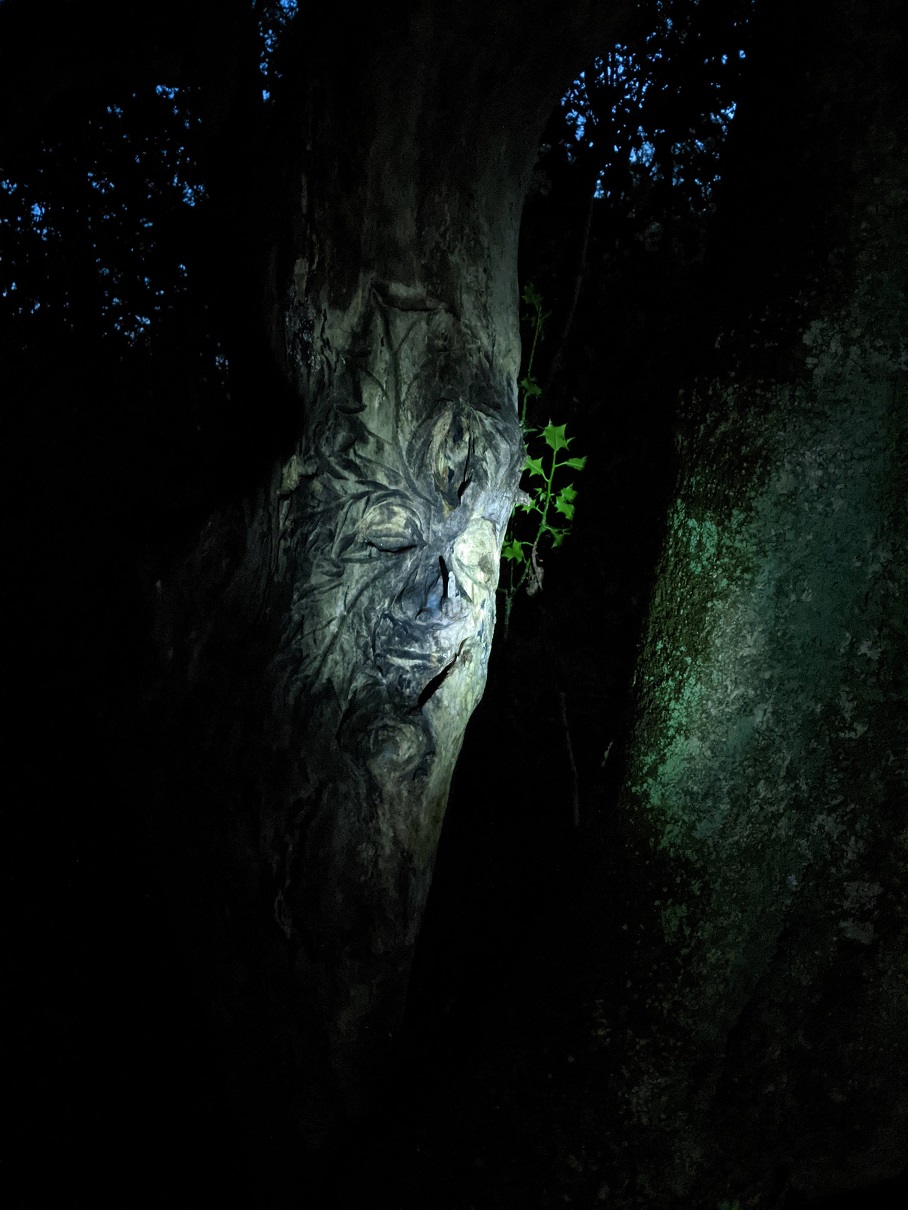
But there is far more to Doon Hill than bright garlands and shiny coins, it also has a certain wildness...

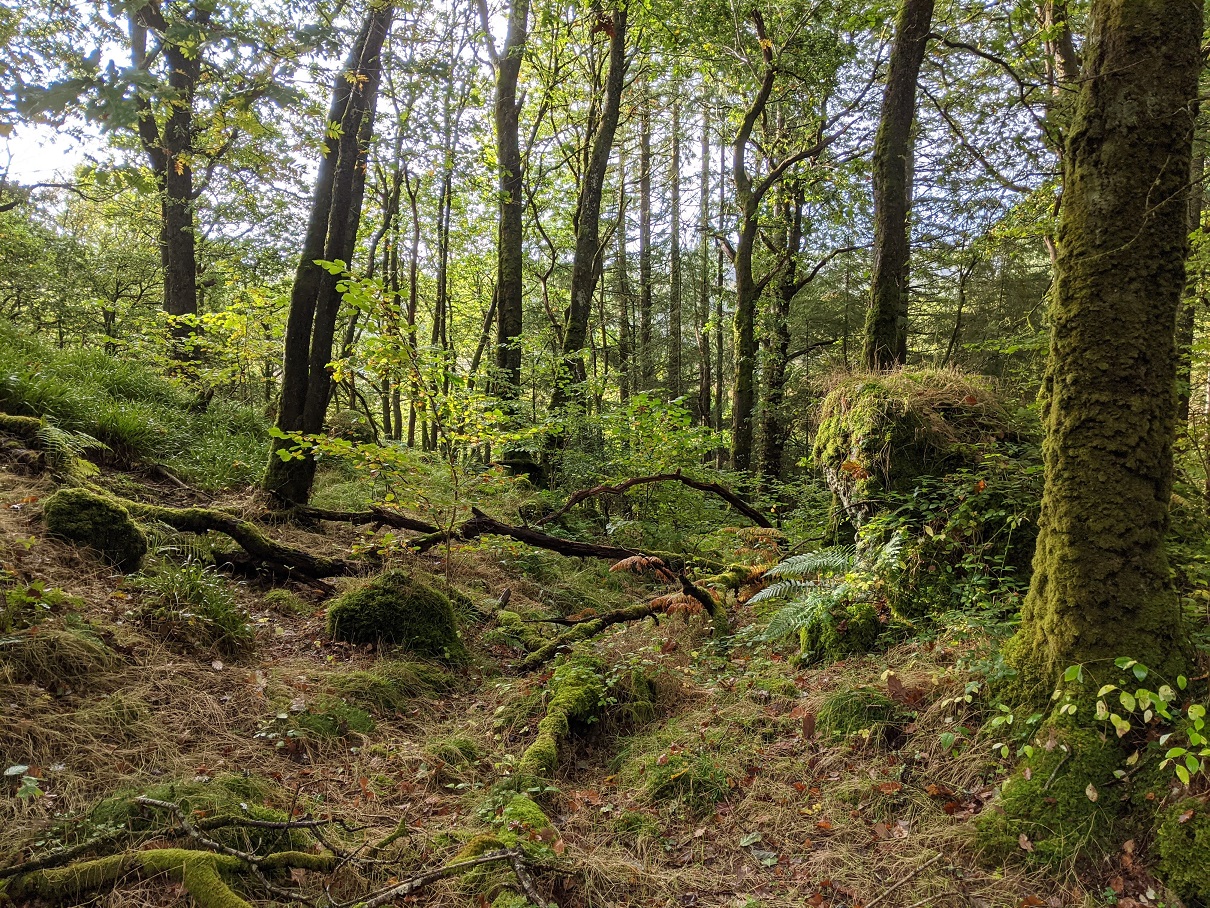
...especially at twilight...

Sources and Further Information

Briggs, Katharine. Dictionary of Fairies (1976)

Edinburgh University Library, Images from Robert Kirk related manuscripts

Evans-Wentz, Walter. The Fairy-Faith in Celtic Countries (1911)

Ferguson, John. Bibliographical notes on the Witchcraft Literature of Scotland (1897)

Graham, Patrick. Sketches of Perthshire (1812) 

Henderson, Lizanne. The Guid Neighbours: Fairy Belief in Early Modern Scotland 1500-1800 (1997)

Hendrie, William. The Trossachs: History & Guide (2004)

Hunter, Michael. The Occult Laboratory (2001)

Macgregor, Alasdair Alpin. The Peat-fire Flame: Folk-tales and Traditions of the Highlands & Islands (1937)

Maclean, Donald. The Life and Literary Labours of the Rev. Robert Kirk of Aberfoyle. Transactions of the Gaelic Society of Inverness vol XXXI 1922-24 (1927) p328-366

Manwaring, Performing Kirk: A search for authenticity in the dramatisation of the life of the 'Fairy Minister', Reverend Robert Kirk

McKerracher, Archie. The Minister of Fairyland, Fate Magazine January 1990

Partington, Wilfred. The Private Letter Books of Sir Walter Scott (1930)

Reid, John. Bibliotheca Scoto-Celtica (1832)

Rossi, Mario. Text-Criticism of Robert Kirk's Secret Commonwealth. Translated by M.I. Johnston. Edinburgh Bibliographical Society Transactions Vol III Part 4 (sessions 1953-54, 1954-55) published 1957

Sanderson, Stewart. A Prospect of Fairyland, Folklore, Volume 75 (1964)

Scott, Hew. Fasti Ecclesiae Scoticanae Volume IV (1923)

Scott, Sir Walter. Letters on Demonology and Witchcraft (1887)

Sharp, L.W. The Scottish Historical Review, Vol. 38, No. 126, Part 2 (1959)

Smith, David Baird. Mr. Robert Kirk's Note-Book, The Scottish Historical Review 18, volume XVIII No 72 July 1921 https://archive.org/details/ScottishHistoricalReview18

Strathard Heritage Website

Walsh, Brian. The Secret Commonwealth and the Fairy Belief Complex (2002)

Wednesday, 6 October 2021

The Fairy Doctor of Carue

My post today tells of a curious tale I came across completely by chance whilst holidaying near the Cairngorms in Scotland. I would say it's not often I book holiday accommodation only to discover there's a fairy site a 5 minute walk away... but this seems to be happening surprisingly often!

This tale takes us to a beautiful forested area east of the Cairngorms, near the village of Logie Coldstone. According to Epitaphs & inscriptions from burial grounds & old buildings in the north-east of Scotland, by Jervise (1875) the fairies once lived in the Seely Howe, a hollow in the Carue Hillock upon the laird of Blelack's land. Before leaving for the 1745 wars he became determined to dislodge them from his land, and called upon the services of "a reputed magician, named John Farquharson, tacksman in Parks". However, the fairies refused to obey his command to leave until they were assigned a new place to live. Farquharson agreed, and sent them to the Hill of Fare near Banchory, but they deeply disliked their new abode and announced to Gordon, the laird of Blelack:

"Dool, dool to Blelack, 

And dool to Blelack's heir, 

For drivin' us frae the Seely Howe, 

To the cauld Hill o' Fare!" 

Whilst to Farquharson himself they told:

"While corn and girs grows to the air, 

John Farquharson and his seed shall thrive nae mair!". 

Jervise adds that Farquharson's luck went bad from that day onwards and he left his native country and was never heard of again. The laird died without lawful issue and his estate passed to his sister's son. 

However, according to Tales and memories of Cromar and Canada by Donald Robert Farquharson (1930s?), John Farquharson's fate was not so terrible after all, and the plot thickens! According to the author, John Farquharson was also known as "The Fairy Doctor" and the author's father told him that he lived at the farm of Carue, though his father may have been in error as another family of the same name believed that he lived at "The Parks of Coldstone", the farm on which the author's father was born. However, the fairies lived on the farm of Carue, in a knoll known as "The Fairy Seely Howe".  He tells:

"In this hollow the lingering fairies were supposed to have their abode or place of meeting, and the most friendly relations seem for some time to have existed between them and The Fairy Doctor. Their visits to his home were frequent, and there were times when, in words betokening the most tender attachment, they deigned to serenade their friend. To this latter fact witnesses the one refrain of their songs which has come through my father to my knowledge: 

"Johnny, I lo'e ye, Johnny, I lo'e ye, 

"Nine times in ae nicht will I come and see thee." 

At last, for some reason not disclosed there was a breach in the harmony. Probably the little people in green became a nuisance either to Johnny himself, or to the laird of Blelach whose residence was near Carue. Whatever the cause, Johnny, the "Witch" or "Fairy" Doctor, was constrained to summon them out of The Seely Howe. On the ground that the summons was defective inasmuch as it had failed to indicate an assigned destination, the fairies refused to move. Johnny thereupon peremptorily ordered them to remove to the "Hill of Fare," about seventeen miles distant, and near the town of Banchory. Reluctantly the little people obeyed the behest, but first left with their quondam friend a permanent reminder of their opposition and malice, in words which my father rendered, 

"As lang as corn and girse grow to the air, 

"The Farquharsons will be rich nae mair."" 

The author then mentions the story also appearing in Rev. J. G. Michie's History of Logic Coldstone (1896), and tells that the copy he was gifted in Feb 1897 included a manuscript sheet in the handwriting of Mr Michie with some further information, probably received from his friend the minister of Selkirk.

 "The full imprecation on Farquharson ran thus : 

"Now we maun awa' to the cauld hill o' Fare, 

"Or it will be mornin' e'er we get there ; 

"But though girs and corn should grow in the air 

"John Farquharson and his folk shall thrive nae mair."

However it appears that John Farquharson and his descendants did thrive, and the following record was received by Mr. Michie from one of John's descendants, but too late for insertion in his book. 

"John Farquharson, born about the year 1700 A.D., became tacksman of The Parks of Coldstone which he left soon after the Rebellion of 1745, migrating to Moray where he took a farm near Forres, in the churchyard of which he was interred, and his son after him and where there is a tomb-stone to his memory. The legend about the fairies was preserved in the family, in consequence of which he was known as "The Fairy Doctor."

The book continues with further information about the successful lives of his descendants. It appears in this instance at least, the fairies did not follow through with their threats to him, a narrow escape compared to the fate of the poor laird of Blelack.

As I was staying in a holiday lodge a short walk from Blelack I couldn't resist going for a wander to see Carrue for myself. Issue 59 of Ballater & Crathie Eagle magazine, Autumn 2010, contains an article titled The Fairy Doctor of Carrue by Ken Glennie and confirms that "Carrue, a former farm, is now a wooded area south of Blelack House, Logie Coldstone". Unfortunately it's difficult to know exactly which knoll the stories speak of, and the ground is so densely forested that it's hard to spot hollows and knowes. I hope the maps and photos below will give an idea of this beautiful location though. No wonder the fairies were reluctant to leave!


Sources and Further Information
Epitaphs & inscriptions from burial grounds & old buildings in the north-east of Scotland, Jervise (1875)
History of Logie-Coldstone and Braes of Cromar by John Grant Michie (1896)
Tales and memories of Cromar and Canada by Donald Robert Farquharson (Book is undated, some library catalogues say 1930s)
Issue 59 of Ballater & Crathie Eagle magazine, Autumn 2010, The Fairy Doctor of Carrue by Ken Glennie


A big thank you to Cairngorm Lodges, it was on their website I first discovered the story, after I'd booked a week away in one of their beautiful lodges! If anyone is thinking of taking a quiet forest break, I thoroughly recommend them.


Saturday, 28 April 2018

The Fairy Folk of the Cairngorms


Folklore from the Cairngorms, including: Fairy Sweethearts, Green Fairy Dogs, Kelpies, Brownies, and Well Spirits 

The birds are singing, the leaves are unfurling, could Spring finally be here? It's definitely a wonderful time to go wandering in search of fairies, and lucky me, I’ve just returned from a holiday in the beautiful Cairngorms of Scotland! Although little is spoken of fairy folklore in this area, a bit of digging turned up more folklore than I was expecting, including some wonderfully magical and very unusual stories. In days long ago, “almost every large common was said to have a Circle of Fairies belonging to it” (Shaw, 1827). “They glided familiarly among the folds and the bothies, listened to the songs in the gloaming, and, in fact, knew all that went on. As for themselves, they milked the deer on the mountain tops, and had in their possession all the requisite appurtenances of a Highland dairy.” The women of the shielings would hear their fairy music, but knew to avoid the green-kirtled fairies, they were vindictive and mischief making with thievish propensities (Sinton, 1906).

So what do Cairngorm fairies look like? “Though generally low in stature, they are exceedingly well proportioned, and prepossessing in their persons. The females, in particular, are said to be the most enchanting beings in the world, and far beyond what the liveliest fancy can paint. Eyes sparkling as the brightest of the stars, or the polished gem of Cairngorm, - cheeks in which the whiteness of the snow and red of the reddan are blended with the softness of the Cannoch down, - lips like the coral, and teeth like the ivory, - a redundant luxuriance of auburn hair, hanging down the shoulders in lovely ringlets, and a gainly simplicity of dress, always of the colour green, are prominent features in the description of a Highland fairy nymph” (Stewart, 1823). This is a rather romanticised description, but it does perhaps explain why fairy sweethearts are particularly common in the Cairngorms.


Fairy Sweethearts

Stewart explains that “The fairies are remarkable for the amorousness of their dispositions, and are not very backward in forming attachments and connections with people that cannot with propriety be called their own species. We are told it is an undeniable fact, that it was once common practice with both sexes of the fairy people to form intimacies with human swains and damsels, whom they would visit at times and in places highly unbecoming and suspicious; and these improper intimacies not unfrequently produced, as may well be believed, their natural consequences”. He reassures us that “such intercourse as that described to have taken place betwixt them is now extremely rare: and, with the single exception of a good old shoemaker, now or lately in the village of Tomantoul, who confesses having had some dalliances with a “lanan shi” in his younger days, we do not know personally any one who has carried matters this length”.

Fairy sweethearts were also found in the Gaick Forest area, and were said to visit hunters in the forest. It was believed that the earthly wife of a hunter who fell in love with a fairy was in great danger of being hurt by her supernatural rival (Gordon, 1949).

A suspicious wife in Avie suspected her husband’s affections had strayed and one evening followed him as he set off up the glen. Much to her fury she saw a beautiful young lady in a green gown join her husband at a small rounded knoll in the middle of the glen. She sprang at them like a tigress but found she only grasped an empty green gown. She suddenly felt a calmness sweeping over her, and her husband too, and they lovingly entwined arms and walked home, forgetting their quarrels. As she entered her house she accidently snagged the dress on a nail and a piece of fabric fell to the floor. Her daughter picked it up and instantly transformed into the most beautiful woman, and the wife and her daughters forever carried a piece of the dress by their hearts, and all happily married and continued to pass pieces of the dress down to future generations (Gray, 1987).

A rather wonderful tale of a fairy lover is told of a soldier in Ruthven in 1644. A forester in Argyll’s army was followed wherever he went by his leannan-sith (fairy sweetheart) and she appeared in the form of a white hart. Whilst they were in camp near Ruthven Castle some of Argyll’s officers started to mock him about his follower, and unfortunately Argyll was a touchy fellow and in revenge he commanded some of his soldiers to shoot the hind. They took aim and fired but not a single bullet pierced her. However Argyll noticed that the forester had disobeyed his command, refusing to shoot at his love, and he was brought before Argyll and told that he alone must fire at the hind. The forester replied bravely, “I will fire at your command, Argyll, but it will be the last shot that I shall ever fire”, and scarcely was the charge out of his gun when he fell dead upon the spot. The fairy gave a terrifying scream and rose up like a cloud of mist and vanished into the mountains and was never again seen following the army. It was said that he left a widow back home in a place called the Fairy Corry, and that she wrote a lament about his body being laid to rest in Kingussie, so far from home, with no wife to lament for him (MacPhearson, Highland Monthly 1889-90) This lament is an old one but possibly unconnected to the story of the Fairy Sweetheart as it makes no actual mention of the above story (A big thank you to Kate Louise Mathis for her translation of this lament). Below you can see a photo of Ruthven Barracks, which now stands where the castle once stood:


Ruthven barracks, where Ruthven castle once stood


Fairy Abodes and Fairy Dancing
According to Elizabeth Taylor’s The Braemar Highlands (1869), the fairies lived below grassy eminences including a certain circular hillock near Glen Cluny. During moonlight they celebrated on the hill top, and at other times they stayed within the hill. A man once entered the hill and saw “a lot o’ little fouk dancing – the heartiest folk that ever he saw”. Some Cairngorms fairies prefer to dance on rocks, particularly the Big Stone of Cluny. One man saw them dancing by moonlight but when he showed his delight at the beautiful dance moves of one particular fairy she flew at him in a fury and almost strangled him before he could say a prayer! Below you can see the fairy stone as it appears on Google Maps.


Sometimes the fairies were accompanied by a fairy piper, as seen on a green hillock between Auchallater and Loch Callater (MacGillivray, 1855). Fairy Hills were common throughout the Cairngorms, and the names can still be seen on Ordinance Survey maps even today. There was once a wooded fairy knoll at Fincastle (Gordon, 1949), and Sithean Dubh da Choimhead in Glen More was said to be a fairy hill (Affleck, 1987) though the reason behind the name has been forgotten. I visited this particular hill and it does appear strangely conical and pointed, very unusual.

Sithean Dubh da Choimhead in Glen More

The fairies of Glen Avon lived in “fairy turrets”, dwellings of very large dimensions with lights shining through crevices in the rocks. Two men passing by one heard the “most exquisite sounds ever emitted by a fiddle-string” (Stewart, 1823). Stewart describes fairy turrets as composed of stones in the shape of irregular turrets, resembling masses of rocks or earthen hillocks. Their doors, windows, smoke-vents, and other conveniences, are so artfully constructed, as to be invisible to the naked eye in day-light, though in dark nights splendid lights are frequently reflected through their invisible casements”.

The fairies of Glen More were said to milk deer and wash their clothing in Lochan Uaine, so causing the water to appear a wonderful greenish tinge (Forsyth, 1900). After visiting the loch I can confirm that the water is indeed a beautiful and mysterious green colour, as shown in the photos below:

Lochan Uaine, where the fairies wash their clothing

Glen More was also said to be home to the King of Fairies himself, Big Donald. There are fairy hills, or sithean, at both ends of Loch Morlich but those at the west end are his abode (Forsyth, 1900). MacGregor only mentions one faery knowe and describes it as the meeting place of the fairy folk of Rothiemurchus and the Braes of Abernethy, and tells this story:

“Not so long ago a man, who was in the habit of boasting that he had no illusions about faeries and the like, was passing by this loch, when he heard the sound of distant bagpipes. As the sound drew nearer to him, he began to look around him for the piper. But, nearer and nearer and louder and louder though the piping came, there was no sign anywhere of the player. So close to him came the music eventually that he actually stepped aside, so as to allow the invisible piper to pass.”

He claimed he felt the gusts of wind on his cheeks that were issuing from the drones of the bagpipes, and when he told his friends they were of the opinion he had heard the faery bagpipes, played by none other than Big Donald himself (MacGregor, 1937).

Another time, when homes were lit by fir torches instead of paraffin oil, people from the lowlands came to this area to gather fir from the forest. They stayed with crofters and grazed horses on their land, but Donald considered them a nuisance and wanted them gone. One day, whilst gathering fir, they were suddenly aware of a gigantic figure that began pelting them with sticks and stones. They fled in a panic and didn’t return again to the glen (Gray, 1987).

The west end of Loch Morlich, home to Big Donald

A fairy hill at the west end of Loch Morlich

The Cairngorm fairies are very fond of music. A farmer in Strathspey was singing while he sowed a field, and whether it was the singing or seed that attracted her, a fairy damsel of great beauty and elegance introduced herself to the farmer. She requested he sing a particular song, “Nighan Donne na Bual”, and afterwards she asked for some of his corn. He asked what he would be offered in return, and she said if he granted her request then his seed would never fail him. He granted her request and sure enough, no matter how much he sowed his bag of seed never got less full. Unfortunately his good luck ended when his rather nosey wife accosted him with her suspicions, ending the spell (Stewart, 1823).  

Fairy music was also heard in the higher mountain regions of the Cairngorms. In the late 1940s and early 50s, Hugh Welsh, a stalwart of the Cairngorm Club and believer in the supernatural, reported hearing fairy music coming from rocks in Coire Sputan Dearg, high up Ben Macdui (Watson, 2011)


Fairy Midwives

As in other areas of Scotland, there was a need for human midwives to deliver fairy babies in the Cairngorms too. One midwife found a stranger on horseback knocking at her door late one night asking for her assistance. He reassured her “though I am conducting you to a fairy habitation to assist a fairy lady in distress, be not dismayed, I beseech you; for, I promise you by all that is sacred, you shall sustain no injury, but will be safely restored to your dwelling when your business is effected, with such boon or present as you shall choose to ask or accept of”. After she helped the fairy lady to give birth she chose as her boon that whomever she attended in child birth should have a safe and speedy delivery (Stewart, 1823).

Murdoch Mackenzie was a weaver and midwife and was said to possess a gift in his family that came from the fairies for some service rendered to them. During labour he would stroke a patient’s hand and take the labour pains on himself, leaving him rolling and roaring in agony (Forsyth, 1900).

It seems human healers were also in demand. Dame Aliset was asked to heal a fairy child by a four foot tall man wearing old fashioned clothing. She fetched healing waters from a well and used them to cure the child, and in return the fairies offered her great gifts, which she refused and only asked that they reward her with their friendship. However they did give extra powers to the healing well, and it is said that anyone who washes there can receive their youth again if only they wish for it (Swire, 1963).


Trading with the Fairies

An unusual method of trading with the fairies seems to have been discovered in the Cairngorms area. If you see a fairy carrying something you wish to acquire, you need only repeat these words ”mine to you, yours to me”, and throw something in return to the fairy. It seems they cannot refuse the trade! A hunter of Glen More acquired a set of jewelled silver pipes in this unfair manner, but the fairies had the last laugh. When he returned home he found they had turned to blades of grass and an empty puff-ball (Forsyth, 1900).

Robin Og had a similar experience at the Sithean of Big Donald, King of the Fairies, who was known for his fairy pipes. When passing the sithean one day he flung his bonnet in the air and whispered in gaelic “Is leat-sa so; is leam-sa sin! – This is yours; that is mine!” and in exchange for his bonnet a tiny set of bagpipes fell at his feet. But of course when he returned home he found only willow-reeds and a puff ball (MacGregor, 1937).

It seems trading with fairies can save lives too. John Roy of Glenbrown in Abernethy threw his bonnet at the fairies and shouted “Sluis sho slumus sheen (mine is yours, yours is mine)” and when they abandoned their booty it was “a fine fresh lady, who, from her dress and language appeared to be a Sasonach” (That English lady from Outlander really does turn up everywhere!). She lived with John for several years and he treated her with the utmost tenderness, but one day an English Captain and his son visited and the son recognised her as his mother, who they believed to have died, but a stock had been left in her place. She recognised them too and happily returned home with them (Stewart, 1823).


Fairies and Burning Mills

Quite unusual are the Cairngorm tales of fairies and burnt mills. Strong Malcolm of Duthil worked as a miller and was helped by a band of little men whom nobody ever saw and few ever heard. Malcolm left meal in the hopper before bed and the men would work hard all night and in the morning he would find the meal in the bags. If any fool entered the mill at night an unseen power would kick him in the rear and when he got up, usually with a broken and bleeding nose, he would find the mill silent and in darkness. One night, as the little men were busy in the mill, the kiln of Tullochgriban caught fire and the little men were heard to exclaim “we will have plenty of meal now, and sowens too, for Tullochgriban kiln is on fire, and Strong Malcolm must henceforth work for himself, or starve” and the little men never returned again (MacDougall, 1910).

Another mill burning took place in Delnabo. A fairy woman resided in the turrets of Craig-ail-naic, and one day she called on one of the tenant’s wives and requested the loan of a firlot of oatmeal to feed her family. She promised to return it soon as she was expecting a considerable supply. The tenant’s wife agreed, not wanting to anger the fairy, and after sharing a dram with some bread and cheese, they went to get the oatmeal. Once outside the fairy suddenly told the wife that she did not need the oatmeal after all, as she was now supplied as expected, and off she went. The wife was not surprised when she observed a few minutes later the corn-kiln of an adjacent farm engulfed in flames (Stewart, 1823).

I wonder if fairies stole the corn and oats and set fire to the mills, or perhaps the burnt corn and oats now belong to the fairies as they have burnt and ‘died’ and are no longer of the human world? Perhaps like ritual offerings being burnt or destroyed as an offering to the gods? There is much to ponder here, and I’d love to hear any reader’s thoughts on this and any similar stories they have read.


Fairy Dogs

Fairy dogs also seem to be more common in the Cairngorms than in other areas of Scotland. They were usually green in colour, and although not evil, their third bark was a death omen unless you had the courage to kill it after the first bark. Though, hearing even one dark was considered to bring ill luck. Human dogs were said to howl miserably and flatten themselves to the ground at the approach of a fairy dog. A green fairy dog once roamed the area around Ruthven Castle, and it was seen by several within the memory of those living fifty years ago. This was the last fairy dog to be seen, and they are now said to be extinct in the Highlands (Swire, 1963).

A shepherd was sitting one evening in his remote cottage, far up in the hills, when he heard scratching. Thinking it was his own dog wanting to be let in he opened the door, but in walked a green dog with golden eyes and crimson ears, and it went and lay down by the fire. He felt very nervous, knowing that a fairy dog made for a chancy companion, especially in a remote cottage at night, but he knew better than to disturb it. He placed food and water near the great hound and it drank well but refused the food. Then his own dog scrabbled at the door and when he let it in it saw the creature by the fire, and flattened down in terror. The fairy dog made a strange sound in its throat, but not a bark, and moved over to let the shepherd’s dog near the fire. The shepherd’s dog guardedly came to the fire and ate its supper and lay down under its master’s chair, and there they spent the night. At dawn, the green dog rose, shook itself, and walked to the door. The shepherd quickly opened it and to his surprise the fairy dog licked his hand before leaving. That winter, when his own dog had hurt its paw and was unable to assist him, the shepherd found himself in trouble. The snow was deep one night and at dawn he set out to dig his sheep out of the snow and gather them safely, but he was an old man and without his dog he had great difficulty and knew his sheep would die if he couldn’t reach them. Suddenly he noticed the green dog, and he knew his time was up as he waited to hear the customary three barks. Much to his surprise the dog licked his hand and then threw back its head and bayed, and the moor came alive with fiery-eyed green dogs. They ran back and forth, gathering the sheep, and when one found a buried sheep it waited until the shepherd arrived to dig it out. Then he was led to a small sheltered corrie where he found his whole herd grazing contentedly with green dogs on guard. The great hound led him back to his cottage, licked his hand once more, and the man bent to pat his head but found nothing but empty air (Gray, 1987).

An old cottage at the Highland Folk Museum in Newtonmore

Some believed that fairy dogs were a fairy creature, and others believed that the fairies were not satisfied with the breed they had and were always trying to obtain their own strain, as suggested in the following story. A man named Calum near Loch Guinach was in great trouble. The children were crying out with hunger and nothing he did went right. With great despair he one day decided to drown himself in the loch, in the hope that someone would take pity on his widow and children and provide for them better than he could. He was removing his boots and coat, so they could identify his body, when between him and the water he saw a beautiful woman. He found himself confiding in her his troubles, and she told him to go home and he would find all well if he agreed to one condition, that he meet her here again in a year and a day and give her whatever or whoever first meets him tonight when he returns home. Calum agreed, remembering that he had a lamb tethered by his door after its mother died, and being sure that it would be the first to greet him. However, as he approached the house his wife flung open the door, eager to tell him of their new good fortune, and his children rushed out to greet him. But before they could reach him, his dog sprang out and ran over, jumping up to lick his face. A year passed and Calum, now a well-to-do farmer, could not bear to condemn his beloved dog to the fairies and confided in his wife. She urged him to offer back all the fortune they had been given so she would spare the dog, and she did but she refused, saying that if she took back all her gifts then that would include his life. He even offered her all of his other beasts instead, but still she refused. As if sensing the dilemma, his dog left him and approached the fairy, crawling in fear. The fairy spoke gently to it and the dog rose and licked Calum’s hand, before heading back to the fairy. She told Calum to meet her again in a year, and then vanished. Calum returned a year later as asked and there saw the fairy, his dog, and with her was the finest puppy he had ever seen. His dog came to greet him, bounding and wagging her tail happily and the fairy smiled and said she was the best dog in all of the world. She told Calum that he would only see his dog once again, when it was time for him to die, but the puppy was now his to take home. He took the pup home and it was a wonderful dog, though it retained some fairy characteristics and all of its offspring had silvery eyes and could “see wind as light-eyed dogs should”. Many years later as Calum went to his sheepfold he met his old dog, and it barked three times, then he patted its head and it licked his hand one final time. Then Calum knew his time had come and three days later he died (Swire, 1963).

One final unusual tale tells of a hunter looking after a litter of puppies given to him by a demon. The demon collects all but one of the pups, and for some unknown reason breaks the leg of the remaining pup and leaves it with the hunter, who names him Brodainn. The hunter later decided to hunt the white fairy deer of Ben Alder, and it ran away with Brodainn in hot pursuit. Just as the hound was gaining on the deer, it ran straight into the loch, and they both disappeared forever (MacBain, Transactions of the Gaelic Society of Inverness vol xvi , 1890). The loch became known as Loch Vrodin, and today it appears on Ordinance Survey maps as Loch Bhrodainn.


Fairies, Deer, and Milking

The fairies of the Cairngorms were infamous for their milking of deer in the mountains. A herder in the Monadh-Liath Mountains north west of Kingussie was wandering in search of goats when he heard a sweet song and saw a fairy milking a deer. He shot at her, hitting the milk cog, and in defeat she bestowed upon him his first three desires and told him where to find his goats (T.S., The Celtic Magazine, vol xii, 1887). The Glaistig, however, preferred the same milk as humans. She was a thin grey little woman, dressed in green and with long yellow hair that reached to the ground. In Rothiemurchus, milk was poured each night into a hollow stone known as the Clach na Gruagaich, and at night she would come and drink the milk. Unless this was done, no milk was to be had at the next milking (Gordon, 1949).

Also associated with milking and deer was the Cailleach. The ruins of the dwelling of Cailleach Bheathrach could be found on the Morrone hills, and it is said that her “milch cows were the hinds of the forest” (Gordon, 1949).

A curious deer at Insh Marshes


Changelings and Kidnappings

Unfortunately this area of Scotland was greatly at risk of kidnappings by the fairies. They were particularly fond of newly born babies, children, and mothers who had just given birth. Two Strathspey whiskey sellers were returning from visiting their friend when they found a little child abandoned on the road, and on closer inspection they recognised it as none other than the child of the goodwife they had just visited. On their visit they had heard the babe crying pitifully and the goodwife had blessed it as she raised it from the cradle, and it seems this child had been a changeling or stock and the blessing had caused the fairies to abandon the real child which they had taken. When the men returned the child to its rightful home a fortnight later the goodwife told them that the (changeling) child under her care had become suddenly ill last night and death was certain, and when the men began creating a fire the changeling took the hint and flew away out of the smoke-hole (Stewart, 1823).

Important measures were taken to prevent the theft of children by fairies. It was said that suspending the child’s head downwards, when it was dressed in the morning, is an excellent preservative from all forms of supernatural being. Alternatively, a red thread was tied about its neck (don’t try this one at home!) or a rowan cross was worn (Stewart, 1823).

If a child is stolen by the fairies and a stock left in its place, the stock should be taken to the junction of three shires, or the confluence of three rivers, and it should be left there for the night. If the child had indeed been stolen by the fairies, then they would return it in the night and take away the stock (Stewart, 1823). A woman in Abernethy said that as a child she was found rather unaccountably one night on the outside of a window, so her parents believed she must have been taken by the fairies and a stock left as her substitute. They took the child to the junction of the shires of Inverness, Moray and Banff and left her alone there for the night. Luckily they had wrapped her up warmly in a blanket and she suffered no ill effects or injuries, and her parents were satisfied with the result.

The fairies would also steal grown adults too. A woman who lived at the farm of Tom of Cluny in Strathtay disappeared one day and reappeared a fortnight later, claiming she had been carried away by the fairies and made to cut peats for them on the nearby moors. As proof of this she produced a spade only 15 inches in length (Macgregor, 1937). A likely story indeed!

Livestock were at risk of fairy kidnapping too. A farmer at Auchriachan farm in Strathavon was searching for his goats on a remote hill in Glenlivet when he became lost as darkness approached. Spying a twinkling light in the distance, he headed towards it, but much to his dismay found the place looking wild and horrible, as if a human had never set foot there. He resolved to spend the night there and upon entering he saw, much to his horror, an old female acquaintance whose funeral he had recently attended. She ran over and ushered him to a quiet corner off the main room, telling him that he was done for unless she could hide him until he could make his escape. He hid and saw “an immense concourse of fairies”, who cried out for food, and spoke badly of him, calling him a miserly fellow who never leaves them their dues. They described how they were powerless against his usual safeguards but tonight his family had forgotten so they were free to take his favourite ox and his wife’s bannocks. The farmer watched as they killed his ox and cooked it, and while they were distracted the housekeeper helped him escape from “Mr Rhymer’s council-chamber”. The references in this story to Thomas the Rhymer are most bizarre considering how far we are from the Scottish Borders, his usual stomping ground. The farmer returned home and killed the stock the fairies left in place of his ox, and it rolled down the hill where it lay uneaten as neither cat nor dog would touch it (Stewart, 1823).

When a human catches a fairy, if they are bold and brave they should ask for wishes to be granted. Big Meg of Ruthven caught a fairy at the tree clad fairy knoll near the house as it washed its clothes in the stream. It could not go invisible due to its lack of clothing, and she had little difficulty in catching it. In return for its freedom it offered to grant Meg three wishes, and she chose sons (as she had daughters and no sons), the skills to be a good spinner, and for her cows to be good milkers and carry quey calves. The fairy granted her wishes and picked up her clothing and immediately disappeared. In the course of time Meg bore seven sons, became an expert spinner, and the cows were noted for their good quality milk and quey calves (Gray, 1987). It’s probably not advisable to catch fairies though, any failed attempts are likely to result in a very bad outcome!


Fairy Protection

Should you lose a friend to a fairy hill, there’s no use returning right away as the hill will remain closed until a year later (Taylor, 1869). Some say the right time to return is a year and a day later, wearing a rowan cross for protection (Stewart, 1823).

A rather permanent protection from the fairies can be gained by eating a very special cheese. You must go the summit of a cliff or mountain where no species of quadruped has ever fed or trod, and there gather the herb in the Gaelic language called “Mohan”. This herb you must feed to a cow, and then make a cheese from the milk produced, and whoever eats this cheese will be given protection from “every species of fairy agency” (Stewart, 1823). I have been unable to find out which plant this is, but if anyone knows I would love to hear from you.

Other methods of protection from fairies include putting fir on the crook in the chimney (Taylor, 1869), a piece of fir torch carried about the person (Stewart, 1823), planting stonecrop in the thatch of a house or planting a rowan tree nearby (Forsyth, 1900), crossing the first bannock so the fairies cannot eat them (Stewart, 1823), leaving ragwort growing around the margins of a field so the fairies would ride the ragwort stalks instead of the farmer’s horses (Swire, 1963), and a knife made from iron which has never been applied to any purpose (Stewart, 1823).

Ironically, a fairy bolt was also said to protect the possessor from the fatal effects of the fairies for as long as he keeps it on his person. The irony being, the fairy bolt was usually found embedded in the dead body of a cow or an unfortunate human (Stewart, 1823).


Brownies of the Cairngorms

There are quite a few stories of brownies in the Cairngorms, but most are attributed to a certain pair of infamous brownies, most often known as Mag Mulloch and Brownie Clod.

When mention is made of Mag, few authors fail to mention her unusual hair. Shaw tells that she has been seen in the evening as a young girl whose left hand was all hairy, and that she instantly disappeared (Shaw, 1827). Henderson rather unkindly refers to her as “Hairy Hand” and says she was supposed to come down the chimney and take children away (Henderson, 1911). These stories almost give the impression of her being a ghost or bogie of some sort, but Sir Walter Scott refers to her as a familiar attendant upon the clan Grant and calls her “May Moulach” a female figure whose left hand and arm were covered with hair (Scott, 1802).

Confusingly, MacGregor describes Mag Mulloch as having exceptionally long hair, and gives a male gender, describing how he would attend the laird’s table and supervise the dairy. He would also escort the laird of Tullochgorm home over the dark moors in the small hours when he had too much to drink and the brownie would then appear as a small boy carrying a lantern (MacGregor, 1937).
Stewart gives her a “super abundance of hair” and describes Hairy Mag, or Maug Vuluchd, as an honest and excellent house keeper but disliked by the female-servants as she would report any neglect of their duties to their master and mistress. Whenever someone at the table called for anything she floated it over the air to them invisibly and lighted it on the table with the utmost care and ease, much to the amusement of guests (Stewart, 1823).

Stewart also describes her as one of the last two brownies known in this quarter of the highlands, appendages of the ancient family of Tullochgorm in Strathspey, and names the other as a male brownie called Brownie Clod. “They were male and female, and, for aught we know, they might likewise have been man and wife”.

Brownie Clod is described as having a humorous disposition, indulging in little sports at the expense of his fellow servants, and as having a great trick of flinging clods at people.  He once made an agreement with the servants of Tullochgorm to thrash as much corn as two men could in the whole winter, and in payment he was to receive an old coat and a Kilmarnock cowel. But the foolish servants felt pity for him and out of gratitude gave the clothing to him before he had finished, and he refused to thrash another sheaf (Stewart, 1823).

A very early but brief mention of these infamous characters can be found in Aubrey’s Miscellanies upon various subjects (1784) where in an account of a man named James Mack Coil-vicalaster alias Grant in Glenbeum (who is said to have second sight) a brief mention is made of him seeing things that others could not see, including “Brownie and Meg Mulloch”. The author adds that they are two ghosts of old who haunt a family in Strathspey of the name of Grant, who appear in the likeness of a young lass and lad.

Of course, Mag and Brownie Clod were not the only brownies in the Cairngorms.  Bodach an Duin of Rothiemurchus was another infamous brownie, and was also known as Bodach an Don, or the Ghost of the Dune (Shaw, 1827). When the Grants of Rothiemurchus displaced the Shaws, he was said to have chanted a Gaelic rhyme and left his old home and instead spent his days guarding the tomb of the Shaws in Rothiemurchus churchyard (Gordon, 1949). MacGregor describes the brownie as the invisible protector of the fortunes of the Grants of Rothiemurchus and tells how he stayed behind when the family deserted the old Doune and moved to the new one.  At night he was said to assist the maids with their domestic duties by tidying the fire places, sweeping soot from the chimneys, and tinkering the pots and pans, and in return he was given a bowl of cream each day. One night he was clinking and clunking so loudly that the laird shouted down “stop that infernal din, and let decent folk sleep!” and the next morning the maids found the brownie had left his work half done and he was never seen at Rothiemurchus again, though his invisible visits were said to account for milk and cream disappearing from the dairy. Some say you can still hear him at work in the interior of a nearby mound if you place your ear to it. Interestingly, the author points out that this old mound seems to show signs of being a prehistoric structure (MacGregor, 1937).

So what does a brownie look like, you may be wondering. According to Stewart, “His person was not quite so tall as that of the Fairy, but it was well proportioned and comely; and, from the peculiar brownness of his complexion, he received the appellation of Brownie” (Stewart,1823). In 1843 a baby with peculiar features was said to have been born with unusually long dark hair, and an old lady was said to have exclaimed at first sight of it “Eh, sirs! It’s the brounie come back again!” (MacGregor, 1937).


Kelpies, Water Horses and River Spirits

The rivers that weave their wicked way through the Cairngorms were well known for their dangers and fatalities. The Spey was said to demand at least one life a year, and was said to be home to a variety of water horses and kelpies including a deadly white kelpie who was most often seen on boisterous thundery nights (Macgregor, 1937). An earlier source tells that the river Spey was spoken of as a “she” and bears the character of being bloodthirsty (Gregor, 1892).

Poll nan Craobhan, a pool on the river Spey, was home to a black water-horse with a coat as black and glossy as the raven’s wing. Any man or woman who was fool enough to mount him would not live long enough to regret their action, as he would spring as quick as an arrow from the bow and plunge into the water, killing all he carried. He wasn’t seen again until a year and a day had passed.  A man named Little John, with advice from the black wife of Alnaic, managed to tame the beast one Beltane’s eve. He crept up wearing the skin of an ox and grabbed the water horse’s bridle, forcing it to obey his every command. Unfortunately one day his daughter decided to ride the horse and unknowingly used its own bridle, and it plunged headlong into the nearest loch, and neither girl or horse were ever seen again (MacDougall, 1910).

This same location is also mentioned in an old rhyme that the water-kelpie would sing to his unfortunate victims (Macgregor, 1937, gives source as Banff field club journal 1884):

“Sit weel, Janety, or ride weel Davie,
For this time the morn ye’ll be in Pot Cravie.”

MacDougall explains that Pot Cravie is the lowland form of the name “Poll na Craobhan”, and another source associates a very similar rhyme with a tale of a white kelpie or water horse who offered a ride to a couple returning from market and when they accepted its offer and mounted it set off at a trot, singing (Henderson, 1910):

 “And ride weel ,Davie
And by this night at ten o’clock
Ye’ll be in Pot Cravie.”

There was also said to be a yellow water-horse in the Spey, who at one time only carried away girls but later changed its habits and began taking couples (Gray, 1987).

The water horse at Loch Pityoulish near Coylum Bridge preferred to take children as his victims. The heir to the Barony of Kincardine was playing with his young friends by the shore of the loch when they spotted a beautiful steed with a silver jewel encrusted saddle and bridle. In great excitement the children ran over and grasped at the bridle. At once the great steed galloped off towards the loch, with the children stuck fast to the bridle being dragged behind. The heir was a bright young lad and a fast thinker and managed to grab his dirk and sever his fingers, freeing himself just in time to escape the terrible drowning that awaited his friends (Forsyth, 1900). Since that day the local folk have been wary of the loch, especially avoiding the sunken crannog where the water-horse was said to live (MacGregor, 1937). Swire adds that it was said to be a white highland pony that lived in this loch, and it has been known to carry off as many as nine children at a time (Swire, 1963).

Loch Pityoulish, home to a deadly Water Horse

Another sinister water creature could be found at Loch Garten, now more famous for its Ospreys. This “large carnivorous water-monster – a cross between a huge bull and a large stallion” used to haunt the burn and dark woods between Loch Garten and Loch Mallache. It wandered forth at night, with glistening eyes and jet black mane, and its roars were heard echoing through the hills. Its meal of choice was said to be children and lambs. An old crofter once tried to catch it and attached one end of a rope to a boulder and the other he baited with a hook and lamb, and although he heard furious roaring and a tremendous storm that night when he returned in the morning there was no trace of the monster or the rock, just a deep rut where the boulder had been dragged into the water (Robertson, 1961).

Not all kelpies were deadly, a kelpie in Braemar took a liking to a woman near the mill of Quoich and when she ran out of meal the kelpie stole some for her from a nearby mill. Unfortunately for him, the miller saw a mysterious tall man leaving his mill with a sack of meal on his back and hurled a fairy-whorl at him, breaking his leg. He fell in the river Dee and drowned, an ironic end for a kelpie perhaps (Gregor, Folklore Journal vol 7, no 3 1889). MacGregor’s Peat Fire Flame (1937) explains that the whorl was used to prevent fairies from setting the mill in motion, and reports that the kelpie in question was known for making love to women of the countryside!

Another helpful kelpie appeared when a man was stranded at Garchory mill and couldn’t take his meal home. He vented “Ma wife an bairns ‘ill be a’ stervt for wint o’ mehl afore I win hame. I wis (wish) I hed any kyne (kind) o’ a behst, although it war (were) a water kelpie”. Sure enough a horse appeared and carried his meal home as he walked next to it, and once he had unloaded it at his house the horse plunged into a big pool of the Don (Gregor, Folklore Journal vol 7, no 3 1889).

Despite being said to require three lives a year (Gregor, Folklore Journal, vol 3 no 1 1892), the Dee also had a more gentle side. A basket maker slipped into the Linn O’Dee and was drowned but the search for his body proved unsuccessful. His distraught window knelt by the river bank and prayed to the river deity to return her dead husband to her, and threw his plaid into the river. The next morning she found his body by the edge of the Linn, wrapped in his plaid (Macgregor, 1937).

When a man was drowned in the Don at Inverurie and the body could not be found, a local woman of uncanny disposition told them to throw a soft biscuit into the river at the point where the fatality had occurred. This was done and as the biscuit drifted down stream, it sunk at the exact place where the body could be found. The gift of the biscuit was thought to appease the river spirit, who then allowed the body to return to the surface (Macgregor, 1937).

The river Don was also home to a kelpie, and a nearby boulder was known as the Kelpie’s Stane. Legend tells that a man travelling to a relative’s death bed became stuck by a river after a torrent had washed away the bridge at Luib. A tall man suddenly appeared and volunteered to carry him across, but mid-river the stranger turned back into a horse and tried to drag him down to the river bed. The victim managed to escape, but as he scrambled to the bank the kelpie hurled a boulder at him, which afterwards became known as the Kelpie’s Stane (Macgregor, 1937).

Never trust a lone horse in the Cairngorms

Another blood thirsty spirit was said to live in Lochan-nan-Deann between Gorgarff and Tomintoul, and when the men of the town tried to drain the loch to find him a terrific yell was heard and a diminutive creature with a red cap came from the loch, and threw the men’s picks and spades into the loch as the men fled in terror. He disappeared back into the water as it “boiled and heaved as red as blood” (Gregor, Folklore Journal, vol 3 no 1 1892).


Well Spirits

The Little Grey Man, guardian of the well of the Grey Wood, was another deadly water spirit. If you didn’t leave an offering of a pin or other metal object at his well when you took a drink, then next time you visited the well you would be hunted until you died of thirst (Gregor, Folklore Journal, vol 3 no 1 1892).

Not all well spirits were so terrifying, though many did demand an offering. The spirit of the kettle stone on Allargue Estate in Corgaff was partial to gold, and if an offering was left then the 3 springs would cure blindness, deafness, and lameness. He wasn’t completely harmless though, if you tried to rob his gold then death would soon follow (Gregor, Folklore Journal, vol 3 no 1 1892).

Fairies are also sometimes associated with wells. There was said to be a well about a mile from Kingussie where pins and gifts were left for the fairies and a wish was made. If the little people approved of the gift they would grant the wish, but once someone threw in a broken button and his wish was reversed by the angry fairies with disastrous results (Swire, 1963). I did search for this well whilst in Kingussie and from the description of it being before the loch comes into view, I believe it to be north of Kingussie and perhaps in the area of the golf course. Do any locals know of such a well?
I’ll leave you with some final advice for those wishing to gain the favour of the fairies. It is said that all liquids spilled on the ground belong to the fairies (Stewart, 1823), so don’t forget to give the fairies a share of your whiskey or tipple of choice next time you’re in Scotland, and leave a little milk out for the brownies and glaistig too.

Bibliography
Forsyth (1900) In the Shadow of Cairngorm
Gordon (1949) Highways and Byways in the Central Highlands
Gray (1987) Legends of the Cairngorms
Gregor, Folklore Journal, vol 7 no 3 1889, Kelpie Stories
Gregor, Folklore Journal, vol 3 no 1 1892, Guardian Spirits of Wells and Lochs
Henderson (1911) Survivals in Belief Among the Celts
MacBain, Transactions of the Gaelic Society of Inverness vol xvi , 1890, Badenoch: It’s history, clans and place names
MacBain (1922) Place Names Highlands & Islands of Scotland
MacDougall (1910) Folk Tales and Fairy Lore in Gaelic and English
MacGillivray (1855) The Natural History of Dee Side and Braemar
MacGregor (1937) The Peat Fire Flame
Macpherson, Highland Monthly vol 1, 1889-90, The Old Church and Churchyard of Kingussie
Robertson (1961) Selected Highland Tales
Scott (1802) Minstrelsy of the Scottish Border Volume 1
Shaw (1827) The History of the Province of Moray
Sinton (1906) The Poetry of Badenoch
Stewart (1823) The Popular Superstitions and Festive Amusements of the Highlanders of Scotland
Swire (1963) The Highlands and their Legends
Taylor (1869) The Braemar Highlands: Their Tales, Traditions and History
T.S., The Celtic Magazine, vol xii, 1887, Snatches of Song collected in Badenoch
Watson (2011) It’s a Fine Day for the Hill