Friday, 8 February 2013

The Water-horse Skeleton, Ord


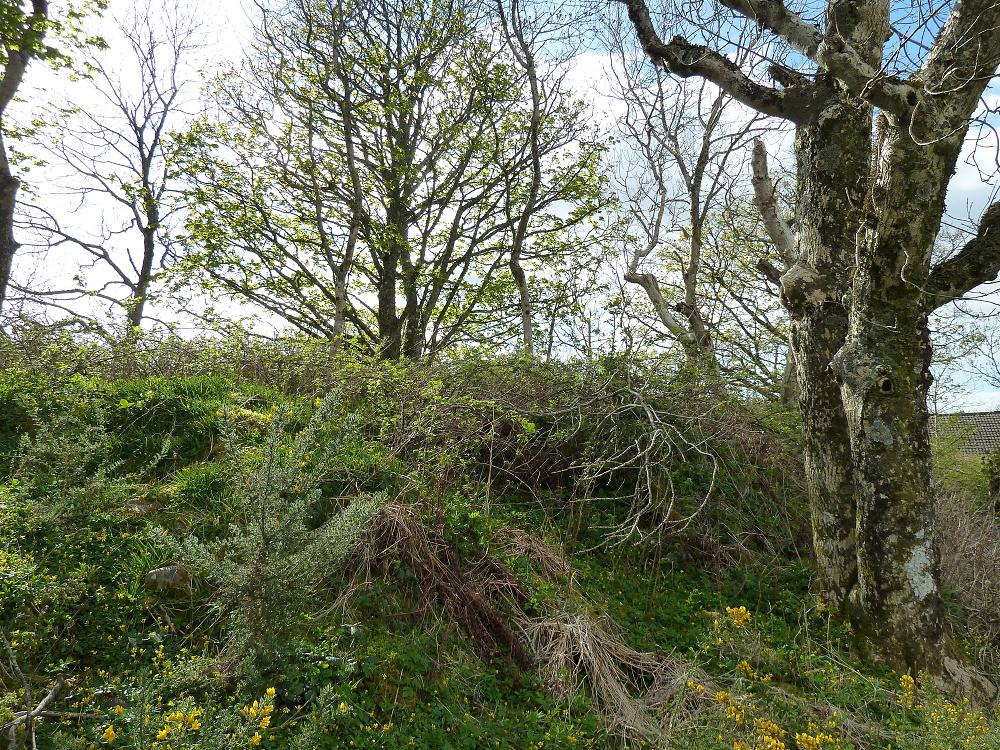
Well, here's something you don't see every day... the skeleton of a water-horse! Whilst visiting Skye I bought Geoff Holder's very interesting book 'The guide to Mysterious Skye and Lochalsh', and a photo on page 60 caught my eye, a mossy overgrown skeleton, accompanied by a nearby photo of a plaque reading: 
'Each Uidge Earballach, Hydro Equus Extendus, Long-tailed Water Horse. This is the only known example of this rare beast - a distant relative of the better known Monstra Nessium Hydro E.E.is usually sighted only twice a year when it swims inshore to browse on whelks. This specimen was stranded at an exceptionally low tide in 1967.' 

The author kindly tells the reader where they can find this delightful beast, in the garden of 'An Acarsaid' on the shore at Ord. He gives details of access to the garden with opening times and how visitors can give donations to charity, but when I visited I couldn't spot the charity box unfortunately, or the sign. I think perhaps no one is currently maintaining the garden? Though it does appear to still be open to the public via the little gate opposite the beach.


 Sources & Further Information
The guide to Mysterious Skye and Lochalsh, Geoff Holder

The Fairy Flag of Dunvegan Castle, Skye

 
This is a story that I've been putting off writing about for fear that I cannot do it justice. It's a beautiful story, with romance and tragedy, but it's such a varied and traditional story that I'm simply not sure where to start. The more I researched it, the more variations I came across, and the longer and longer my notes became. Hopefully these notes will make sense and form some sort of order as I write them!

What is the Fairy Flag?
For those unfamiliar with this curious relic, the Fairy Flag is a piece of ancient looking fabric, that some say originally belonged to the fairies. Norman MacLeod in 1799 described it has consisting of "a piece of very rich silk, with crosses wrought on it with gold thread, and several elf spots stitched with great care on different parts of it." The crosses are no longer visible but the elf spots remain.

The flag is currently on display at Dunvegan Castle and truly worth a visit as such wondrous fairy relics are few and far between. The Dunvegan Castle website tells that the flag is thought to have been dyed yellow and is made of silk from the Middle East, and has been dated between the 4th and 7th centuries AD. An image of the flag can be seen here on the castle website. 

Stories of the Fairy Flag
An early version of the tale can be found in 'A tour in Scotland and voyage to the Hebrides' by Thomas Pennant (1772):
"Here is preserved the Braolauch shi, or fairy-flag of the family, bestowed on it by Titania the Ben-Shi, or wife to Oberon king of the fairies. She blessed it at the same time with powers of the first importance, which were to be exerted on only three occasions: but on the last, after the end was obtained, an invisible Being is to arrive and carry off standard and standard-bearer, never more to be seen. A family of Clan y Faitter had this dangerous office, and held by it, free lands in Bracadale. The flag has been produced thrice. the first time in an unequal engagement against the Clan-Roland, to whose fight the Macleods were multiplied ten-fold. The second preserved the heir of the family, being then produced to save the longings of the lady:  and the third time, to save my own; but it was so tattered, that Titania did not seen to think it worth sending for."
Notes of the Relics preserved in Dunvegan Castle, F Macleod
'Notes on the Relics preserved in Dunvegan Castle, F Macleod (1915?) includes two tales told to the author by Rev RC Macleod that he heard in his boyhood of how the Flag came into the possession of his forefathers.
"The first relates that an early Chief espoused a fairy, whose married life was limited to a period of twenty years. Summonsed to leave him at a spot about three miles from Dunvegan, which now bears the name "Fairy Bridge," she flew away, dropping in her flight a portion of her silken attire - the Fairy flag - which was found and preserved by the Chief."
"The other relates that on the occasion of the birth of an heir to a former Chief great rejoicings were held in Dunvegan Castle; that, as the child was slumbering peacefully, the nurse, who was anxious to join in the festivities, slipped away and left the infant alone. Being restless, the clothes in which the infant had been wrapped fell off, and he lay exposed to the cold. The fairies watched over the sleeping babe, and wrapped his body in the flag. Meanwhile the clansmen had been clamouring to see the young heir, and the nurse, returning, found him thus clothed, and brought him into the hall. As she entered, an invisible choir was heard singing the magic powers of the Flag."

Image: The Fairy Bridge, near Dunvegan
This book goes on to tell more stories of the Flag, including a version given in a manuscript history of the MacLeods written around 1800 that tells of the importance of the flag bearers and how it was once stolen. This version tells of a She-Devil rather than a Fairy:
"The legend of its origin is that a MacLeod who had gone on a Crusade to the Holy Land when returning home in the garb of a pilgrim was benighted on the borders of Palestine in a wild and dangerous mountain pass, where by chance he met a hermit who gave him food and shelter. The hermit told him that an evil spirit guarded the pass and never failed to destroy the true believer; but by the aid of a piece of the true Cross and certain other directions given by the hermit this MacLeod vanquished and slew the 'She Devil' called Nein a Phaipen, or Daughter of Thunder, around whose loins this banner had been tied; and that in reward for conveying certain secrets which she wished some earthly friends to know she revealed the future destinies of the Claim to her conqueror, in whose family this knowledge was supported to be deposited to its final extinction, and desired that her girdle should be converted into this banner, which was to be attached to her spear, which became the staff which is now lost. The secrets were never known and are likely to remain unknown forever, although many editions have been recited."

The Macleods of Dunvegan, Rev RC Macleod
Rev RC Macleod in 'The Macleods of Dunvegan' (1927) narrows the Fairy Flag story down to three versions. Version 1 tells of the 20 year romance with the fairy, and the author writes that we owe this tradition and the lullaby that the fairy sings to the infant, to "Mr Neil MacLeod, the clan bard in the latter half of the nineteenth century. He obtained the version given below from several old women in the MacLeod country, and published it in the Gael in October 1878."
"According to the tradition, on a fine evening in autumn a beautiful fairy paid a visit to Dunvegan Castle. Without any difficulty she passed through several closed doors, and made her way to the nursery where the infant heir of the Chief was lying in his cradle. With him was his nurse, but if she had wished to oppose the fairy's entrance, she would have been powerless to do so, for some potent spell made it impossible for her to move. 
Taking no notice of the nurse, the fairy went straight to the cradle, took the child on her knee, and sang to him the famous lullaby. Both the words and the tune were so remarkable that they impressed themselves on the nurse's memory, and from that time forward she habitually lulled the child to sleep by singing to him the fairy's lullaby. 
As time went on it came to be believed that any infant of the Chief's family over whom this lullaby was sung would be protected by the fairies in any dangers which might assail him during his life and, for a long time, no nurse was engaged to take charge of the Chief's children who could not sing the lullaby to them."
The author's friend Miss Tolmie, gave him this version of the fairy's lullaby in English rather than the traditional Gaelic:

Behold my child, limbed liked the roe or fawn,
Smiting the horses,
Seizing the accoutrements of the shod horses,
Of the spirited steeds,
Behold my child.

Oh, that I could see thy cattle folds,
High up upon the mountain side,
A green shaggy jacket about thy white shoulders,
And a linen shirt,
My little child.

Oh, that I could behold thy team of horses,
Men following them,
Serving women returning home.
And the Catanaich sowing the corn.


Oh, tender hero, whom my womb did bring forth,
Who didst swallow from my breast, who on my knee wast

reared.

My child it is, my armful of yew [bow and arrows],Merry and plump, my bullrush, my flesh and eggs, that will
soon be speaking.

Last year thou wast beneath my girdle,
Plant of fertility, and this year fair and playful on my
shoulder, thou wilt be going round the homestead,
My little child.

Oh, let me not hear of thy being wounded.
Grey do thou become duly ;
May thy nose grow sharp [with advancing years],
Ere the close of thy day.

Oh, not of Clan Kenneth [MacKenzie],
Oh, not of Clan Conn [MacDonald],
Descendant of a race more esteemed.
That of the Clan Leod of swords and armour,
Whose father's native land was Scandinavia [Lochlann.]


According to version 2 of Roderick Macleod's version the flag is of Eastern origin. A Macleod joined a crusading army in the Holy Land and was sent on a mission requiring a lengthy and lonely ride through the desert. After narrowly escaping the clutches of a wicked old witch, which is a whole different tale, he came to a river and proceeded to cross it by a ford. Suddenly a fairy maiden rose from the water, blocking his passage. After a "severe struggle he overcame her, and made good his passage over the river. After this he made friends with the maiden, and before they parted, she gave him a box of scented wood. In this, she told him, were several smaller boxes, each of which exactly fitted the one outside it. In the inmost box was a magic banner, the waving of which would bring forth a host of armed men to help its owner. ' Take it home with you,' the fairy said, ' and wave the banner in danger's hour but in any case do not dare to open the box for a year and a day. If you do, for another year and a day no crops will grow in your land, no sheep or cattle will produce their young, no children will be born." He took it home and presented it to the Chief's wife and told her the warning but her curiosity got the better of her and she opened the box. The events foretold by the fairy followed, but the chief was impressed by it's power and preserved it to be used when he would need it most.

Version 3 is the same version I have already told above, where a fairy lady wraps the heir to a former Chief in the fairy flag after the nurse sneaks off to join in the festivities. The author also relates information from the Bannatyne Manuscript, including the circumstances of when the flag has been used, these events also vary greatly from text to text.

Skye: The Island & It's Legends, Swire
In Swire's 'Skye: The Island & It's Legends' (1961) the author relates the story of the fairy lover,  she names the Macleod who married the fairy as Ian the forth Chief or his father Malcolm, and says that marrying a fairy was not an unusual practice at this time. In this version of the tale she is called back to her own people after giving birth to a son. Her husband accompanied her as far as he could, and at the Fairy Bridge they said their final goodbyes. The story then turns to the story of a heir being born, only in this version it is the fairy wife's child with the chief. During the celebrations when the nurse sneaks away, the baby cries as he wakes cold and miserable after his covers have fallen away. His mother, the fairy, hears his cries and covers him with the fairy flag and sings him a lullaby to comfort him. The nurse hears the singing and returns to the room and takes the baby to the banqueting hall, where fairy voices were heard singing about the powers of the flag and how it can be used only 3 times. The baby's nurse ever after sang the lullaby to him and told her descendants that although she never forgot a note, she found the words hard to remember, and whenever she hesitated or stopped she was helped by "voices all about her taking up the song." she also sang the lullaby to her own baby  and she believed he was also guarded and protected by the fairies as he never suffered any accidents. The author then gives Miss Tolmie's version of the lullaby, and a version by a Kenneth Macleod:

Sleep my little child,
Hero, tenderling,
Dream, my little child
Hero, fawn-like one,
high on mountain brows
Be thy stag tryst
Speed thy yew arrow straight antlerwards

Sleep my little child,
Hero, gentle-bred,
Dream, my little child
Hero, battle-bred.
skin like falling snow
Green thy mail coat
Live thy steeds, dauntless thy following

I think this is my own favourite version of the tale. It's certainly the most romantic and heartwarming. The author then gives detail of the times the flag is said to have been waved, and gives suggestion that it could be the magic banner "Landoda, the Land Ravisher, which when waved brought certain victory. It belonged to Harald Haardrada of Norway who saw service in the East including Jerusalem and returned with the flag banner." He is said to have brought it into battle whilst fighting in England but it was too late to save him, and what happened to the banner is unknown.

A Summer in Skye, Alexander Smith
In Alexander Smith's 'A Summer in Skye' (1865), a man named Malcolm tells that author that that the fairy Flag is "kept in a glass case, and never shown to strangers, at least when the family is from home." The author asks him how the Macleods came into possession of the flag and he replies "Well the old people say that one of the Macleods fell in love with a fairy, and used to meet her on the green hill out there. Macleod promised to marry her; and one night the fairy gave him a green flag, telling him that, when he or one of his rae was in distress, the flag was to be waved, and relief would be certain. Three times the flag was to be waved; but after the third time it might be thrown into the fire, for the power would have gone all out of it. I don't know, indeed, how it was, but Macleod deserted the fairy and married a woman." This version of the tale ends in tragedy, the fairy woman heard of the marriage and was in a great rage. "She cast a spell over Macleod's country and all the women brought forth dead sons, and all the cows brought forth dead calves. Macleod was in great tribulation. He would soon have no young men to fight his battles, and his tenants would soon have no milk or cheese wherewith to pay their rends. the cry of his people came to him as he cat in his castle, and he waved the flag, and next day over the country there were living sons and living calves. Another time, in the front of a battle, he was sorely pressed, and nigh being beaten, but we waved the flag again, and got the victory, and a great slaying of his enemies." He tells that it has not been waved a third time yet, not even during the potato failure when people were starving.
 
Superstitions of the Highlands and Islands, Campbell
In this book, written in 1900, the author briefly mentions the banner, calling it the Bratach Shith MhicLeoid, and tells of it's powers. He also mentions that "Every pregnant woman who sees it is taken in premature labour (a misfortune which happened, it is said, to the English wife of a former chief in consequence of her irrepressible curiosity to see the banner), and every cow casts her calf."

This brings me to the end of my research at present. I apologise for not going into further details of the times the flag has been used, but those are also as varied as the story itself! Whilst visiting Skye I couldn't resist paying a visit to Dunvegan Castle and the Fairy Bridge.


Primroses, picking them is said to call the fairies....
 
Dunvegan Castle & it's gardens....


Sources & Information
The Dunvegan Castle Website
A Tour in Scotland and Voyage to the Hebrides, Pennant
Notes of the Relics preserved in Dunvegan Castle, F Macleod
The Macleods of Dunvegan, Rev RC Macleod
Skye: The Island & It's Legends, Swire
A Summer in Skye, Alexander Smith
Superstitions of the Highlands and Islands, Campbell


Port Henderson Mermaid


If anyone is still out there, hello :) I know it's been rather a long while since I last updated my blog, I've got a mountain of stories to tell, but unfortunately I keep letting work get in the way and the stories are patiently queueing in my head (and in my big stack of notebooks) just waiting to be typed out! It's been a quiet winter with little in the way of adventuring but finally having a paid job again has certainly allowed me to expand my bookshelves! Thank you AbeBooks.

I'm going to start by catching up with the rest of my adventures in Skye, Applecross, and North Wales from last year. We start far north of Applecross on the West coast of Scotland in a little fishing village by the name of Port Henderson. John Dixon, Gairloch in North-West Ross-Shire (1886) tells the story best:
"Here is a story of a mermaid; they say it is quite true:- Roderick Mackenzie, the elderly and much respected boatbuilder at Port Henderson, when a young man, went one day to a rocky part of the shore there. Whilst gathering bait he suddenly spied a mermaid asleep among the rocks. Rorie "went for" that mermaid, and succeeded in seizing her by the hair. The poor creature, in great embarrassment, cried out that if Rorie would let go she would grant him whatever boon he might ask. He requested a pledge that no one should ever be drowned from any boat he might build. On his releasing her, the mermaid promised that this should be so. The promise has been kept throughout Rorie's long business career; his boats still defy the stormy winds and waves. I am the happy possessor of an admirable example of Rorie's craft. The most ingenious framers of trade advertisements might well take a hint from this veracious anecdote."
So my map-reading man and I took the long picturesque drive up the coast to Port Henderson. The view from the top of the nearby cliff was breathtaking, with enough nooks and crannys in the rocks to give a mermaid plenty of privacy whilst combing her flowing locks.

We didn't spot any mermaids, however after just looking back through my photos today I have noticed a curious shape in the water near the rocks. Most likely a bird diving into the water, or could it be a mermaids tail? Close up below followed by original photo....

Here are some more beautiful photos taken on the cliffs.... 
 

 Cormorants on the rocks...

Sources and Further Information
Garloch in North-West Ross-Shire, John Dixon
Copy of above book on Electric Scotland Website
Port Henderson Mermaid, Mysterious Britain
Port Henderson on Street map
Port Henderson, Historical Monuments of Scotland Website


Thursday, 13 September 2012

The Fairy Women of Llyn Barfog, North Wales


I've been a very lucky lady and have spent a sunny week in beautiful North Wales in search of the Tylwyth Teg, the Fair Family of Wales. This first entry concentrates on a beautiful secluded loch known locally as Llyn Barfog. John Pughe in an article in Archaeologia Cambrensis Vol IV (1853) describes the Llyn as "one of the many communications between this outward world of ours and the inner one of Annwn - the unknown world - the dominion of Gwyn ap Nudd, the mythic king of the fabled realm, peopled by those children of mystery, Plant Annwn.

Pughe paints a beautiful picture of the magic of the Llyn, relating information passed to him by Thomas Abergraes, a "shrewd old hill farmer" well skilled in local folklore. He told the author:
"In years gone by, though when, exactly, he was too young to remember, those dames [Gwragedd Annwn - fairy women of lakes] were wont to make their appearance, arrayed in green, in the neighbourhood of Llyn Barfog, chiefly at eventide, accompanied by their kine and hounds, and that on quiet summer nights in particular, these ban-hounds were often to be heard in full cry pursuing their prey - the souls of doomed men dying without baptism and penance - along the upland township of Cefnrhosucha. Many a farmer had a sight of their comely milk-white kine ; many a swain had his soul turned to romance and poesy by a sudden vision of themselves in the guise of damsels arrayed in green, and radiant in beauty and erace; and many a sportsman had his path crossed by their white hounds of super-natural fleetness and comeliness, the Cwn Annwn; but never had any one been favoured with more than a passing view of either, till an old farmer residing at Dyssymant, in the adjoining valley of Dyffryn Owyn, became at last the lucky captor of one of their milk-white kine."
"The acquaintance which the Gwartheg y Llyn, the kine of the lake, had formed with the farmer's cattle, like the loves of the angels for the daughters of men, became the means of capture; and the farmer was thereby enabled to add the mystic cow to his own herd, an event in all cases believed to be most conducive to the worldly prosperity of him who should make so fortunate an acquisition. Never was there such a cow, never such calves, never such milk and butter, or cheese, and the fame of the Fuwch Gyfeillion, the stray cow, was soon spread abroad through that central part of Wales known as the district of Rhwng yddwy Afon"
But alas his wealth had gone to his head and he soon forgot the importance of his elfin Cow, and fearing that she was now becoming too old to be of profit to him, he fattened her up to send to the butcher. A beautiful fat beast she became and at last the day of slaughter came and neighbours crowded from miles around to witness the slaughter of such a magnificent beast. The butcher bared his arms and raised the knife, but before he could harm the beast his arm became paralysed and the knife dropped from his hand and fell harmlessly to the floor.
"The whole company was electrified by a piercing cry that awakened echo in a dozen hills, and made the welkin ring again; and lo and behold! the whole assemblage saw a female figure clad in green, with uplifted arms, standing on one of the craigs overhanging Llyn Barfog, and heard her calling with a voice loud as thunder:-
"Dere di velen Einion,
Cym Cvveiliorn - braith y Llyn,
A'r voel Dodin,
Codwch, dewch adre"
"Come yellow Anvil, stray horns.
Speckled one of the lake,
and of the hornless Dodin,
Arise, come home."
"And no sooner were these words of power uttered than the original lake cow, and all her progeny to the third and fourth generations, were in full flight towards the heights of Llyn Barfog, as if pursued by the evil one. Self-interest quickly roused the farmer, who followed in pursuit, till breathless and panting he gained an eminence overlooking the lake, but with no better success than to behold the green attired dame leisurely descending mid-lake, accompanied by the fugitive cows and their calves formed in a circle around her, they tossing their tails, she waving her hands in a scorn as much to say, "You may catch us, my friend, if you can," as they disappeared beneath the dark waters of the lake, leaving only the yellow water lily to mark the spot where they vanished and to perpetuate the memory of this strange event."
The author tells that the greedy farmer soon became impoverish, and few felt pity for such a greedy man who so quickly forgot the wonderful and magical favour he had once recieved from the fairies.

Pughe also tells of further legends of the Llyn, including the Arthurian legend of the Afanc y Llyn, which some believe to have taken place here at Llyn Barfog. There is said to be a rock here that bears the hoof print of Arthur's horse as it dragged the beast from the Llyn. More on this story and directions on finding the Llyn can be found on the Glyn-yr-Aur Website. It is also said to be unlucky and perilous to "let the waters out of the lake".

So off we (My partner and I and a waterproof OS map!) wandered to find this beautiful and mystical Llyn, tucked away and hidden from the world. Unfortunately the weather wasn't in our favour and we got half way up the hill when the skies opened up and poured what felt like the entire contents of the Llyn on our heads! I managed to sneak a few photos between showers though, and although I didn't spot any fairy cattle there were no shortage of sheep at the edges of the Llyn, so perhaps the fairies are keeping sheep these days instead! :)
 
 Sources and Further Information
Gwragedd Annwn, Archaeologia Cambrensis Vol IV, John Pughe
British Goblins, Wirt Sikes
Celtic Folklore: Welsh and Manx , John Rhys
Glyn Yr Aur Website, Llyn Barfog
Mysterious Britain Website, Llyn Barfog

Wednesday, 18 July 2012

Broadford Fairy Knoll, Isle of Skye

Beauty can sometimes be found in the most unexpected of places, and the same can definitely be said of fairy sites. Within a couple of minutes walk of the busy town centre of Broadford can be found a grassy and magical little knoll, covered in delicate wild flowers and wildly knotted blackberry vines. Beneath the knoll hides a deeper secret, that of the ancient dead. 'The Gentleman's Magazine' of 1841 gives further details of this fascinating site...
"The discovery [of chambers inside] was made by a poor girl, who related the circumstance to me as follows. One day, when she was sitting on the Cairn, some of the earth near her suddenly gave way, and fell in; presently a large stone followed, -- revealing, to her great surprise and alarm, a dark hole, and showing that the Cairn whereon she had been sitting was hollow. She ran and communicated her discovery to some men; who first threw some stones into the cavern, and then descended."
(Drawing from The Gentleman's Magazine of 1841)

Descriptions of what they found inside the tomb seem to vary but most seem to agree that human bones were found, together with the remains of a stone coffin. According to the young girl she also saw an amber bead, and the sign near the cairn mentions a green stone archer's wristguard but the Gentlemen's magazine seems to suggest that this was found at another cairn.

No mention of fairies was made in this article, but MacCulloch does mention in 'the Misty Isle of Skye' (1905) that several places in Skye are noted as haunts of the fairy folk, including "a fairy knowe close by the Inn at Broadford." Swire also mentions the fairies in 'Skye: The Island and It's Legend' (1961) and writes that "fairy music used often to be heard in Broadford, on the fairy knoll near the hotel. On the little promontory where Sutherland's garage now stands, fairies could be seen dancing. Whether they still do so, in and out of the petrol pumps, is not known."

Whether all sources are speaking of the same grassy knoll I'm not entirely sure, but the Liveras chambered tomb has an undeniable atmosphere of mystery about it. Although the knoll is relatively small, the dense vegetation and clambering blackberry vines make exploration very difficult, and no matter which direction you approach from and which path you try to follow, you never seem to find yourself any further up the hill! I hope the photos below manage to capture the wonder of this beautiful place...

Sources & Further Information
The Misty Isle of Skye, MacCulloch
The Gentleman's Magazine, 1832
Skye: The Island and It's Legend, Swire
The Modern Antiquarian, Liveras Chambered Tomb

Tuesday, 17 July 2012

Loch nan Dubhrachan Water Horse, Isle of Skye


Now for something a little more chilling. In modern times Kelpies and Water Horses are often portrayed as beautiful and kindly creatures, but in days long past their reputation was not so pleasant. These creatures were greatly feared and their sightings brought terror and horror to local people, who would hide their children indoors lest the Kelpies took them away forever. They had the powers to rise from the water in human form, and some would seize their prey and drag them beneath the waves, and others would prey in human form and drink the blood of their victim. Some disguised themselves as old women and would knock on the door of a lonesome bothy, pleading for shelter from the cold. If a young maiden was foolish enough to let the old woman in it is unlikely she would ever wake the following morning. Some Kelpies would disguise themselves as a handsome young man, so young maidens were warned to never go near a man with seaweed or shells in his hair, lest he drag them to their doom.

Loch nan Dubhrachan is a dark and brooding loch close to the road side between Isle Ornsay and Knock on the Isle of Skye, and was once said to be tenanted by a water-horse. According to MacCulloch's 'The Misty Isle of Skye' (1905) the water-horse had a perchant for pretty girls, but they did not like his attentions. This creature caused so much fear that in 1870 it is said that an attempt was made to catch the beast and end it's reign of terror. An account of the hunt was published by Alasdair MacGregor in 'Somewhere in Scotland' (1935). The entire account can be found here on the Comann nan Each-uisge Website. Another account can be found in MEM Donaldson's "Wanderings in the Western Highlands and Islands (1920), and can also be found on the Comann nan Each-uisge Website. Swire gives name to the beast in "Skye: The Island and it's Legend" (1961), refering to it as the 'Beast of the Little Horn'.

According to folklore great provisions were made for this hunting of the Waterhorse, with children being freed from school for the day, and people coming from far and wide to join in with the hunt. According to Donaldson's account vast quantities of alcohol were consumed too, which could explain a lot! He tells that two boats were brought along and a net was stretched between them to be dragged along the loch, but the net caught in a snag and "the majority of the spectators, thinking that the water-horse was indeed enmeshed, in terror rushed for their houses and carts or fled precipitately from the scene. Beside the snag, all that was caught on this occassion was two pike, so that the fisherman who aspires to a catch out of the common still has chance of the water-horse."

MacGregor's account published in 1935 comes from a man named John MacRae, who as a boy witnessed the hunt for the water-horse. He tells that the hunt began after a cattleman and his wife observed a small, black object on the shore of the loch. At first the cattleman thought it to be one of a farmer's cows that had drowned and washed ashore but as he neared the beast it "swam out with his head below water, putting little waves ashore." MacRae tells how the people were terrified and believed it to be the 'each-uisge' so Lord MacDonald said he would dredge the loch, and hence the hunt began.

After a short scramble through overgrown bushes I came across the loch, a dark and forboding place. The water appears dark and brooding, and the undergrowth is brittle and skeletal. No flowers bloomed or birds sung, this is not a welcoming place. We didn't stay long.


Sources & Further Information
Skye: The Island and it's Legend, Swire
Somewhere in Scotland, Alasdair MacGregor
The Misty Isle of Skye, MacCulloch
Wanderings in the Western Highlands and Islands, Donaldson
Comann nan Each-uisge

An Sithean, Isle of Skye


I apologise for the very long delay in putting any new blog entries up, I haven't stopped my adventuring, I just found a new job so the adventuring has been a little less often and nearer to home lately. I did however make it across to the Scottish West coast in April to celebrate my 30th Birthday, and visited many fairy sites over that lovely sunny week, so i'll try and update my blog with those photos over the coming weeks and maybe we can try and convince the sun to come back out again :)

I'll begin with a lovely green grassy knoll on Skye known as Aant Sithe or An Sithean. According to Swine's "Skye: The Island and it's Legends' (1961): "This, as it's name implies, is a fairy place. On clear moonlight nights the fairies can be seen dancing on the grass that surrounds the central stone and anyone approaching quietly and with a receptive mind may hear the wonderful strains of fairy music issuing from the ground. What the mound was before it was a fairy dwelling is something of a mystery. In the centre of the summit stands a large stone, perhaps once a 'standing-stone' but not closely resembling a broken tooth. Round it is a ring of grass, and then a ring of stone much overgrown."

There are a great many magical places on Skye, but there are few more magical and mysterious than here. The scattering of grey rocks and boulders appear random, but have the definite feeling of a purpose about them, though long forgotten apart from on the OS map where it is marked as a 'chambered cairn'. I listened very carefully and peeked beneath the rocks but unfortunately didn't manage to catch a glimpse of fae, or hear any whispered notes of fairy songs. As I left a hooded crow took perch upon the central stone, a fitting guardian indeed for such a magical place.


An Sithean is easy to find, sitting just off the B8083 heading out from Broadford. The chambered cairn remains sit at the base of the hill marked on the OS map as 'An Sidhean', with the top of the hill being set much further back from the road. However from Swine's description it seems that the rocky part with the standing stone was once thought to be the fairy hill itself, so i'm not entirely sure which part the fairies are said to live in. The photos above cover the cairn hill itself and the surrounding stones and area.

Sources and Further Information
Skye: The Island and it's Legends, Swine (1961)
The Modern Antiquarian, An Sithean