Showing posts with label Fairy. Show all posts

Friday, 30 July 2021

Fairies of the Whitby Area

Bridge at Beck Meetings

After a year and a half of hiding in the house avoiding Covid, and not reading nearly as many books as I had intended to, I've had my covid vaccines and the world is finally starting to feel like a safer place again. Last week I ventured out to the Whitby area on a careful and cautious socially distanced holiday that involved a lot of early morning wanderings before the car parks filled up, and a lot of Yorkshire banoffee ice cream in Runswick Bay! 

This post will focus on fairy sites and sightings of the Whitby area, for lack of a better geographical description! Some sites are further north and south along the coast, and others further inland, but all are within reasonable proximity to Whitby. There are many more sites further west into the North York Moors and beyond but I will save those for a future visit and blog post!    

Thanks to Percy Shaw Jeffrey's Whitby Lore and Legend (1923) we know that fairies were sighted in the Whitby area as far back as 1650. Jeffrey was assisted in his research by folklorist Major Fairfax-Blakeborough, who gave him access to his father's research and his great-great-grandfather's diary, as mentioned below. He writes, "There is a very circumstantial and interesting account of some Whitby fairies in Major Fairfax-Blakeborough's old diary under the date ye 7, 1650, as follows:- 

"Very earlie in ye morning Ralph Blackburn, George Pickersgill, Anthony Thompson and Mary his wife, having to goe to Whitby when they came nigh unto Anthony Barker's small close they one and all espied many fairies disporting themselves righte merrilie in their splightlie midnight revels. They watched yem for some time, until one dancing a little space from ye ringe discovered yem when, giving a signal, they departed on the instant, and not one of them kennd wither. Alle ye witnesses are of good report. Thys pleaseth ye Townsfolk mightly, none been seen syn Dan Outhwaite war murdered eight year cum next Candlemas.

Ye fairies were oft seen after thys, even by mysen as late as a week ago, T.R. (Thomas Rogers, who transcribed the notes from the original MS in 1695)."

A note has been added to this: "Me Thos. Dodd seed Fairies in our close mony a time at Beck Meetings. T.D." 

Beck Meetings

 Jeffrey notes that Beck Meetings is a small village near Staithes, and elsewhere in the book writes "even so late as 1870, when any Staithes fishing coble was driven into Whitby by stress of weather, the thirteen members of the crew would walk home to Staithes through the dark winter evenings hand in hand, in order to give them other confidence against the various terrors that fly by night." Gutch's Folklore of Yorkshire (1901) also mentions Staithes folk and tells that "fearless as are the fishers in their daily juggling with the dangers of the sea, yet so fearful are they of nameless spirits and bogies, that I am assured I should be unable to find a volunteer who for a couple of sovereigns would walk by night to a neighbouring village of Hinderwell, a couple of miles distant." Folks certainly seemed to be scared of something lurking in the nearby area after dark.

Staithes


The Hob-Hole Hob of Runswick Bay

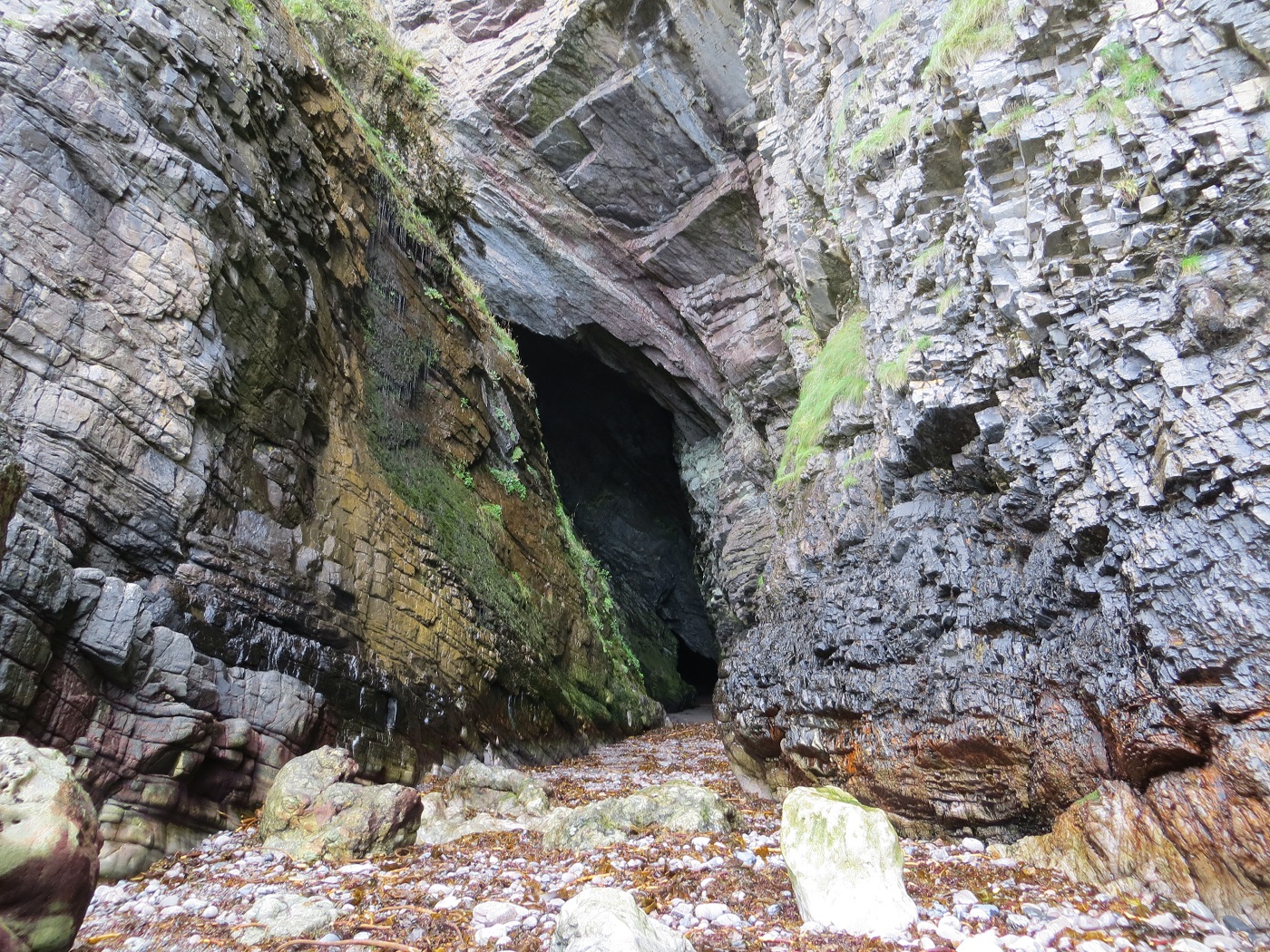
In Runswick Bay are a series of arched caves and holes reaching deep into the cliffs along the shoreline. The most famous of these was known as Hob-Hole, and according to Young's A History of Whitby volume 2 (1817) it was 70 feet long and 20 feet wide at the entrance, with a double pillar that has since disappeared. Leyland's Yorkshire Coast and the Cleveland Hills (1892) tells that the caves were excavated by the action of the sea, but the jet-diggers have now destroyed the "cavernous features of the haunt of the Hob, whereto he was want to beguile the unwary that there they might be destroyed by the incoming sea." Most sources describe the Hob as a benevolent character, and according to Young "his powers were exercised in curing young children of the hooping-cough. When any child in Runswick or the vicinity was under that disease, one of its parents carried it into the cave, and with loud voice thus invoked the demi-god of the place: 

"Hob-hole Hob! My bairn's got kink-cough:

Take't off; take't off!"

 Illustration of Hob-Hole from Young's A History of Whitby vol  2 (1817)

The caves as they stand today are still extremely dangerous and should not be entered as the rocks are unstable and can fall down at any time, you can safely view them from a distance at low tide though.


Claymore Well Fairies

At Claymore Well near Kettleness, according to Young's A History of Whitby vol 2 (1817) "the fairies in days of yore were wont to wash their clothes, and to bleach and beat them; and, on their washing nights, the strokes of the battle-door were heard as far as Runswick!". Atkinson's Forty Years a Moorland Parish (1891) explains that the Battledore was an old-fashioned implement used to smooth newly washed linen, now replaced with the mangle! 


The Black Dog of Kettleness

Although possibly not one of the fairy folk, I feel a quick mention should be made of the curious exorcism of the black dog of Kettleness. Yorkshire boggles and boggarts were known for their shape shifting and could appear in many forms including cats and dogs. 

The Reverend Dr Donald Omand recieved a letter in the 50s from a schoolmaster who claimed that himself and two friends had experienced a wave of terror when looking over the shore at Kettleness and had seen a huge hound, "so large it could not be mortal", that appeared from thin air and disappeared as silently as it had appeared. They were left with a strong sense of evil and believed an exorcism should be performed. Omand agreed to their request and as they set off at night to the shore at Kettleness they saw "what looked like a huge black hound, but bigger than any member of the canine species, known to man. It was moving straight in our direction". The schoolmaster fled back to the car and Omand performed an exorcism, splashing holy water in the dog's direction, and it disappeared. A more in depth account and further information can be found on Simon J. Sherwood and Wendy E. Cousins paper, The Black Dog of Whitby and Kettleness

In a curious twist to the story, at nearby Goldsborough once stood a Roman signal station and when excavated it was found to contain the skeletons of 2 men and a large dog who had met with a violent end. Some say the dog's jaws were clamped around the neck of one of the men. Further details can be found in the Yorkshire Journal issue 3 Autumn 2014. 

Kettle Ness, as viewed from the cliffs above


Mulgrave Woods, Sandsend

Young's History of Whitby vol 2 (1817) tells that a mischievous fairy named Jeanie of Biggersdale lives in the woods "at a place so called at the head of Mulgrave woods". Presumably this is referring to Biggersdale Hole Waterfall, marked on present day ordinance survey maps. 

"A bold young farmer, perhaps under the influence of John Barleycorn, undertook one night, on a wager, to approach the habitation of the sprite, and call to her: but his rashness nearly cost him his life; Jeanie angrily replied that she was coming, and while he was escaping across the running stream, he fared worse than Burn's Tam O'Shanter, when pursued by Nanny the witch; for Jeanie overtaking him just as his horse was half across, cut it into two parts, though fortunately he was on the half that had got beyond the stream!"

Atkinson's Glossary of the Cleveland Dialect (1868) tells that a hobthrush lives in the woods in a certain cave, and that when addressed replies:

"Hob-trush Hob! where is thou?

Ah's tying on mah left-fuit shoe;

An' Ah'll be wiv thee - Noo!" 

Katherine Simpson's Jeanie o' Biggerdale and Other Yorkshire Stories (1893) gives the same rhyme but with the first line being "Biggersdale Jeanie! where is thoo?", in this book Jeanie is described as "the wicked sprite, or bogle, that haunted the mill and glen. Was it not well known that her mocking laugh was never heard but as the forerunner, or accompaniment, of accident or calamity". She was said to bring misfortune on those who inhabited Biggersdale Mill, and resented it being constructed. 

I do wonder how much is fiction or whether many many years ago a woman named Jeanie lived in these woods. Or perhaps she is a nursery bogie character, and children dared each other to call to her inside the cave and then run away before she could catch them? I would love to hear from any locals who have their own stories to share.


The Sandsend Bogey

The infamous Sandsend Bogey, according to Jeffrey's Whitby Lore and Legend (1923), was supposed to live in a cupboard in Mr Snowden's Cottage, and "it used to accompany the fishing boats when they put out to sea, sitting quietly in the bows, and its presence was welcomed by the fishermen as it foreboded a good catch. But after a while, it became more enterprising and, as it took to frightening the village children, the inhabitants of Sandsend petitioned the priest of Lythe, who came to their rescue and exorcised the Bogey with bell, book, and candle, so that thereafter it appeared no more."


The Fairies of Pannett's Park, Whitby

Johnson's Seeing Fairies (2014) includes a Whitby fairy sighting from July 1956 in Pannett's Park. "We were peacefully on a seat after an enjoyable but rather strenous walk when I noticed some considerable movement in a tree that grew at the foot of a wooded slope facing us. It was swarming with elves, and when I drew my sister's attention to it, she could see them too, but neither of us had any idea what they were doing so busily." She describes the elves as brown, and they seemed to be moving quite easily above, below, and between the branches.

Old postcard of Pannett Park


Roxby and Mickleby Fairy Mounds

In the Roxby and Mickleby areas the fairies were said to live in houes, or grave mounds, but the mounds had been dug into and ploughed over so "the former denziens had clearly been evicted and forced to retire", tells Forty Years in a Moorland Parish, Atkinson (1891). 


Fairy Cross Plains

The Reverend John Atkinson was a keen writer and collector of local Yorkshire folklore and customs, and he collected some wonderful tales of the fairies. In his Forty Years in a Moorland Parish book (1891) he tells of visiting an elderly parishioner and her husband who tells him of the fairies of nearby Fairy Cross Plains, she said they used to come down the hill by her door and go into a large culvert which conveyed the water of a small beck underneath the road about a stone's throw from the cottage. "A further question elicited the reply that it was a little green man, with a queer sort of a cap on him, that had been seen in the act of disappearing in this culvert." She said they lived under the ground, "why t'mouldiwarps (moles) dis, an' wheea not t'fairies?". 

Reverend Atkinson also spoke to a parish clerk who told him that his childhood had been spent near the Fairy Cross Plains, and that the fairy-rings just above the inn were the largest and most regular and distinct he had ever seen. He and the other children had amused themselves by running round and round in the rings, but never nine times, "you see if we had run the full number of nine times, that would have given the fairies power over us, and they would have come and taken us away for good, to go and live where they lived." The Reverend asked if he really believed that and he replied that he did, "for the mothers used to threaten us, if we wer'n't good, that they would turn us to the door (out of doors) at night, and then the fairies would get us." 

An interesting article on the Darlington and Stockton Times website by Nicholas Rhea titled Fryup - a dale of horses and fairy rings includes more recent fairy beliefs. Rhea tells he used to play there as a child but never found any fairies, though that is where they were thought to live and "some thought the fairy rings indicated the whereabouts of an underground fairy village". He says that it was not considered sensible to dance around the circles on the Eve of May Day or at Halloween as those nights were given over to the fairies, and that it was believed that sheep and cattle would never graze near the fairy rings and that locals believed it risky to try and remove the circles.  

Fairy Cross Plains, as seen on Google Maps


The Hob of Hart Hall

Hobs are said to be a type of domestic house spirit, similar to a Brownie, and most often found in very old farm houses. Atkinson's Forty Years in a Moorland Parish (1891) tells of a Hob at Hart Hall near Glaisdale:

"Hob would come unasked, unwarned, to the rescye, and the corn would be threshed, dressed, and sacked, nobody knew how, expect that it was done by the Hob. Unaccountable strength seemed to be the chief attribute ascribed to him". When the farm workers of Hart Hall were carting hay to save it from approaching bad weather a wheel slipped and the cart became stuck. They tried to pull it loose with both horses and men but efforts were in vain and as darkness approached they had to abandon it for the night. After they had retired to bed, "Hob went forth in his mysterious might, made no difficulty about extricating the locked-in wheel, and trailing the cumbersome load up the steep, broken road to the homestead, putting the hay in beautiful order on the stack, and setting the wain ready for the leading that would of course be renewed early in the morning".

According to Atkinson's Glossary of the Cleveland Dialect (1868), he was "a farm-spirit 'of all work', thrashing, winnowing, stamping, the bigg, leading, &c. Like the rest of the tribe who ever came under mortal eye, he was without clothes - nak't - and having had a harding-smock made and placed for him, after a few moments of - it would seem, ill-pleased - inspection, he was heard to say- Gin Hob mun hae nowght but a hardin' hamp, He'll coom nae mair, nowther to berry nor stamp". Atkinson explains in his Forty Years in a Moorland Parish (1891) that stamp was the action of knocking off the awns of the barley previous to threshing it, and berry meant to thesh. Hamp was one of the English peasant's only garments, a "smockfrock-like article of raiment, gathered in somewhat about the middle, and coming some little way below the knee". 

Atkinson asked an elderly woman about the Hart Hall Hob and she gave a more detailed story, claiming that one moonlight night one of the lads of the farm had heard him working and peeked through a little hole in the boards and say "a lahtle brown man, a' covered wi' hair" working hard and striking the sheaves with the flail. The lad crept away unseen and related what he had seen to the other workers. They knew the winter nights were cold and were worried about "t' lahtle hairy man, amaist as nakt as when he wur boorn", "wiv nobbut thae au'd rags". They decided to make something to help him, and made a new outfit, as near as the boy had described him as wearing, "a sort of a coorse sark, or shirt, with a belt or girdle to confine it around his middle". They laid it in the barn before nightfall, ready for the Hob to find, and as in the previous tale he was not pleased with his new clothing!  

Hart Hall is now a Bed and Breakfast, but whether the Hob is still a guest or not I cannot say!


The Hob of Hog Garth

Another Hob dwelled at Hob Garth, south west of Glaisdale. Jeffrey's Whitby Lore and Legend (1923) includes a very early mention of the Hob from the diary borrowed from Major Fairfax-Blakeborough.

 "May ye 13, 1669. Nathan Warner of Castleton, thys daye had speech of the Hobman that hanteth ye Hob Garth from beyond whither he had been. Thys he sweare to an oath, and he is a man of good report and not given to vaine talk. Methought I once had sighte of hym mysen but not been ower certayne out (of it) I helde my peace, but after what warner declareth on oath, I hav smalle doubt that yt was hym I spied mysen, but I do not declare yt, the Lord knoweth." 

A more detailed account of the Hob's antics can be found in Richard Blakeborough's Yorkshire Wit, Character, Folklore and Customs of the North Riding of Yorkshire (1898). The author was told of the hob by an old man who worked on the Mulgrave Estate, whose grandfather Thomas Stonehouse lived at Hob Garth for many years and kept sheep. A misunderstanding arose between him and a neighbour Matthew Bland of Great Fryup. Matthew was said to have broken Thomas' hedge one night allowing the sheep to escape, and Thomas only managed to gather up five out of the forty missing before retiring to bed with a severe cold. The next morning much to his surprise he found not only the lost sheep returned to their field, but the hedge had been repaired too with new posts and rails. The next night every head of his enemy's cattle had been turned loose, but not by Thomas as he was still very ill in bed. Matthew recovered his cattle and Thomas' sheep were once again turned lose, and the neighbours did all they could to gather them again but few were found. Sure enough, the next morning all but four had been returned to the field again and further repairs had been made to the fence. The missing four were later found dead, having fallen into a disused quarry. The villagers began to talk, and they decided that it must be the hobman who was gathering up the sheep and repairing fences. "When this conclusion was come to, heads were shaken in an ominous manner, for evidently if Tommy was befriended by the hobman, Matthew would have to mind what he did."  

As soon as he had recovered, Tommy set off to see his sheep. It was late at night and a neighbour offered to drop him at the field and pick him up later when he returned. Tommy counted his sheep and cut some hay for them, and then sat by the gate waiting for his lift home....

"Presently an old man accosted him, and begged him not to fret about the lost sheep, as they would be more than compensated for when lambing time came. The old chap told him that Bland had on both occasions been guilty, but that he had not to mind. Just then his friend drove up. Tommy bade his new acquaintance good-night, thanked him, and got into the cart. No sooner was he seated, than the good neighbour asked him what he meant by saying good-night and thanking nobody at all. It transpired that the owner of the cart had not noticed any one speaking to Tommy. In the end he thought the old chap ’war a bit waak an rafflin.’ Anyway, when lambing time came, though the weather was very severe, and every one else, and more particularly Bland, lost many lambs, Stonehouse never lost one. Ewes, during Tommy’s absence, were found safely delivered of their lambs, and mostly had two, and never a black one amongst them. ‘An’ noo that war a larl bit sing’lar, warn’t it? Bud then, ya knaw, i’ them daays when t’ hobman did tak ti yan, ya war yal reet i’ t’ lang-run; an’ ivvery wo’d ’at Ah’ve tell’d ya’s trew, ’coz Ah’ve heeard mah gran’father tell t’ taal ower an’ up agaan; bud it’s a gay bit sen noo,’ wound up my informant. The hobman was described as a little old fellow, with very long hair, large feet, eyes, mouth, and hands, stooping much as he walked, and carrying a long holly stick. The date of the story would be about 1760."


Egton Grange Fairy Butter

Atkinson's A Glossary of the Cleveland Dialect (1868) tells that "Egton Grange has (as alleged) been famous within the memory of living persons for the nocturnal proceedings of the said elves; one of their pranks being to fling their butter so as to make it adhere to the gates and doors of the premises". An Elderly lady near Fryup told Rev Atkinson that she had never seen a fairy but had frequently heard them making butter whilst servant at a farm. She said there was a certain gate and she had heard the fairies at their work "as plain as plain, and in the morning the butter was clamed (smeared) all over main part o' t' gate." A History of Whitby vol 2 (1817) explains that fairy butter is a type of yellow soft fungus that grows on dead wood, and that "when found in houses it is reckoned very lucky!" 


The Fairy Child

Atkinson's Forty years in a Moorland Parish (1891) tells a most curious tale of a fairy bairn, told to the author by an elderly lady near Fryup. "She had known a lass quite well, who one day, when raking in the hayfield, had raked over a fairy bairn. "It was liggin' in a swathe of the halfmade hay, as bonny a lahtle thing as ever you seen. But it was a fairy-bairn, it was quite good to tell. But it did not stay lang wi' t' lass at fun' (found) it. It a soart o' dwinied away, and she aimed (supposed) the fairy-mother couldn't deea wivout it any langer".


What do fairies smell like?

I will leave you with my favourite snippet of folklore from Yorkshire, concerning the important question, what does a fairy smell like? Morris writes in Yorkshire Folk Talk (1892) of a lady who had never seen the fairies (though her relatives often had) but she had smelt them! 

"On his asking what sort of odour he was to expect so that he might be similarly favoured, she went on to enquire if he had ever been in a very crowded 'place of worship' wherein the people had been congregated for a length of time. Such was the description; a very different one had been looked for; but it is the unexpected which happen. It was supposed that the young woman who was such an adept at scenting out the fairies was in reality trying to give an idea of the gushes of hot air one sometimes comes across on broken ground during summer time."


Sources and Further Information

A History of Whitby volume 2, Young (1817)

Glossary of the Cleveland Dialect, Atkinson (1868) 

Forty Years in a Moorland Parish, Atkinson (1891)

Yorkshire Folk Talk, Morris (1892)

Yorkshire Coast and the Cleveland Hills, Leyland (1892) 

Jeanie o' Biggerdale and Other Yorkshire Stories, Katherine Simpson (1893)

Yorkshire Wit, Character, Folklore and Customs of the North Riding of Yorkshire, Blakeborough (1898)

Folklore of Yorkshire, Gutch (1901)

Whitby Lore and Legend, Jeffrey (1923) 

Seeing Fairies, Johnson (2014)

The Black Dog of Whitby and Kettleness, Simon J. Sherwood and Wendy E. Cousins

Fryup - a Dale of Horses and Fairy Rings, Nicholas Rhea, Darlington and Stockton Times 

Yorkshire Journal issue 3, Autumn 2014


Tuesday, 16 May 2017

Fairy Folklore of the Isle of Arran

For the first of this year’s fairy investigations I chose the wonderful Isle of Arran in Scotland, a place I’d never been before but have long wanted to go. Although perhaps more famous for its castles, whiskey and golf, Arran is also home to a very generous scattering of prehistoric monuments and stone circles, including the beautiful Machrie Moor containing six stone circles and a variety of burial cairns and cists. On an island so full of history it comes as no surprise to find so many stories of fairies and fae folk, and a wide variety from fauns to bochans, and bleaters to uruisg. Many of the fairies of Arran were found in groups, small in size, and often dressed in green or red. But not all of the fairies on Arran were wee folk. “They were of all sorts and sizes. Some of them were as great as giants; others of them were of the same size as Human Folk; many were of a shape that was partly human and partly animal.” (Scott, 1919). MacArthur’s Antiquities of Arran tells that in 1861 the belief of fairies in Arran still lingered in the minds of the older inhabitants, “many curious stories are told of the pilfering habits and cunning tricks of the wee-folks, who held their midnight meetings within the stone circles and old forts of the Island" (MacArthur,1861).

Where to Find Fairies
The fairies of Arran live in a wide range of habitats from the cave of Aird-bheinn (Mackenzie, 1914), to the Tor na’ Shian of Glen Cloy where the faerie queen sat at twilight (McArthur, 1861).  If you see a tough hard grass called the pull of necessity growing in circular patches on the moors, you’ve found a place where the fairies dance (Mackenzie, 1914).

Fairy dance circles? Spotted on the walk to Dun Dubh

They dwell in and about cairns and stone circles, old stone chambers, beside bridges, beside fords with flat stepping stones, everywhere on the hills, and some glens are populous with them (Scott, 1919). If this is to be believed, there is barely a spot on Arran without fairies!

 “Where do they say the Fairies in Arran are to be found? The best way to get an answer to that question is to ask the old people very gently and politely about the magic places. They will likely say, “Hoot, toot!” to begin with, and pretend to have no interest in the matter at all. But if you try again and hang on to them very gently and politely, they will tell you where the magic places are. It doesn’t matter very much if they say at the end “O, it is just nonsense!” – that is what they always say!” (Scott, 1919)

In Bennan two men were walking home from an inn when a hole opened in the ground, “the interior of which was lit up, while strains of fine music were to be heard” and the men saw fairies dancing and making merry. One of them men joined them but was rescued a year and a day later (Mackenzie, 1914).

In Dundubh at Corriegills was a cave where the fairies lived with their treasure. To this home of the fairies an old man named Fullarton would visit, he’d take a stocking with him and sit knitting and talking. But Fullarton was aware that the fairies did not always let their guests leave, so always placed a darning needle in the collar of his jacket, or carried a piece of rowan wood with him so they would have no power over him. On one occasion he forgot to take these precautions, and the cave nearly closed before he could escape (Mackenzie, 1914). 
I think the mound at the back is Dun Dubh, but couldn’t get any closer due to forestry work

Fairies were also said to dance on a stone in nearby Corriegills burn, and the top of the granite boulder was said to be flattened out by the fairies dancing on it. Baukans or bocans were also seen near the burn, and only the bravest folk would go through the area at night. The bochan is a hobgoblin usually seen about fords or bridges, or at lonely places along the road or shore. It could not speak to you unless you spoke to it first, and if you ask a question you should ask it in the name of God. They were usually known by the name of the person who saw them, e.g. Donald’s Bocan. It could appear in human form, animal form, or even an inanimate object like a ship (Mackenzie, 1914). Bochans are also common in Kintyre, and some seem to have moved to Canada with Scottish settlers.
Corriegills Burn, where the fairies dance

Few Scottish islands are without a fairy cave and piper story, and Arran is no exception. A piper named Currie and his dog went into a cave playing the pipes. He never returned, but his dog came out at some place in Kintytre. Another piper entered the King’s caves to explore the subterranean passage, armed only with his bagpipe and accompanied by his dog. After some distance he must have met with enemies as these wailing words were played loudly on his pipe: “Woe’s me, woe is me not having three hands, two for the pipe and one for the sword”. He never returned, but his dog returned, without its hair (Mackenzie, 1914). A piper also entered a cave near Dippin with his dog, and the muffled notes are still said to be heard today (McArthur, 1861). The piper story is a common one, and in some versions it is the fairies or even a fairy queen responsible for the death of the piper, though I’ve yet to find mention of this on Arran. 
King's Caves, where the piper entered and never returned

A most unusual fairy home can be found in the stone circles of Machrie Moor. “The perforated column of “Fion-gal’s cauldron seat”, on the Mauchrie Moor, was believed to contain a fairy or brownie, who could only be propitiated by the pouring of milk through the hole bored in the side of the stone” (McArthur, 1861). After much searching I managed to find the hole in question, but unfortunately had forgotten to bring any milk! 
Machrie Moor holed stone, said to be home to a fairy or brownie

Fairy Encounters
In a town in the south end of Arran some farmers stopped for dinner by an old disused burial place, said to be under the guardianship of the fairies. One farmer joked to the others that “surely the little folk think very little of our work since they don’t think it worth their while to give us dinner” and sure enough, when they returned to resume their work they were much surprised to find a table spread with every food you can think of. Now, the men were no experts on fairy etiquette, and none of them could bring themselves to take even the smallest bite, and this caused the fairies great offense. Not so much as one blade of grass grew for all of the farmers labour (Mackenzie, 1914).

Another time a farmer out ploughing the fields was struck with hunger and said to himself “If I had a bit of bread it would keep me up until noontide”. As he came to the head-rig he could smell a newly baked bannock and exclaimed that he’d like to eat a piece, and when he next reached the head-rig there lay a newly baked bannock lying on the ground before him. He was astonished but ate it, and he’d never tasted a sweeter bannock. He said how he’d like to get a boll of the meal from which it was made, and when he returned again to the spot there he found a boll of meal. He concluded this was the work of the fairies but knew it was his duty to reward their kindness so when his own meal came from the mill he left a boll at the head-rig. A short time later the fairies met him in the field and thrashed him severely with flails for not giving them the top grain like they gave him. He promised to give them some top grain and this he did, and they stayed good friends after this (Mackenzie, 1914).

Not all fairies were so kind. A housewife on Arran suddenly became very lethargic and sleepy and no amount of rousing would wake her up, much to the puzzlement of her family. They decided to keep watch one night to find out the cause and witnessed a group of fairies enter her room, turn her into a horse, and with this steed they rode their cart all night. In the morning a careful search revealed the harness hidden in the garden (Mackenzie, 1914).

Although no direct mention of the fairies is given, there are a few warning tales on Arran of misfortune to those who disturb an ancient burial cairn. A man partially removed a cairn at Torlin and strewed the human bones over his field, taking one skull home. He had barely entered his home when the walls began shaking as if struck by a tornado, though there was no breeze at all in the neighboring wood. He was wise enough to know a warning when he saw it, and re-buried the bones in their desecrated grave. Day and night shadowy phantoms continued to haunt his mind and track his steps and a few months later he was thrown from his horse and died (McArthur, 1861). At Tor Castle, the locals cleared a mound to partition the land and plant cabbages. Before the year ended the children of the hamlet were all fatherless, all apart from one father who had been called away to another part of the island when the mound was cleared (McArthur, 1861).
Torrylin Cairn, do not disturb!

Perhaps more mischievous than dangerous, a group of fairies twelve to eighteen inches in height took the door off a cart on the road between Lamlash and Brodick (Mackenzie, 1914). Scott’s The East of Arran says the event took place as the cart was passing by the “strange stones” on the right of the road, and describes them as “little brown men”, hanging on to the tail-board of the cart and pulling it off with a clatter before running off with great glee.
Stone circle at the side of the Lamlash to Brodick road, where the brown men climbed on the cart? There are a few stones along this road, but these are the most visible. 

Near Shiskin lived another group of trouble making fairies. They met on the summit of Durra-na-each and amused themselves by throwing pebbles into Mauchrie forest. The rules of the game required the stones to be thrown from between the finger and the thumb. The great forest is now gone but the stones can still be seen over the moors in the grey monoliths and stone circles (McArthur, 1861). Due to the large size of the stones in question, they were either very strong fairies, or this tale originally featured giants rather than fairies! 
One of the Machrie Moor stone circles, thrown by the fairies?

Fairy Kidnappings and Stolen Wives
Fairies are well known for their kidnapping of women, especially those at liminal moments in their life, e.g. child birth, the wedding night, or the death bed. The fairies of Arran are no exception. The wife of Farmer Cook at Claoinead had recently given birth and was attended night and day by the neighbouring maidens, as was the custom at the time. One night a terrible noise was heard coming from the byre. The attendants rushed down to see what was the cause only to find everything as quiet as a mouse, but when they returned to the house the wife had disappeared, stolen by the little folk. Her husband sorely missed her but one day as he was working by the Sliddery burn he saw a great many little folk travelling over his head. He threw in his reaping hook and there appeared his wife, only she could not stay. She said the fairies were good to her, but asked him not to sweep the kiln entirely clean, but leave some grains for them to eat. She told him to leave the front and back doors of the house open on a certain night and as she and the fairy folk trooped through the house, he should throw his wife’s wedding cloak over her and she would be restored to him. As is often the case in such stories, the husband lacked the courage to throw the cloak, and the fairies snatched her away and she was never seen again (Mackenzie, 1914). 
An old derelict cottage in Cloined, could this be where the wife was stolen?

A similar tale appears in Napier’s Folk Lore or Superstitious beliefs in the West of Scotland within this Century, where a new mother near Pladda was carried away by the fairies and her husband failed to throw her wedding gown and save her as his neighbours held him back. In the morning the roof and wall were dashed with blood and the wife was seen no more.

A Kilpatrick farmer was cutting brackens at the Leaca-Bhreac when the sky darkened as something like a thick swarm of bees blotted out the light. He threw his reaping hook up and down came his own wife who he thought to be ill in bed. He tied her to his horse and took her home and put her in the barn as he went to check the house. There he found a “black, ugly old woman” in bed shivering with cold. He said he would put on the fire to warm her up, and then threw her into it! She let out a terrible cry and vanished up the chimney (Mackenzie, 1914).

A man named MacMurchie in Druimaghineir was friendly with the fairies and visited them often, but always sticking a piece of iron above the door as an escape route. One night be found them assembled on a hillock and he travelled with them on ragwort stalks to Ireland. He followed them to a house where a housewife was on her deathbed, and he saw them snatch her and leave in her place a log of wood with the appearance of the woman. When they returned home the fairies gave the woman to Machmurchie for accompanying them to Ireland, and she remained with him as his wife. Seven years later an Irish beggar came by and saw the woman, exclaiming “Well, if I had not placed my wife with my own two hands in the coffin, I would swear that thou art she”. What happened next isn’t told, but the story ends with her departing with the Irish beggar, her lawful husband (Mackenzie, 1914). Carmina Cadelica volume 2 mentions a 79 year old crofter named Donald Macalastair at Druim-a-ghinnir on Arran who told a story in August 1895 of how a man used to visit the fairies in their home. The story is similar to above and they travel to Ireland on ragwort with the King of the Fairies, but no mention is made of a kidnapping.


Fairy Lovers
Not all humans joined the fairies unwillingly. A married man of Arran fell in love with a fairy and visited her often. His wife found out and consulted an old lady who was believed to have power over the fairies. She advised her to watch her husband and when she thought he was about to leave to meet his fairy lover, sprinkle oatmeal on his back. This caused him to see his lover as the ugly creature she was, and he never strayed again (Mackenzie, 1914).

It was not only men who took fairy lovers on Arran. An Arran girl had a most handsome sweetheart, he met her in secret whilst she was spinning and would never tell her his name or where he lived. He asked her to elope but she always refused, until one day he offered to spin the whole sack of wool if she would go with him. As she was very tired of spinning she agreed but on the condition that she would be free from her promise if she discovered his name before the sack of wool was spun. A few evenings later she happened to hear a spinning wheel whilst crossing a stream in a lonely place. She drew nearer and saw a n “old, dark, wizened man” spinning and singing “Oh ! little does my sweetheart know that "Crodhanach" is my name” and she now understood what kind of a sweetheart she had and gained her freedom (Mackenzie, 1914).


Bleaters and Brownies
Although the brownie seems to be very common in Kintyre, few mentions are made of the brownie on Arran. The brownie on one Arran farm was said to be a most useful member of the household, although very jealous of strangers. The farmer once invited a friend to supper but the guest could not eat his porridge for as soon as he lifted a spoonful it slipped back onto the plate. The farmer noticed and violently flung his chair into the corner, shouting “Get out of this”, and explained to his friend about the brownie, and he concluded his meal in peace (Mackenzie, 1914).

Perhaps unique to Arran are the bleaters: curious creatures, neither human nor beast, who came and went as they liked. A bleater in the south end of the island stayed with a family for a long time, going in and out with the cattle, and lying in a cow stall at the end of the byre. He was never seen eating but every night the goodwife would leave meal for him and in the morning it was gone. This went on for a long time until the farmer’s son got married and the young wife threw a coat over him to protect him from the cold. He took offense at this and left, weeping sadly. It is also given the name of the meileachan, and in this source is said to be the young one of the glaistig.

The bleater in Beannan visited three of the largest farms in the area and every day went in and out with the cattle. His head and body were always covered, and all that could be seen of him were his legs. Every morning he stood on a certain hillock and shouted:

“The cattle of Cook, the cattle of MacKinnon,
The cattle of Big Ferguson of Beannan –
Turn them out”

One cold winter day one of the women found him standing on a flagstone moaning and lamenting and shivering cold. She took pity on him and threw her own plaid over him, but he wept bitterly and left the farms, crying “ill is the turn thou hast done me, and heavy is the burden thou hast laid on me” (Mackenzie, 1914).

Even more unusual is the tale of the farmer who was riding home to Clachaig from Lamlash when a monster leapt on his horse’s back. It leapt on and off, startling the horse, and eventually the farmer managed to seize the creature, a young meileachan. He took it home and tied it to the post that was supporting the rafters, but it was not long before mother glaistig tracked it down, threatening to pull down his house. He was glad to be rid of them both and when her young returned to her she told it “I hope you have not revealed to them the virtue of egg-water or of the root of the nettle”, what this means is anyone’s guess! (Mackenzie, 1914). The version in Scott’s East of Arran describes the monster as “cold and slimy. It had hair upon it too, like an animal’s hair, but he touched an arm and shoulder like the body of a human being”. It had human hands but webbing between the fingers, and hair like an otter on the back.


Uruisg, Gruagach, and Hoofed Women
A terrible uruisg was once said to swell in The Monster’s Pool. It had a young male one called meileachan, and at times he would leave the banks of the stream and walk through the fields. The uruisg was a large solitary creature that haunted lovely and mountainous places, they were said to be the offspring of unions between mortals and fairies (Mackenzie, 1914). This suggests that perhaps meileachan and bleaters are different creatures after all, or the uruisg and glaistig are interchangeable in this area, both being considered to be the parents of these creatures.

A young maiden in a shieling at Loch Iorsa was visited one night by a strange woman seeking shelter. As she entered the maiden’s sheep dog moved to the farthest corner, with an angry look. The woman soon retired to bed and the young girl watched her distrustfully, and suddenly noticed with horror a black hoof stretched out from under the bed covers. The maiden ran out the door and down the hill, her dog running behind. The hoofed woman gave chase and the maiden set her dog on her, but still she didn’t stop. The girl reached her father’s house with her heart in her throat, and she barely had time to bolt the door behind her. Her dog didn’t manage to get inside the house in time, and was found the next morning mangled to pieces with not a hair left on him (Mackenzie, 1914). No name is given to this creature, but it does bare similarity to highland stories of the glaistig.

A gruagach lived in a cave in East Bennan, and herded the cattle of the town of Bennan. The herd thrived without death or mishap, and she would come forth with her long golden hair streaming on the morning breeze, and her beautiful voice filling the air with melody. She would wait on a hillock until the folk brought out their creatures, singing her song. The townsfolk were so grateful they resolved to give her a linen garment and sandals, but she was greatly offended by their gift and left the district. She placed her left foot on Benbuidhe in Arran and her right foot on Ailsa Craig, and as she tried to step to the mainland or Ireland she was struck by the mast of a ship and fell into the sea and was never seen again (Carmichael, 1900).  The story ending seems more fitting to a giantess than a gruagach perhaps. 

This next tale is perhaps more typical of a ghost than a fairy. Archie M’Millan was driving his cart home and as he passed the stone bridge over the Achancairn Burn he felt uneasy, sure that something was about to happen. His mare stopped in a cold sweat and no amount of coaxing would move her. Suddenly he noticed a quiet blue flame before him on the bridge, not unlike a corpse light. A pale figure stood by the light, maiden in form and with a deadly beauty. He felt a shiver up his spine but he was brave as a lion and shouted “On I will go, I tell ye, though I drive horse and cart to the Bottomless Pit!” Out went the light and the “fay maiden” melted away like a puff of mist. On moved the mare, and as they passed the bridge Archie heard a splash in the burn, like the sound of a great monster slipping back into the water (Scott, 1919).
Bridge over the Auchencairn Burn, was this where the fay maiden appeared?

Ailments and Cures
Elf shot was the weapon of choice of the Arran fairies, more commonly known today as prehistoric flint arrow heads. It was shot so hard that it required much force to remove it when stuck in the shaft of a spade (Balfour, 1910). An account from 1716 tells of a man who claimed to cure people who were elf shot using a “little black soap” (Mackenzie, 1914). 
Flint arrowheads, or elf shot, at Arran Heritage Museum

The fairies of Arran seem unusually keen to share their knowledge with humans. It was said of physician Doctor Ban that he gained his learning from the fairies under castle hill (Mackenzie, 1914). Doctor M’Larty, said to have lived in the 1700s, was famous for his cures and also said to have been educated by the fairies. He was born at Corriecravie and on his first day of school was met by a “little green-coated man” who took him to a fairy school underneath Torr a’ Chaisteil, an ancient dun (Mackenzie, 1914). 
Torr a’ Chaisteil fairy school. Note the solitary hawthorn tree.

Protection
Should you need protection against the fairies of Arran, oatmeal is said to be effective, as well as the usual methods involving iron and the bible. One grandmother protected her grandson on a journey by breaking an oatcake over him as he slept in his mother’s arms, to keep the fairies from doing him harm (Mackenzie, 1914).

A popular method of protection was to always keep on good terms with the fairies. “When corn was dried on a kiln, it was always considered necessary to leave a portion for the fairies. If this were not done grievous harm might be wrought by them on the owner of the corn” (Mackenzie, 1914) When threshing corn it was also good practice to leave a few grains on a stone nearby to “keep the Fay Folk sweet” (Scott, 1919) This book also advises to throw an iron reaping hook among the fairies  if you see them flying overhead  like a swarm of bees, and a poor mortal trooping with the fairies can be rescued by throwing his coat or mantle over the prisoner.


The Last Fairies in Arran
Depending on who you believe, some say the fairies no longer dwell on Arran. An Arran smack was crossing to Ireland when it began to sink deeper and deeper into the water. The crew could find no leak but one of the men was gifted with the second sight and observed a small brown figure walking across the deck. He called to the other men and told one of them to stand on the top of his feet so look at the deck, and he was horrified to see that the deck, shrouds, and whole vessel were swarming with “brown mannikins”. The little men explained that Arran had become so holy that they were unable to make a livelihood on it, and were moving to Ireland (Mackenzie, 1914). A similar tale can be found in Scott’s East of Arran, where the stowaways are described as “little wee fay folk, red ones, and green ones and brown ones, and all”.

However, since this story was published there have been further sightings of fairies on Arran. One man saw ten fairies playing amongst gorse bushes and round about the grazing sheep. “The sheep were quite undisturbed except that if a fairy went too near one of them it would trot off for a few yards”. Another day he saw fairies whilst wandering in a wood. “I heard the silvery, plangent accents of fairies, and following the sounds saw quite a clan of them hurrying along a green footpath. They seemed angry about something. Observing me, they chattered loudly, scattered as one sees a flock of excited sparrows scattering, increased their speed and fled”. These stories appeared in John O’Groat Weekly 28 March 1936 and can also be found in Seeing Fairies by Marjorie Johnson.

Seeing Fairies also contains an account of a fairy sighting on the cliff top at Whiting Bay. Miss Dorothy McIntyre saw a “transparent lime-green being, eight-to-ten-inches tall and wearing vague, flowing garments.” It was speeding along and vanished over the edge of the cliff. She remembers at the time she had just been laughing with sheer happiness, and it was a perfect summer day. There is a Viking burial site and dun just to the north of Whiting Bay, so perhaps this is the location of the sighting, though we can’t be sure. 
Cliff tops near Whiting Bay, possibly where the fairy was sighted 

In a folder of interviews kept at the Arran Heritage Museum in Brodick is found the following account given to Linda by her grandfather Bobby Taylor: "Miniature people were said to appear in the kitchen of the house on Holy Isle. A lady who lived there a few years ago confirmed that she had seen them." An accompanying note by R Taylor says it is a true story as the writer was "told about the Holy Isle "wee people" by a lady born on the Isle when I took her on the ferry long with her grand daughter to show her where she was born". 
Holy Isle, home to the "wee people"

Even more recently, a lady named Moyra Doorly claims to have encountered the fairies of Arran on multiple occasions including “a procession of little figures led by a faun”. She described the faun as about 3ft tall with tiny hoofs, horns about 6 inches long, and a wrinkled face. He was strutting with pride, and seemed pleased with himself. Her partner Peter also saw the faun and described it as having horns and shaggy legs and hooves, and it appeared agitated “as if some kind of male rivalry issue had been involved”. Moyra also saw an elf boy in the house: “a small figure dressed in mottled greens and browns looked up at me with an expression of sinister mirth. If he had been a child, his height would have put him at around six years old, but he bore no resemblance to any child I have ever met. His face, which was unusually long and well defined, seemed the face of one who had lived for a thousand years.” She also saw a procession of tall slender nature spirits in striped brown green clothing with dull greyish hair by a stream, and dancing imps in bright green who offered her clothing. She entered a hall with them that appeared hewn out of rock, with a long table with preparations for a meal. The couple had perhaps had a lucky escape, and they later decided to “pull back” and stop encouraging the encounters. Full details can be found in the original article, ‘Invitation to Elfland’ in issue 179 of Fortean Times. She also comments that a local folklore expert on Arran said the fairies left when electricity came to the island, though she believes they didn’t leave,  people just stopped being able to see them. It took her months of practice to see the fairies she tells, but I will finish this post with her kind advice for those who wish to see:

"The technique I practised is similar to that required to see the hidden holographic images in Magic Eye pictures. It involves detaching the vision from the object by focusing beyond it and allowing the mind to rest. On a pitch black, moonless night, the aim is not to frantically look for the path ahead but to defocus the eyes and wait for the vague shapes of things to emerge. Rest long and patiently enough and the rocks, trees and hedges will slowly reveal themselves and a slow but safe progress can be made."

Be sure to let me know if you do spot any fairies! 
Faded drawing of a fairy spotted on an information board near Whiting Bay

Bibliography & Further Information
Balfour, John Alexander (1910) The Book of Arran Volume 1.
Carmicheal, Alexander (1900) Carmina Gadelica, Volume 2.
Doorly, Moyra (2004) Invitation to Elfland, Issue 179,  Fortean Times.
Holder, Geoff (2008) Guide to Mysterious Arran.
Johnson, Marjorie (2014) Seeing Fairies.
Mackenzie, W.M. (1914) The Book of Arran Volume 2.
McArthur, John (1861) The Antiquities of Arran.
Napier, James (1879) Folk Lore or Superstitious beliefs in the West of Scotland within this Century.
Scott, Andrew Boyd (1919) The East of Arran.

P.S. A word on copyright. Sadly more and more often i'm finding my photos and research being shared on social media without a link back to my blog or any credit given. I'm happy for readers to cut and paste the stories and share them on Facebook etc, but all I ask is that you include a link back to my blog page. It's just polite, and always makes me smile to see my research appreciated :) 


Tuesday, 27 September 2016

The Mystery of MacKinnon's Cave

On the west coast of the Isle of Mull, tucked away on the coast next to a beautiful waterfall, can be found a mysterious sea cave known as MacKinnon's Cave. According to local legend the cave is a dark and foreboding place, and although versions of the story vary, all seem to end with those who enter the cave meeting an unfortunate and gruesome death. The most detailed account can be found in Maclean's History of the Island of Mull, Volume 1 (1923):
"There is a story that twelve men of Clan Fingan set out to explore Mackinnon's Cave, headed by a piper. Another party walked on the surface, keeping pace with the music. When the party in the cave reached the extreme limit, the fact was to be signalled by a bar of music, and the party above was to mark the spot. After travelling some distance the explorers encountered a fairy woman, who made an attack and slew the party one by one, save the piper, whose music so charmed her that she offered to spare him so long as he did not cease to play on the pipes. The piper retraced his steps to the entrance of the cave, closely followed by the fairy. She agreed that when he saw the light, he could go in peace. He staggered along in the dark, almost overcome by exhaustion, but bravely pouring out his breath, in hopes of reaching his haven. The notes became harsh and discordant, the drones began to groan and the chantes to screech. In spite of the struggle, the contest was too great. The music ceased, and then the fairy attacked and slew him. The harsh notes of the pipe warned the party over the cave that some calamity had befallen the explorers, and unsheathing their swords they rushed to the rescue. Just as they gained the entrance the piper finished his last bar. They found the mangled body of the piper beyond which were the bodies of his companions."

An earlier mention of MacKinnon's Cave can be found in Boswell's The Journal of a Tour to the Hebrides with Samuel Johnson (1898) where the cave is described as "a narrow passage about six feet wide, obstructed by large stones, over which, having passed, there is a second cave of about twenty-five feet in breadth ; and here is a square stone called Fingal's Table." This 'table' can still be seen today, a massive flat stone in the deepest part of the cave. When we visited the table was looking particularly eerie, with a large circle of burnt out tealight candles...


Boswell tells that "The cave derives its same from a tradition that a gentleman of the name of Mackinnon was lost in seeking to explore the cave", but no mention is made of a piper or of Mackinnon's unfortunate fate.

Curiously, Boswell's later published The Life of Samuel Johnson: Including a Journal of a Tour to the Hebrides, Volume 1 (1932) gives a slightly different account and tells that "a piper and twelve men once advanced into this cave, nobody can tell how far, and never returned." He also adds that "A great number of the McKinnons, escaping from some powerful enemy, hid themselves in this cave till they could get over to the isle of Sky."

More recent versions found of the tale on various websites tell of a piper trying to defeat the fairies in a piping competition, and he walked into the cave accompanied by his dog. Only the terrified dog returned alive, but with his fur burnt off. In some versions of the tale he emerged on the other side of the headland, near Loch Scridain.

I haven't managed to find an earlier written source to back up this version of the tale in relation to MacKinnon's Cave, but there are similiar tales on the Isle of Skye and elsewhere. Swire's Skye: The Island and its Legends (1961) tells of a piper called MacCrimmon who entered a cave with his little terrier dog, whilst his sons and friends followed the sound of his pipes above ground. Near Fairy Bridge the pipes suddenly ceased but barking could still be heard and they followed it to Dhubaig where out of a cave ran the little terrier, with every hair singed off his body. Perhaps MacKinnon and MacCrimmon have become confused over the years.

According to the Calmac website, the piper met a female ogre in MacKinnon's cave, who killed him after he failed to please her with a tune from his pipes.

So the true story of what happened in this cave remains cloaked in mystery, but the stories certainly seem to suggest that something unpleasant lurks deep within this cave. Not one to be scared easily, I decided to find out for myself, accompanied by my husband for moral support (and to help me climb over the rocks, he's part mountain goat I swear). A great detailed description of how to find the cave can be found on the Walk Highlands website, though be warned the walk does involve a lot of scrambling over large boulders and slippery rockpools, and the cave can only be reached at low tide. Here's a few photos from our visit to the cave:

Perhaps there's still something living in the cave after all, when I zoomed in on the above photo I spotted a face in the rocks, a trick of the light or something more mysterious?

Sources & Further Information
History of the Island of Mull, Volume 1, Maclean (1923)
The Journal of a Tour to the Hebrides with Samuel Johnson, Boswell (1898)
The Life of Samuel Johnson: including a Journal of a Tour to the Hebrides, Volume 1, Boswell (1932)
Skye: The Island and its Legends, Swire (1961)

Wednesday, 6 April 2011

The Fairy Graveyard, Brinkburn Priory

My blog entry today is about a beautiful old priory in the Parish of Brinkburn. The name 'Brinkburn' is thought to mean "'Brynca's burn, burh or spring', or 'the burn, burh or spring beneath the brink or hill'" according to the Keys to the Past website. A spring beneath a hill certainly sounds like a place that would be held dear to the fae folk, and Brinkburn is known locally as the burial place of the Northumberland Fairies. The earliest written source I've found for the presence of fairies in Brinkburn can be found in 'The Local Historian's Table Book, Legendary Divison Volume 3' (1846) by Richardson:

"In the sweet precincts of the solitude of Brinkburn, the villagers point out a shady green spot as covering the graves of the tiny people, and truly a more suitable place could not have been devised as the scene of so purely poetic a belief."

Another description of this beautiful place can be found in 'History of the Berwickshire Naturalists Club, Volume 4' (1857) by Wilson:
"The fairies, dead and gone this many a weary year, are supposed to lie buried at Brinkburn. Peace be to their tiny ashes! for they could not have a more fitting place of sepulture; not more verdant aisles than those from which the birds and bees intone their requiem."
Tomlinson's Comprehensive Guide to Northumberland (1888) poetically writes:

"A shady green spot in the precincts of Brinkburn is pointed out by a pretty tradition as the burial-place of the Northumberland Fairies. Their tiny forms are no longer seen in the moon-lit glade, but the flowers they loved still bloom plentifully beneath the shelter of green groves."

I'm unsure as to why this place is known as a fairy burial ground, rather than just a fairy hill or dancing green, but Denham suggests that the "mortality, unheard of elsewhere, must have been attributed to the potency of the bells", suggesting that perhaps the building of the priory and the ringing of it's bells killed all the poor fairies living there, the poor things! Brinkburn Priory is also home to another legend, also said to take place at a grassy swell similiar to the fairy resting place. Bit of a long story is this one, and it can be found in Denham Tracts Volume 2 (1895). It is not directly connected to the fairies, but I think may be of interest to some of my readers so I thought to include it:
Under a grassy swell, which a stranger may know by its being surrounded with a wooden railing, on the outside of Brinkburn Priory, tradition affirms there is a subterraneous passage, of which the entrance remains as yet a secret, leading to an apartment to which access is in like manner denied ; and as these visionary dwellings are invariably provided with occupants, it is asserted that a hunter who had in some way offended one of the priors was along with his hounds, by the aid of enchantment, condemned to perpetual slumber in that mysterious abode. Only once was an unenthralled mortal favoured with a sight of the place and of those who are there entombed alive. A shepherd,, with his dog attending him, was one day listlessly sauntering on this verdant mound, when he felt the ground stirring beneath him, and springing aside he discovered a flat door, where door had never before been seen by man yea, that door opening upwards of its own accord on the very spot where he had been standing. Actuated by curiosity he descended a number of steps which appeared beneath him, and on reaching the bottom found himself in a gloomy passage of great extent. Groping along this warily, he at last encountered a door, which opening readily, he along with the dog was suddenly admitted into an apartment illumined so brilliantly that the full light of day seemed to shine there. Thisabrupt transition from darkness to light for some minutes deprived him of the power of observing objects correctly, but gradually recovering he beheld enough to strike him with astonishment, for on one side at a table, with his head resting on his hand, slept one in the garb of a hunter, while at some distance another figure reclined on the floor with his head lying back, and around him lay many a noble hound, ready as ever to all appearance to renew that fatal chase which consigned them all to the chamber of enchantment. On the table lay a horn and a sword, which, seeing all was quiet, the shepherd stepped forward to examine, and taking up the horn first applied it to his lips to sound it ; but the hunter, on whom he kept a watch, showed symptoms of awaking whenever he made the attempt, which alarming him he replaced it, and the figure started no longer. Reassured, he lifts the sword, half draws it, and now both men became restless and made some angry movements, and the hounds began to hustle about, while his own dog, as if agitated by the same uneasiness, slunk towards the door. Alive to the increased commotion and hearing a noise behind him very like the creaking of hinges, he suddenly turned round and found to his dismay that the door was moving to. Without waiting a moment he rushed through the half closed entrance followed by his dog. He had not fled ten paces when, shaking the vault with the crash, the door shut behind him, and a terrible voice assailed his ears pouring maledictions on him for his temerity. The fugitives traversed the passage at full speed, and gladly hailed the light streaming in at the aperture above. The shepherd quickly ascended the steps, but before he got out the cover had nearly closed. He succeeded, and that was all, in escaping perhaps a worse fate than those victims of monkish thraldom which he had just left ; but his poor dog was not so fortunate, for it had just raised its foreparts to come up when the door fastened on it and nipped it through
All that stands of Brinkburn Priory today is a restored 12th century church, and parts of the monastic buildings were incorporated into the manor house next door, which has sadly fallen into a state of disrepair. Both are now owned by English Heritage and are open to the public during the summer for a small entry fee. More about the priory and church can be read here on Wikipedia. So along to Brinkburn we went! After a long drive down a country lane we arrived at the car park. Right next to a car park sits a hill that looks remarkably like a fairy hill. At first I thought it might have been created when the car park was made, but there seem to be some old trees growing from it, suggesting that it may be older...

Along the path to the priory we pass primroses, enchanting lush green mossy tree stumps, and a little hole in a trunk, just the right size for a fairy...

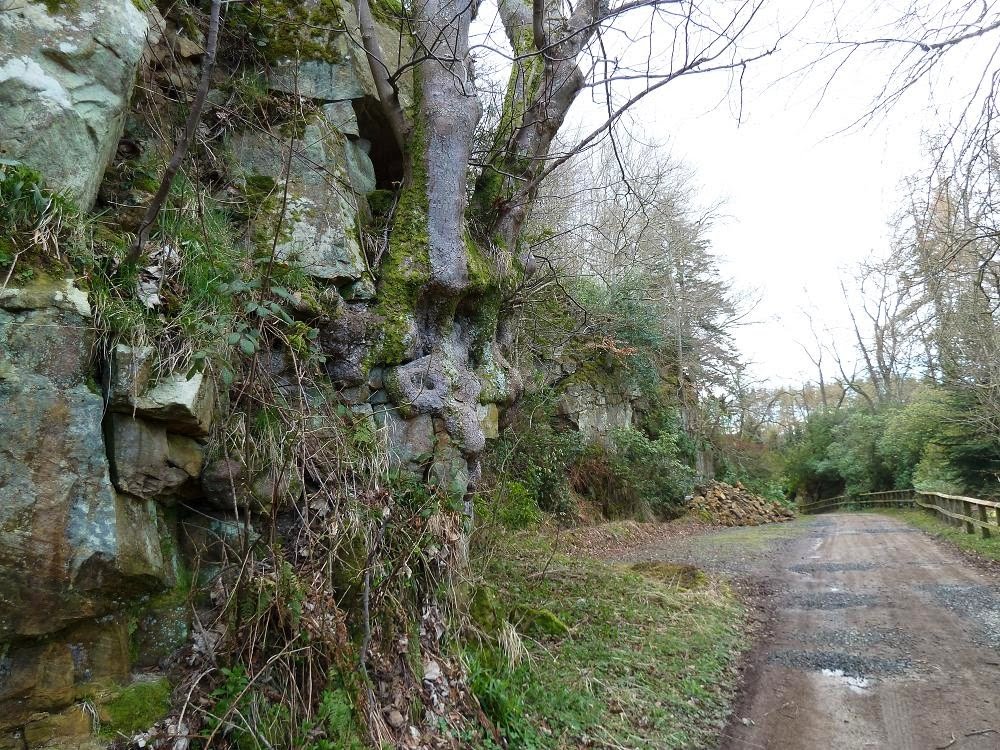
A bit further along the path and i'm face to face with a tree, quite literally! Sure i'm not the only one who can see a face or two in the trunk of this tree, and he seems to be hungry judging by the amount of rocks he's eaten!

Nearly there, just around that corner...

Brinkburn Priory...

Walking around the beautiful priory grounds, where fairies sleep nestled in the ferns, and curled up in the beautiful pink spring blossom...

I apologise for any formatting issues with my blog, especially if it looks like a small goblin has randomly thrown the images at the page and there's spaces where there shouldn't be! I seem to be having a few problems at the moment and i'm not sure if the problem lies with me or the blogger site. Normal blogging will resume when I manage to turf the tricksy goblin out of my laptop!