Monday, 4 July 2011

Fairy Dean, Melrose


Not far from Melrose is a green mossy woodland that hides a gently flowing stream, dappled with sunlight and sprinkled with ferns and nettles. It's name? The Fairy Dean. Sir Walter Scott writes this of it in The Monastery (1830):
"Another, and even a more familiar refuge of the elfin race, (if tradition is to be trusted,) is the glen of the river, or rather brook, named the Allen, which falls into the Tweed from the northward, about a quarter of a mile above the present bridge. As the streamlet finds its way behind Lord Sommerville's hunting-seat, called the Pavilion, it's valley has been popularly termed the Fairy Dean, or rather the Nameless Dean, because of the supposed ill luck attached by the popular faith of ancient times, to any one who might name or allude to the race, whom our fathers distinguished as the Good Neighbours, and the Highlanders called Daoine Shie, or Men of Peace; rather by way of compliment, than on account of any particular idea of friendship or pacific relation which either Highlander or Borderer entertained towards the irritable beings whom they thus distinguished, or supposed them to bear to humanity.
"In evidence of the actual operations of the fairy people even at this time, little pieces of calcareous matter are found in the glen after a flood, which either the labours of those tiny artists, or the eddies of the brook among the stones, have formed into a fantastic resemblance of cups, saucers, basins, and the like, in which children who gather them pretend to discern fairy utensils."
The Fairy Glen is also mentioned in 'The Home Life of Sir David Brewster' by Mrs Brown (1881) 3rd edition, it states that
"On the banks of the Elwand water, which runs into the Tweed about two miles above Melrose, there is a picturesque glen called the Fairy Dean, which has become a favourite place of resort, from it's association with the incidents in the Monastery by Sir Walter Scott."
"When the Waverley Novels were not acknowledged by their author, facts or incidents to which they referred were always welcome subjects of conversation at Abbotsford ; and on one occasion when I happened to mention that singular stones were found in the Fairy Dean, Sir Walter Scott expressed a desire to see them, and to know how they were formed. I accordingly sent some young persons to search for them in the bed of the rivulet, and I was fortunate in thus obtaining several specimens of great variety, and singular shape, and showing, very clearly, the manner in which they were formed."
Some examples of these fascinating stones are held by National Museums Scotland, and a photo of them can be found here.

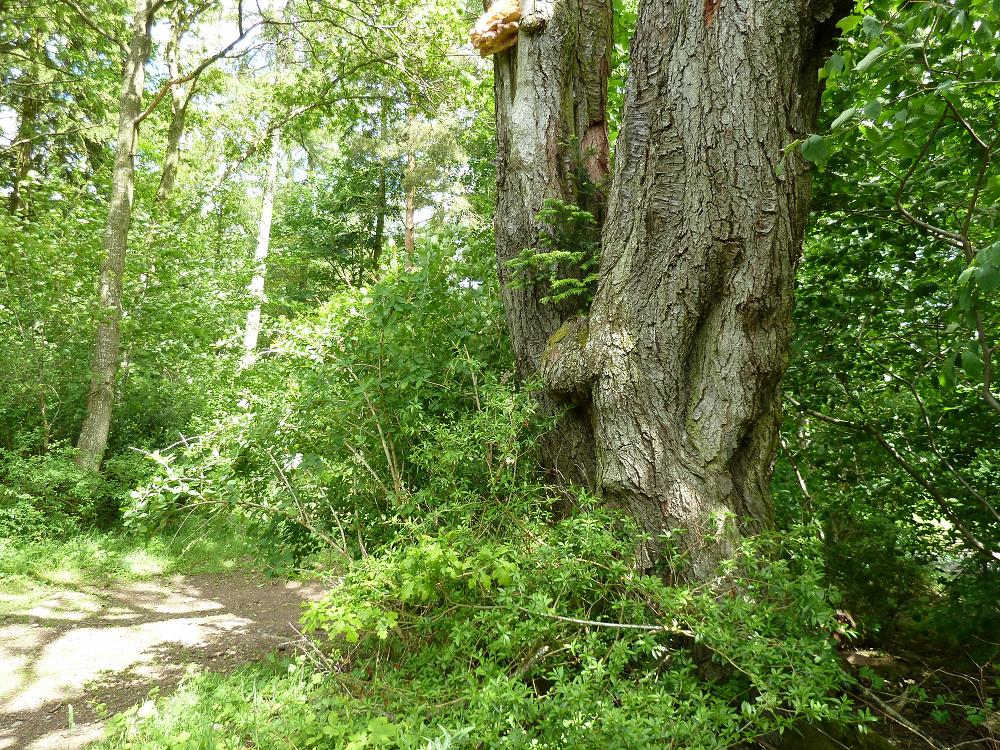
After lots of driving around in circles and getting buried under the crisp white sheets of Ordinance Survey maps, we looked for somewhere to park that would hopefully lead us to the Fairy Dean. Perhaps there's an easy way into the glen, but if so, we couldn't find it! We managed to park up on a country lane and after a walk across field edges and wading through nettles, we came to a beautiful little green oasis hidden among the roughly ploughed fields, the Fairy Dean or 'Nameless Dean' to those who speak with caution and hushed tones when speaking of the fae.

Also worth a mention is the poetically named 'Fairies Bowling Green', a hill not far from the Fairy Dean. In the photo below you can see the hill peaking out over the hedgerow. Unfortunately I haven't managed to find any information on the naming of the hill, but I'm sure there's a very interesting story behind it!

I happened upon a beautiful poem titled 'Beside the Tweed' by Mary Cherry, published in Lyrics of the Open (1914):
Beside the Tweed the Gala mills
To heaven smoke,
Yet, all the way to Eildon Hills
Are fairy-folk.

From Abbotsford to Glendearg Peel
And Lauderdale,
To Leaderfoot from Ashiesteel,
Rings many a tale.

From Huntly-Burn and Rhymer's Glen
To Melrose fair,
The braes are full of fairy-men
And magic there.

Here, every oak a dryad holds,
Each burn a sprite,
And on the hills are fairy-folds
For folk at night.

Among the woods of Avenel
Tradition hides,
And all along the Elwand dell
Romance abides.

Below "The Fairies' Bowling-Green,"
The wee folk play,
And dance along the "Fairy-Dean"
Beside the way.

A mystic music haunts the air
Pan's oaten reed
And memories linger everywhere
Beside the Tweed.

Sources & Further Information
The Monastery, Walter Scott
The Home Life of sir David Brewster, Mrs Gordon
Denham tracts Vol 2, Denham
Lyrics of the Open, Mary Cherry
Fairy Stones, National Museum Scotland

Ettrick Forest Brownie


There was once a large forest in the Scottish Borders called Ettrick Forest, it was a Royal forest and the favourite hunting ground for many of the Scottish kings. It was also home to all manner of faery folk including helpful brownies and wild fearsome shellycoats. Sadly most of the forest has since been cut down and little is known of the creatures who once dwelt there, but the story of the last brownie was recorded and the legend is still told around the area. Gentleman's Magazine, volume 129, published 1821 tells this version of the tale:
"The last Brownie who haunted a wild and solitary spot in Ettrick forest, was banished by the mistaken religious notions of a foolish old devotee, who presented him with a milk porringer, and a piece of money. The parting sprite was heard to howl and cry the whole night, 'farewell to bonny Bodsbeck'."
For those who don't know, brownies are among the most helpful of faery folk and are most often encountered in farmhouses and little old cottages. Once upon a time, nearly every house had it's own brownie, who worked hard and took pride in maintaining a clean and tidy house. But when given an item of clothing, or a coin or two for their work, they vanish most suddenly and refuse to return. Some say that they take offense at the gifts, others say that brownies with money to spare and finery to wear are far too elegant for housework and leave to seek better things.

That said, brownies do have their tricksy moments and have been known to play many a practical joke on neighbouring villagers. According to Scott's Minstrelsy of the Scottish Border (1869 edition) the Ettrick forest brownie once disguised himself as a Shellycoat and played a practical joke on two men on the banks of the river Ettrick:
"Two men, in a very dark night, approaching the banks of the Ettrick, heard a doleful voice from its waves repeatedly exclaim - "Lost! Lost!"- They followed the sound, which seemed to be the voice of a drowing person, and, to their infinite astonishment, they found that it ascended the river. Still they continued, during a long and tempestuous night, to follow the cry of the malicious sprite; and arriving, before morning's dawn, at the very source of the river, the voice was now heard descending the opposite side of the mountain in which they arise. The fatigued and deluded travellers now relinquished the pursuit; and had no sooner done so, than they heard shellycoat applauding, in loud bursts of laughter, his successful roguery. This spirit was supposed particularly to haunt the old house of Gorrinberry, situated on the river Hermitage in Liddesdale".
The story of the Ettrick forest brownie was perhaps fuelled by the release of a book on border life called 'The Brownie of Bodsbeck and other tales' published by James Hogg in 1818 and set in the 17th Century. In this story the Brownie of Bodsbeck was thought to be a monster haunting Chapelhope, but a plot twist reveals all is not as it seems. Hogg was good friends with Walter Scott, and was also very interested in local legends, so his fictional story probably did carry true notes of local folklore. 

In 1826 Robert Chambers published his Popular Rhymes of Scotland, which included a story of a brownie that lived in a farm house in Bodsbeck. The brownie worked hard both in and out doors at the farm and Bodsbeck became the most prosperous farm in the whole district. The brownie took payment for his labour in the form of a small moderate quantity of meat when he required it. During a time of very hard working, when the Brownie had worked even harder than usual, "the goodman took the liberty of leaving out a mess of bread and milk, thinking it but fair that at a time when some improvement, both in quality and quantity, was made upon the fare of the human servants, the useful brownie certainly deserved to share in the blessing. He had calculated, however, without his guest; for the result was, that the brownie left the house for ever, exclaiming,"Ca, Brownie, Ca' A' the luck O' Bodsbeck away to Leithenha." and it is said that the brownie settled in a neighbouring farm house called Leithenhall was never seen again at his previous dwelling.

Whilst visiting the Scottish Borders I paid a visit to the Ettrick Forest area. The forest once stretched for many miles and covered a lot of this area, but now only small areas of forest remain, and these were most likely planted more recently. Magical areas are plentiful though, and I wouldn't be at all surprised if there are still brownies in the woods seeking new houses in local farmhouses, or instead choosing to live in the woods among the elves and gnomes.

Beware the trees with eyes....

I spotted this ball of furry roots at the side of a path, and couldn't help but imagine it growing some arms and legs and some eyes peering out between the rooty hair!

Sources & Further Information
Gentleman's Magazine, Volume 129, 1821
Minsrelsy of the Scottish Border, Walter Scott
The Brownie of Bodsbeck and Other Tales, James Hogg
Popular Rhymes of Scotland, Robert Chambers
Study of Hogg's Brownie of Bodsbeck

Cauldshiels Water Bull


A faerie location with a difference can be found at Cauldshiels Loch, south of Melrose in the Scottish Borders. Sir Walter Scott once took Washington Irving there, who wrote about the visit in his book 'Abbotford and Newstead Abbey' published 1835. He wrote:
"The most interesting circumstance connected with it, however, according to Scott, was that it was haunted by a bogle in the shape of a water bull, which lived in the deep parts, and now and then came forth upon dry land and made a tremendous roaring, that shook the very hills. This story had ben current in the vicinity from time immemorial:- there was a man living who declared he had seen the bull, - and he was believed by many of his simple neighbours." 
The water bull also gets a mention in 'The Gold of Fairnilee' by Andrew Lang, 1888. It seems to be a fictional book rather than local history, but as many folk tales end up later being seen as fictional fairy tales, I see it as worth including.
"Had not her own cousin, Andrew Tamson, passed the Cauldshiels Loch one New Year morning? And had he not heard a dreadful roaring, as if all the cattle on Faldonside Hill were routing at once? And then did he not see a great black beast roll down the hillside, like a black ball, and run into the loch, which grew white with foam, and the waves leaped up the banks like a tide rising? What could that be except the kelpie that lives in Cauldshiels Loch, and is just a muckle big water bull? "And what for should there be no water kye, if there's land kye?"
Kye is a Scottish word for cattle. The water bull seems to be a close relative of the kelpie, but possibly less dangerous, though it's best not to assume such things just incase. It definitely sounds like a faerie creature of some form, especially as it is described as a bogle taking the shape of a water bull, this sounds similar to local Northumbrian legends including the Dunnie of Hazelrigg, a sprite that takes the form of a cow and plays tricks on the locals. It is certainly not uncommon in folklore for fae creatures to take on animal form to play pranks on humans. That said, the water bull at Cauldshiels does not seem to interact with humans in the stories told of it, making it somewhat of a mystery.

Popular Tales of the West Highlands, Voulume VI, by Campbell (1890), contains further information on water bulls, and claims that "there is a water-bull in nearly every Scotch loch of any note" and that Loch Ness is full of them. He says that the water bulls breed with farming cows, who give birth to "'corcach', short eared, a cross between the water-full and a land-cow. They are easily known. no one has ever seen a water-cow." He also tells of a story where a water-bull saves a young lady from a water-horse. The full story can be read online at the Sacred Texts website and is also found in Brigg's Dictionary of Fairies. 

James Mackinlay has included some water bull tales in his book "Folklore of Scottish Lochs and Springs" (1893). He writes that the calves of water-bull can be identified by their "unusual size and pendulousness of their ears and the wide aquatic spread of their jet black hoofs; the foals, in their clean limbs, large flashing eyes, red distended nostrils, and fiery spirit." One tale in this book states that water bull can only be harmed by silver, and he tells of "a farmer who employed his sons to search a certain stream for one of these creatures, while the farmer himself carried a gun loaded with sixpences to be discharged when the monster appeared, silver alone having any effect on such beasts". He gives MacCulloch, the author of 'A description of the Western Islands of Scotland', as the source for this very strange story that suggests not all water bulls are entirely docile.  

So along I went to Cauldshiels Loch, hoping to catch a glimpse of the water bull, though from a very safe distance of course. The Loch is surrounded by beautiful woodlands and rolling Scottish hills, and the shape of the landscape does lead to somewhat of an echo near the loch, the noise of the cattle on the hill was a lot louder than you'd expect to hear, so perhaps this partly explains the thunderous roaring the water bull is said to make.

There stood a lone cow at the side of the loch, perhaps a calf of the water bull hoping to catch a glimpse of their father.

Sources & Further Information
Abbotsford and Newstead Abbey, Washington Irving
The Gold of Fairnilee, Andrew Lang
Popular Tales of the West Highlands, Campbell
A Dictionary of Fairies, Katharine Briggs
Folklore of Scottish Lochs and Springs, Mackinlay
Cauldshiels Loch, Get-A-Map Website

Tuesday, 14 June 2011

Thomas the Rhymer, Melrose


There was once a young man named Thomas, who loved nothing more than to wander the beautiful countryside surrounding his home town of Erceldoune in the Scottish Borders, thought to be modern day Earlston. His favourite spot to sit and admire the views over the mysterious Eildon Hills was a lovely old tree, said by some to be a hawthorn, and later known as the Eildon Tree. One day while taking a rest under the tree, Thomas spotted an elegant lady on a milk white horse:

"True Thomas lay on Huntlie Bank:
A ferlie he spied wi' his ee;
And there he saw a lady bright,
Come riding down by the Eildon Tree.

Her shirt was o' the grass green silk,
Her mantle o' the velvet fyne;
At ilka tett of her horse's mane,
Hang fifty siller bells and nine.

True Thomas, he pull'd aff his cap,
And louted low down to his knee-
- "All hail, thou mighty Queen of Heav'n!
For thy peer on earth I never did see"-

- "O no, O no, Thomas," she said;
"That name does not belang to me;
I am but the Queen of fair Elfland,
That am hither come to visit thee."

The Queen of Fairyland dared Thomas to kiss her, so he did, and she asked Thomas to come away with her and serve her for seven years in Fairyland. She mounted her horse with him behind, and together they travelled, her horse travelling swifter than the wind itself. She told Thomas to hold his tongue no matter what he hears or sees, or he will never return to the mortal realms. Some say this should not be taken literally, and that it refers to Thomas being told never to speak word of their love incase the Fairy King should hear. On they rode, wading through rivers, and through the roaring of the sea, and through rivers of blood. She explains that all blood shed on earth runs through the springs of this country. They finally came to a green garden, where the Faery Queen plucked an apple from a tree, telling Thomas to take it for his wages and it will grant him "the tongue that can never lie". He protests, saying his tongue is his own, but she commands it so. The story ends that:

"He has gotten a cloth of the even cloth,
and a pair of shoes of velvet green;
And, till seven years were gane and past,
True Thomas on earth was never seen."

This version of the tale is as told by Walter Scott in his Minstrelsy of the Scottish border (1802), he says it was collected from a local lady. He continues with an extension of the story where Thomas has returned to Erceldoune seven years later. It is said that the faery folk must pay a teind to hell every seven years, and the Queen fears that this year it will be Thomas, so she returns him to the mortal world. Some versions of the tale say that he returned with the ability to only speak the truth, and others say he had magical powers of prophesy and became famous throughout Scotland. Then one day while Thomas was celebrating with friends in the tower of Erceldoune, a person came running in and told in fear and astonishment that "a hart and hind had left the neighbouring forest, and were, composedly and slowly, parading the street of the village". Thomas arose and left the tower, then followed the animals into the forest, and was never seen again. According to popular belief he currently resides in Elfland, but is one day expected to revisit our mortal realms again.

Interestingly, a man named Thomas Rymour really did live in 13th century Erceldoune. A charter from 1294 mentions "Thomas de Ercildoun, son and heir of Thomas Rymour de Ercildon". Could this be the Thomas the Rhymer of legend? A leaflet I picked up in Melrose refers to Thomas as Thomas Learmont, but according to Briggs' Dictionary of Fairies there is no documented evidence of this name.

If you would like to read more about the various versions of the story, then Jamieson's Popular ballads and songs, volume 2 (1806) is a good starting place. It mentions early manuscripts including one in the Cambridge public library said to be from the 15th century. Interestingly, these early versions do mention places local to modern day Earlston, for example the Lincoln manuscript includes this verse:

"She ledde him in at Eldone Hill,
Underneathe a derne lee,
Where it was derke als mydnight merke,
And ever the water till his knee."

The Eildon Hills are located right next to the present day Rhymer Stone which marking the spot of the Eildon Tree, and dominate the landscape with their 3 peaks that can be seen from miles around. It is said that these hills have been important throughout history, being first inhabited around 1000 BC in the Bronze age, and later inhabited by Celts, Druids, and the Romans, who built the fort of Trimontium at the foot of the hills. Some say that the hills are hollow, and that fairyland lies inside the hills themselves. Another legend tells of a horse dealer who is taken inside the hill by a mysterious gentleman, where he finds King Arthur and his knights sleeping. Some say a single mountain once stood, but it was cleeved into the present day triple peaks by a mighty wizard. Others say that the ancient tumulus Bourjo, on the lower slopes, was once a Druid oak grove where sacrifices were made. Whatever the truth, the Eildon Hills are bursting with folklore and legend, and were obviously seen as an important spiritual and mysterious place.

So, of course, I went to visit... with my trusty map reading boyfriend of course! The first place on my list was the Rhymer's stone, which is said to mark the place where the Eildon tree grew and Thomas first met the Fairy Queen. The stone is dated 1929, but the stone it is mounted on says it was re-erected in 1970, so I wonder if this was it's original location or whether it was moved so it could be accessed more easily. There is also a stone circle laid in the ground with lines from the poem.

As we wondered further along the path towards the Eildon Hills, we came to Bogle Burn. According to Scott's Minstrelsy, "A neighbouring rivulet takes the name of the Bogle Burn, (Goblin Brook) from the Rhymer's supernatural visitants".

As we walked up the lower slopes of Eildon Hill we came across a very gnarled old hawthorn tree, and I could almost imagine Thomas sat underneath enjoying the cool breeze on such a warm sunny morning. A blossoming thorn stood a little further up the hill.

It's easy to see why the Eildon hills are seen as such a magical place, the views are breathtaking (and not just because I was so out of breath!) and the carpet of golden gorse fills the air with the enchanting scent of coconuts.


I especially loved the mysterious circle of gorse on the slopes below, it seems to have grown in a perfect circle... most intriguing!

Also spotted a strange stone with a ring of circles on, though no idea what made the pattern, maybe someone else knows?

On the way down the slopes towards Melrose I spotted another beautiful hawthorn tree, decorated with a sprinkling of white blossoms. Again, no Thomas the Rhymer to be seen, but I did keep a careful eye out for the Fairy Queen and spotted a few horse shoe tracks along the pathways.

Kray Van Kirk has written a beautiful song called 'Queen of Elfland' based on the tale of Thomas the Rhymer. His magical and inspiring lyrics can be read here and this enchanting song and many more can be downloaded for free from his website here. Well worth a listen!

Sources & Further Information
Minstrelsy of the Scottish Border, Walter Scott
Popular Ballads and Songs, Jamieson
Modern Antiquarian, Eildon Hills
Site Record for Bourjo
Thomas the Rhymer, Tam-Lin.org

Wednesday, 1 June 2011

Tam Lin, Carterhaugh


"O I forbid ye, maidens a',
That wear gold on your hair,
To come or gae by Carterhaugh,
For young Tam Lin is there."

In a beautiful mossy forest in the Scottish Borders, lies a little piece of folklore history, tucked away and forgotten by many but held dear by those who know the legend of Tam Lin. Most of the forest has long been cut down but part remains, together with a mossy old well hidden among the ferns, and marked with the name of 'Tamlane's Well' though it is well buried beneath the undergrowth and hidden from those who do not seek it.

The legend goes that a young man named Tam Lin or Tamlane was out hunting with this grandfather Roxbrugh when he fell from his horse and was taken away by the Queen of the Fairies herself who dwells in the green hill. She made him a knight of her elven companie and set him the task of guarding the forest of Carterheugh, where according to local townsfolk he would only let those young maidens pass who gave him a token of treasure or else their maidenhood. Despite the warnings, young Janet ventured into the forest, with her green kirtle held above her knee and her wild blonde hair braided. As she was passing the well she came across a milkwhite steed, and she took rest and picked a wild rose growing near the well, and pulled a branch from the tree. At once, Tam Lin appeared and cried:

"Why pulls thou the rose, Janet,
And why breaks thou the wand?
Or why comes thou to Carterhaugh
Withoutten my command?"

Janet is a stubborn young lady and stands her ground, telling him that Carterhaugh belongs to her, a present from her father, and that she will come and go as she pleases without asking his permission. Little is said of what happens next, and how Tam Lin charmed young Janet into giving up her maidenhood, but Janet returns to Carterhaugh and as the days pass her father discovers that she is with child. She refuses to let the blame lie with a knight of her father's company, and stubborn Janet tells her father:

"If that I gae wi child, father,
Mysel maun bear the blame,
There's neer a laird about your ha,
Shall get the bairn's name.

"If my love were an earthly knight,
As he's an elfin grey,
I wad na gie my ain true-love
for nae lord that ye hae'"

Janet returns to Carterhaugh, some say to collect herbs to cause miscarriage, and once again she finds Tam Lin's milkwhite steed stood at the well. Once again she pulls a rose, and Tam Lin appears, enquiring to know:

"Why pu's thou the rose, Janet,
Amang the groves sae green,
And a' to kill the bonny babe
That we gats us between?"

She demands that Tam Lin tell her where he comes from, and he reveals his mortal past to her, telling her that fairyland is a pleasant place but at the end of every seven years the fairy folk must pay a tiend to hell, and he fears that he has been chosen. It is the night of Halloween, when the veils between the faerie lands and mortal realm are lifted, and Tam Lin tells Janet that at the midnight hour the fairy folk will ride past Miles Cross and she may rescue her true love and win him back from the Fairy Queen. She must first let pass the black horse, and then the brown, and then quickly run to the mlkwhite steed and pull the rider to the ground, as this fairy knight shall be none other than Tam Lin. He warns her that he will be turned into all manner of beast and horror, including a newt, a snake, a bear, a lion, a red hot iron, then a burning coal or gleed when at once she must throw him in to well water, and then finally he shall turn into a naked man. At once she must cover him with her green mantle and hide him out of sight. She does exactly as told, freeing Tam Lin, much to the anger of the Fairy Queen:

"Out then spak the Queen o Fairies,
And an angry woman was she,
"Shame betide her ill-far'd face,
And an ill death may she die,
For she's taen awa the bonniest knight
In a' my companie."

"But had I kend, Tam Lin," said she,
"What now this night I see,
I wad hae taken out thy twa grey een,
And put in twa een o tree."

This final verse seems to suggest the Fairy Queen wishes that she had taken out Tam Lin's grey eyes and replaced them with wood, taking away his sight of the fairies and perhaps never allowing him to have fallen in love with Janet. Another version of the tale has the Fairy Queen wishing she had taken out his heart and replacing it instead with stone.

According to Sir Walter Scott's Minstrelsy of the Scottish Border (1802) it  is thought that the story of Tam Lin was first found in the 1549 book "The Complaynt of Scotland" and that perhaps it is connected to "The dance of Thom of Lyn", though it is not known for certain exactly how old this romantic ballad is. The exact lyrics of the ballad vary considerably, and many of the variations can be found in Francis Child's 'The English and Scottish Popular Ballads', where #39A is thought to perhaps be the oldest and most popular.

On a lovely not-so-sunny bank holiday weekend, myself and my partner (and his newly purchased collection of Scottish Borders ordinance survey maps) headed off for a long weekend in the Scottish Borders. My first port of call was of course Carterhaugh, the most likely location for where the tale took place, though as with most folklore stories the exact location can never be known for sure, and others have suggested that perhaps Carter Bar in the Cheviot hills may have been the location in the ballad. Carterhaugh certainly fits the descriptions though, and the magical feel of the place is undeniable. I must admit even I found it slightly eerie that the field behind Carterhaugh farm, where Carterhaugh forest once stood, contains only 3 horses... one black, one brown, and one white, exactly as in the story. Perhaps the farm owners are aware of the story and have a good sense of humour, or perhaps something magical is at work here. Below are the photographs from my visit to Carterhaugh Woods and Tam Lin's well.


According to the Royal Commission on the Ancient and Historical Monuments of Scotland website, "The trough into which this well flowed, and water pipe are still in situ, but the well, which was in the bank 2.5 m N of the trough, is now filled in." which suggests that perhaps there was once a deeper well, that a person could indeed have fitted into. If you're thinking of visit Carterhaugh, please be considerate of the farm house, and do not trespass on their land. The well can be found at the side of the road and is easily accessible though buried in undergrowth, and the woodlands behind can be accessed by walking from the nearby Bowhill Country Estate (entry fee charged) or the very limited parking at the road side.

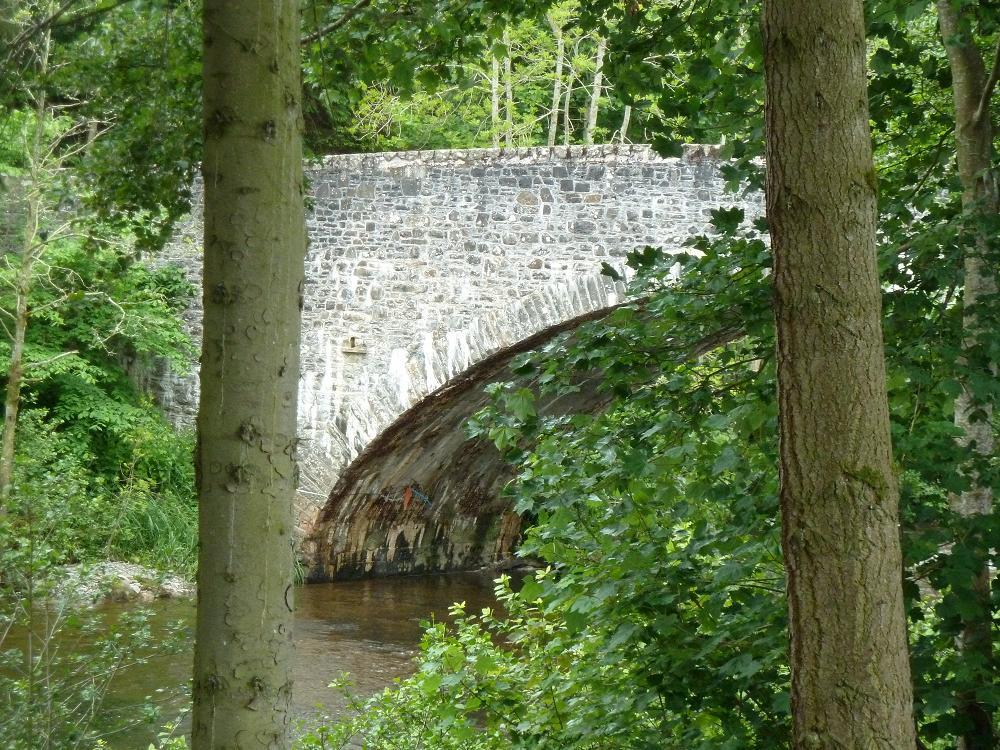
Next, I went in search of the bridge, where rumour has it Janet met Tam Lin on Halloween night and won him from the Fairy Queen. The location in the ballad is most often given as 'Miles Cross', but this location is not marked on any present day maps. Alternative versions of the ballad give the location as the 'Mill Bridge', which may refer to Carterhaugh bridge as this seems to be the nearest to the well, and is a cross roads of sort. Though, as pointed out on the Tam-lin.org website, if Janet did indeed have to drop Tam Lin in the well once he took the form of the burning coal or gleed, then this is quite a long way to run. Here are some photos of the bridge as it stands today:


Finally on the journey of Tam Lin, I went in search of Janet's home, said in the ballad to be a nearby castle. According to Sir Walter Scott's Minstrelsy of the Scottish Border (1802), "Newark Castle; a romantic ruin, which overhangs the Yarrow, and which, we may suppose, was the habitation of our heroine's father." The castle can be reached by walking from the Bowhill Estate, and is a magnificant ruin. I fear my photos do not do it justice.


The other possible location for Janet's father's castle is said to be Oakwood Castle, presently known as Aikwood. Though this is slightly further away, so perhaps less likely. The castle today is rented out as holiday accommodation, and is also home to other local legends including the Warlock of Aikwood.


I would like to give special thanks to the owner of the Tam-Lin.org website, as their website was a huge help in my research and a wonderful read. I would also like to thank Tricky Pixie for recording such a magical musical version of the Tam Lin tale, which can be heard and purchased on the Tricky Pixie website. It provided the perfect soundtrack on the long drive to Carterhaugh!

Sources & Further Information
Minstrelsy of the Scottish Border, Sir Walter Scott
The English and Scottish Popular Ballads, Francis Child