Monday, 26 September 2011

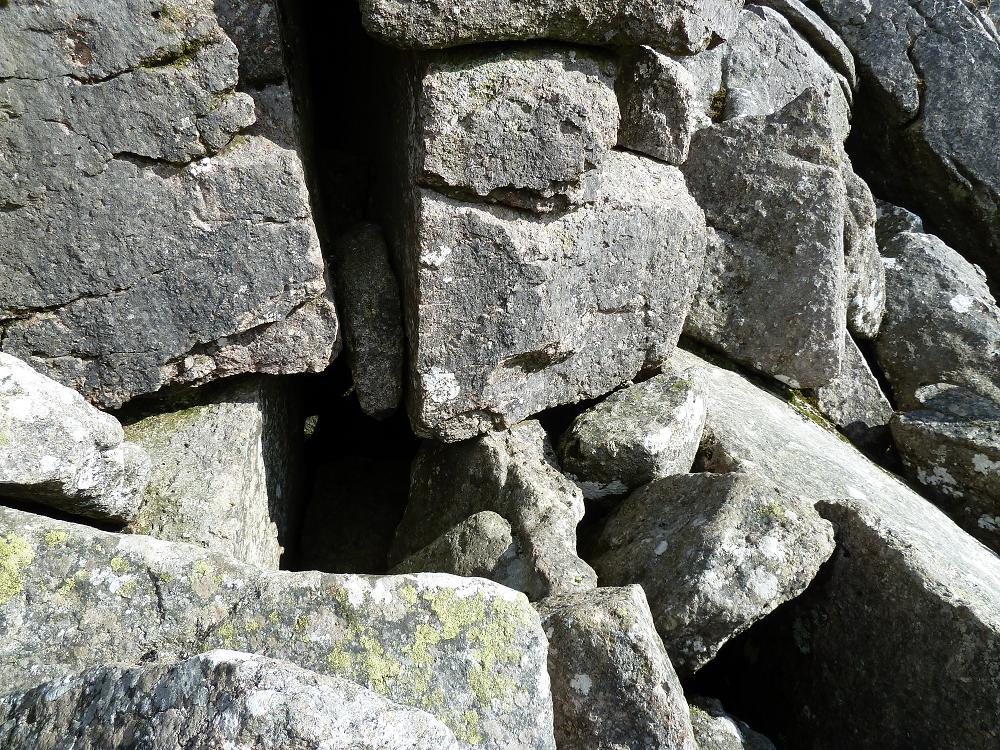
Pixies Hole at Chudleigh Rocks, Devon


Not far from Dartmoor lies another Pixie Cave, hidden away in the Chudleigh Rocks. These rocks are steeped in Pixie stories varying from kidknapped children to pixy-led travellers. According to John Britton's 'The Beauties of England and Wales, Volume IV' (1803), the caverns are said "in the traditions of the peasantry to be inhabited by Pixies, or Pisgies, a race of supernatural beings, "invisibly small".

John Page, in his book 'The Rivers of Devon' (1893) informs us that the main object in the cave is the Devil's pincushion or Pope's Head, a soft mass of rock "into which both credulous - if any there now be - and incredulous tourists delight in sticking a pin as a propitiatory offering to the elfin inhabitants."

The rocks are also mentioned in Issue 61 of Notes & Queries, Dec 28 (1850):
"At Chudleigh rocks I was told, a few weeks ago, by the old man who acts as a guide to the caves, of a recent instance of a man's being pixy-led. In going home, full of strong drink, across the hill above the cavern called the "Pixies' Hole", on a moonlit night, he heard sweet music, and was led into the whirling dance by the "good folk", who kept on spinning him without mercy, till he fell down "in a swoon". On "coming to himself", he got up and found his way home, where he "took to his bed, and never left it again, but died a little while after," the victim (I suppose) of delirium tremens, or some such disorder, the incipient symptoms of which his haunted fancy turned into the sweet music in the night wind and the fairy revel on the heath."
Chudleigh also get a mention in Lady Northcote's Devonshire Folklore article in Folklore Vol II No 2 (1900), as a place where "mothers used to tie their babies to them in bed at night for fear of the Pixies." She also tells the following story:
"A keeper and his wife used to live at Chudleigh, near the rocks, whose holes the pixies "bide in". This couple had two children, and one morning when the wife had dressed the eldest she let her run away while she dressed the baby. Presently her husband came and asked her "where the little maid was to?" For she was gone and was not to be found. They searched high and low for days; the neighbours came to help, and at least bloodhounds were to be sent for. But one morning some young men thought they would go and help themselves to some nuts from a clump of nut-trees not far from the keeper's house, and at the farthest side they came suddenly on the child, undressed, but well and happy, and not at all starved, playing with her toes, or toads; I do not know which. The pixies were supposed to have stolen the child, and are still firmly believed to have been responsible for her disappearance."
The most scenic way to get to the Pixies Hole cave is through The Rock Gardens at Station Hill, Chudleigh. A small entry fee will gain you entry to the rock gardens, which are lovely and overgrown and wild in the best way possible, and lead through to Chudleigh Cave, a narrow illuminated cave full of interesting and rather creepy rock formations. To get to the Pixies Hole and other caves you leave through a gate at the back of the gardens into the Clifford Estate. The paths here are not as well maintained and it's rather easy to accidently stray from the path and get a little lost, and the paths to the caves require some scrambling over rocks to get to, though we might have missed an easier route! The cave itself is gated and locked to protect a colony of bats living inside it, but on a sunny day you can see quite far into the cave.


John Britton, quoting Mr Warner, in his book 'The Beauties of England and Wales, Volume IV' (1803) gives a full description of the cave, for those intrigued as to what lies behind the metal gates.

"The entrance to the cavern is by a natural arch, about twelve feet wide, and ten high: the passage continues nearly of the same dimensions for about twenty yards, when it suddenly diminishes to nearly six feet wide, and four high, and still decreasing in size, extends about fifteen yards further. Here it expands into a spacious chamber, which dividing into two parts, runs off in different directions: but the rock dropping, neither of them can be pursued to any great distance; though tradition asserts, that a dog put into one of them came out at an aperture in Botter rock, about three miles distant."


Sources & Further Information
The Beauties of England and Wales, Volume IV, John Britton
The Rivers of Devon, John Page
Notes & Queries, Issue 61, Dec 28 1850
Devonshire Folklore, Lady R Northcote, Folklore Vol II No 2
The Rock Gardens, Chudleigh

Sheeps Tor Piskies Cave, Dartmoor


Dartmoor is an area rich in stories of the fairies, or should I say, pixies. Anna Bray's book 'A Peep at the Pixies' (1854) tells us that pixies and fairies are two distinct races:
"It is a matter of tradition that the Fairies wished very much to establish themselves in Devonshire, but the Pixies would not hear of it; and a terrible war ensued. Oberon, was, with his host defeated; and his majesty received a wound in the leg which proved incurable; none of the herbs in his dominions have hitherto had the least beneficial effects, though his principle secretary and assistant, Puck, has been in search on a healing nature ever since."
According to Popular Romances by Hunt (1865) the Pixies of Dartmoor resemble a bale or bundle of rags, and he tells a story of these rag pixies leading away a small child from his mother. Luckily he was retrieved from under a large oak-tree, said to be a favourite haunt of the local pixies. Some Dartmoor folk say that Pixies are the souls of unbaptised children.

This week just passed I was fortunate enough to spend a week in Dartmoor, and see some of the local pixie sites for myself. First on my list was Sheepstor Piskies Cave, a site so well known that it appears on modern day Ordinance Survey maps. Over the years the name of the cave seems to have varied, including Pixies Cave, Piskies Cave, Piskies Hole, and Elford's Cave. The latter name is due to a man named Elford said to have hidden in the cave from Cromwell's army. According to the Legendary Dartmoor website, there is an early mention of the cave by the Reverend Polwhele in 1797 in his 'The History of Devonshire' but I confess I have not been able to track down a copy to see for myself. The earliest mention I have seen can be found in 'A description of the part of Devonshire bordering on the Tamar and the Tavy' by Mrs Bray (1836).
"On reaching the little hamlet of Sheepstor, we were informed by the matron of it, whom from her age and appearance we denominated the septuagenarian Sibyl, that we might easily find the 'pixies' house; where we should be careful to leave a pin, or something of equal value, as an offering to these invisible beings: otherwise they would not fail to torment us in our sleep."

"With a little boy for our guide, we again ascended the mountain. Leaving our horses below, we followed our conductor over some rugged rocks, till he came to one in which was a narrow fissure. On his telliung us this was the entrance, we laughed, and said none but the pixies and himself could enter it; but, on his assuring us it was the spot, I resolved to make the attempt. With great difficulty I succeeded, and found a hollow about six feet long, four wide, and five feet high. It was formed by two rocks resting in a slanting direction against another in a perpendicular direction."
Always up for a challenge, my partner and I decided to visit the cave for ourselves, presuming of course that it is indeed the same cave known as the Piskies Cave during the 1800s, as some photos online show an entirely different cave, so there seems to be some confusion. We parked in the small parking area just off the road to the south west of the tor, and walked up the beautiful tree lined pathway.


This took us to the bottom of the tor, where we picked a path up through the thick rusty bracken, stepping over the many fallen boulders that litter the sides of the hill.


Half way up the hill we could make out in the distance the square formation of rocks that mark the entrance to the Piskies Cave. You can see it here towards the right side of the photo below.


Next came the challenging part, climbing over all the fallen boulders to reach the cave itself. For me it was a challenge anyway, my partner seems to be part mountain goat and can hop from rock to rock with ease, where I have a tendancy to wobble a lot and frantically wave my arms in the air until they find a tree branch to grip on to for dear life, or a strong hand to pull me up to the next rock. And unfortunately there were very few trees on the tor! I'd like to say a big thank you to my patient and very understanding boyfriend, for his encouraging words and strong hands that kept me calm and safe climbing up to the cave.


As you can see, Mrs Bray wasn't kidding when she said that only the boy guide and pixies could fit in the cave, the entrance really is tiny. According to the Dartmoor CAM website it is possible to fit into the cave if you back in on your stomach, but it's a very tight squeeze indeed and I only went as far as the cave entrance. I decided not to take any chances and as advised by the septuagenarian Sybil in Mrs Bray's tale, I left a nice shiny new pin for the Piskies.

You can see more photos of the inside of the cave, as well as very useful instructions on how to find the cave on the Dartmoor CAM website. The Legendary Dartmoor website also contains lots more interesting information about the cave and the Piskies who live there.

Sources & Further Information
A description of the part of Devonshire bordering on the Tamar and the Tavy, Volume 1, Mrs Bray
Dartmoor CAM, Piskies Cave
Legendary Dartmoor, Piskies Cave
Legendary Dartmoor, Sheeps Tor Piskies

Whitton Dean, Northumberland


Whitton Dean in the Rothbury Forest and Simonside area of Northumberland was once known as a haunt of the fairies according to Tomlinson. According to his Comprehensive Guide to Northumberland (1888), "Whitton Dene is said to have been one of the haunts of the fairies in olden times." He also mentions the mysterious rocks marked with concentric circles, but does not explain if these are also connected to the fairies. Unfortunately this is all I have been able to find out about this site, though I wonder if perhaps the names have gotten muddled over time as there is also a Whittle Dene in Northumberland, also known as a dwelling place of the fae.

We parked up in the Simonside Car park opposite the ancient hill fort remains and wandered to Whitton Dean. It's a rather rocky trail with amazing views over the hills, and at this time of year the hills are covered with beautiful purple heather, with busy bees and butterflies flittering around.


If you look carefully you can find Hare Bells, also known as Scottish Bluebells, or Fairies Thimbles. These delicate blue bell shaped flowers were once said to be rung by the fairies to warn of an approaching hare, perhaps due to the lore that witches used the juice from Hare Bells to transform into hares.


It is clear to anyone who visits this area why it has become associated with the faery folk. The hills are scattered with mysterious ancient rocks, many with cup and circle markings, and ancient burial cairns. In days gone by folk often associated these ancient sites with the fae, and thought that the fairies made cups in the rocks to make their porridge! The Simonside Hills are also said to be home to the duergars (see Duergars of Simonside), dangerous dark dwarves who led travellers to their deaths.


Follow the slope down the other side of the hill, passing the old mossy stone wall and windswept thorn trees. It's here that we became a little pixy led and couldn't for the life of us find where the footpath had vanished off to. We ended up retracing our steps back up the hill and eventually found the path again. Unfortunately I didn't have the sense to remember to turn an article of clothing inside out to see if that improved matters, an old remedy for being pixy led. We passed some lovely old gnarled and mossy trees, and a hidden little sparkling stream.


It's at the bottom of this sloping hill that you'll find Whitton Dean, a tucked away hidden little wooded valley with a stream running through. Ancient mossy rocks are dotted along the banks, and a fallen gnarled old tree lies nearby, the perfect dwelling place for any remaining fae still inhabiting the dene.   


Sources & Further Information
Tomlinson's Comprehensive Guide to Northumberland
Streetmap - Location of Whitton Dean

Monday, 4 July 2011

Fairy Dean, Melrose


Not far from Melrose is a green mossy woodland that hides a gently flowing stream, dappled with sunlight and sprinkled with ferns and nettles. It's name? The Fairy Dean. Sir Walter Scott writes this of it in The Monastery (1830):
"Another, and even a more familiar refuge of the elfin race, (if tradition is to be trusted,) is the glen of the river, or rather brook, named the Allen, which falls into the Tweed from the northward, about a quarter of a mile above the present bridge. As the streamlet finds its way behind Lord Sommerville's hunting-seat, called the Pavilion, it's valley has been popularly termed the Fairy Dean, or rather the Nameless Dean, because of the supposed ill luck attached by the popular faith of ancient times, to any one who might name or allude to the race, whom our fathers distinguished as the Good Neighbours, and the Highlanders called Daoine Shie, or Men of Peace; rather by way of compliment, than on account of any particular idea of friendship or pacific relation which either Highlander or Borderer entertained towards the irritable beings whom they thus distinguished, or supposed them to bear to humanity.
"In evidence of the actual operations of the fairy people even at this time, little pieces of calcareous matter are found in the glen after a flood, which either the labours of those tiny artists, or the eddies of the brook among the stones, have formed into a fantastic resemblance of cups, saucers, basins, and the like, in which children who gather them pretend to discern fairy utensils."
The Fairy Glen is also mentioned in 'The Home Life of Sir David Brewster' by Mrs Brown (1881) 3rd edition, it states that
"On the banks of the Elwand water, which runs into the Tweed about two miles above Melrose, there is a picturesque glen called the Fairy Dean, which has become a favourite place of resort, from it's association with the incidents in the Monastery by Sir Walter Scott."
"When the Waverley Novels were not acknowledged by their author, facts or incidents to which they referred were always welcome subjects of conversation at Abbotsford ; and on one occasion when I happened to mention that singular stones were found in the Fairy Dean, Sir Walter Scott expressed a desire to see them, and to know how they were formed. I accordingly sent some young persons to search for them in the bed of the rivulet, and I was fortunate in thus obtaining several specimens of great variety, and singular shape, and showing, very clearly, the manner in which they were formed."
Some examples of these fascinating stones are held by National Museums Scotland, and a photo of them can be found here.

After lots of driving around in circles and getting buried under the crisp white sheets of Ordinance Survey maps, we looked for somewhere to park that would hopefully lead us to the Fairy Dean. Perhaps there's an easy way into the glen, but if so, we couldn't find it! We managed to park up on a country lane and after a walk across field edges and wading through nettles, we came to a beautiful little green oasis hidden among the roughly ploughed fields, the Fairy Dean or 'Nameless Dean' to those who speak with caution and hushed tones when speaking of the fae.

Also worth a mention is the poetically named 'Fairies Bowling Green', a hill not far from the Fairy Dean. In the photo below you can see the hill peaking out over the hedgerow. Unfortunately I haven't managed to find any information on the naming of the hill, but I'm sure there's a very interesting story behind it!

I happened upon a beautiful poem titled 'Beside the Tweed' by Mary Cherry, published in Lyrics of the Open (1914):
Beside the Tweed the Gala mills
To heaven smoke,
Yet, all the way to Eildon Hills
Are fairy-folk.

From Abbotsford to Glendearg Peel
And Lauderdale,
To Leaderfoot from Ashiesteel,
Rings many a tale.

From Huntly-Burn and Rhymer's Glen
To Melrose fair,
The braes are full of fairy-men
And magic there.

Here, every oak a dryad holds,
Each burn a sprite,
And on the hills are fairy-folds
For folk at night.

Among the woods of Avenel
Tradition hides,
And all along the Elwand dell
Romance abides.

Below "The Fairies' Bowling-Green,"
The wee folk play,
And dance along the "Fairy-Dean"
Beside the way.

A mystic music haunts the air
Pan's oaten reed
And memories linger everywhere
Beside the Tweed.

Sources & Further Information
The Monastery, Walter Scott
The Home Life of sir David Brewster, Mrs Gordon
Denham tracts Vol 2, Denham
Lyrics of the Open, Mary Cherry
Fairy Stones, National Museum Scotland

Ettrick Forest Brownie


There was once a large forest in the Scottish Borders called Ettrick Forest, it was a Royal forest and the favourite hunting ground for many of the Scottish kings. It was also home to all manner of faery folk including helpful brownies and wild fearsome shellycoats. Sadly most of the forest has since been cut down and little is known of the creatures who once dwelt there, but the story of the last brownie was recorded and the legend is still told around the area. Gentleman's Magazine, volume 129, published 1821 tells this version of the tale:
"The last Brownie who haunted a wild and solitary spot in Ettrick forest, was banished by the mistaken religious notions of a foolish old devotee, who presented him with a milk porringer, and a piece of money. The parting sprite was heard to howl and cry the whole night, 'farewell to bonny Bodsbeck'."
For those who don't know, brownies are among the most helpful of faery folk and are most often encountered in farmhouses and little old cottages. Once upon a time, nearly every house had it's own brownie, who worked hard and took pride in maintaining a clean and tidy house. But when given an item of clothing, or a coin or two for their work, they vanish most suddenly and refuse to return. Some say that they take offense at the gifts, others say that brownies with money to spare and finery to wear are far too elegant for housework and leave to seek better things.

That said, brownies do have their tricksy moments and have been known to play many a practical joke on neighbouring villagers. According to Scott's Minstrelsy of the Scottish Border (1869 edition) the Ettrick forest brownie once disguised himself as a Shellycoat and played a practical joke on two men on the banks of the river Ettrick:
"Two men, in a very dark night, approaching the banks of the Ettrick, heard a doleful voice from its waves repeatedly exclaim - "Lost! Lost!"- They followed the sound, which seemed to be the voice of a drowing person, and, to their infinite astonishment, they found that it ascended the river. Still they continued, during a long and tempestuous night, to follow the cry of the malicious sprite; and arriving, before morning's dawn, at the very source of the river, the voice was now heard descending the opposite side of the mountain in which they arise. The fatigued and deluded travellers now relinquished the pursuit; and had no sooner done so, than they heard shellycoat applauding, in loud bursts of laughter, his successful roguery. This spirit was supposed particularly to haunt the old house of Gorrinberry, situated on the river Hermitage in Liddesdale".
The story of the Ettrick forest brownie was perhaps fuelled by the release of a book on border life called 'The Brownie of Bodsbeck and other tales' published by James Hogg in 1818 and set in the 17th Century. In this story the Brownie of Bodsbeck was thought to be a monster haunting Chapelhope, but a plot twist reveals all is not as it seems. Hogg was good friends with Walter Scott, and was also very interested in local legends, so his fictional story probably did carry true notes of local folklore. 

In 1826 Robert Chambers published his Popular Rhymes of Scotland, which included a story of a brownie that lived in a farm house in Bodsbeck. The brownie worked hard both in and out doors at the farm and Bodsbeck became the most prosperous farm in the whole district. The brownie took payment for his labour in the form of a small moderate quantity of meat when he required it. During a time of very hard working, when the Brownie had worked even harder than usual, "the goodman took the liberty of leaving out a mess of bread and milk, thinking it but fair that at a time when some improvement, both in quality and quantity, was made upon the fare of the human servants, the useful brownie certainly deserved to share in the blessing. He had calculated, however, without his guest; for the result was, that the brownie left the house for ever, exclaiming,"Ca, Brownie, Ca' A' the luck O' Bodsbeck away to Leithenha." and it is said that the brownie settled in a neighbouring farm house called Leithenhall was never seen again at his previous dwelling.

Whilst visiting the Scottish Borders I paid a visit to the Ettrick Forest area. The forest once stretched for many miles and covered a lot of this area, but now only small areas of forest remain, and these were most likely planted more recently. Magical areas are plentiful though, and I wouldn't be at all surprised if there are still brownies in the woods seeking new houses in local farmhouses, or instead choosing to live in the woods among the elves and gnomes.

Beware the trees with eyes....

I spotted this ball of furry roots at the side of a path, and couldn't help but imagine it growing some arms and legs and some eyes peering out between the rooty hair!

Sources & Further Information
Gentleman's Magazine, Volume 129, 1821
Minsrelsy of the Scottish Border, Walter Scott
The Brownie of Bodsbeck and Other Tales, James Hogg
Popular Rhymes of Scotland, Robert Chambers
Study of Hogg's Brownie of Bodsbeck